Every winter Sunday in Sydney’s eastern suburbs, a local swimming group called the Bondi Icebergs comes together for a sacred dip. Perhaps you’ve heard of it. Rain, hail or shine, at the dawn of each new week, its members embrace the elements and renew their pact with that famous ocean pool. For health. For community. For the thrill of the chill.
Roughly 9000 kilometres north, at the edge of Siberia in China’s Heilongjiang Province, the swimmers of the Dongyong Association are bound by a similar pledge. But where their Bondi counterparts might endure icy midwinter conditions, here, under six hours’ drive from both the Russian and North Korean borders, these Icebergs are contending with actual ice; their swimming pool a rectangular void cut from a river otherwise frozen solid. One by one, they make their way to the diving platform, smile and wave to a handful of frostbitten well-wishers, and disappear below the dark glass of the Songhua River. Similar thrill, very different chill.
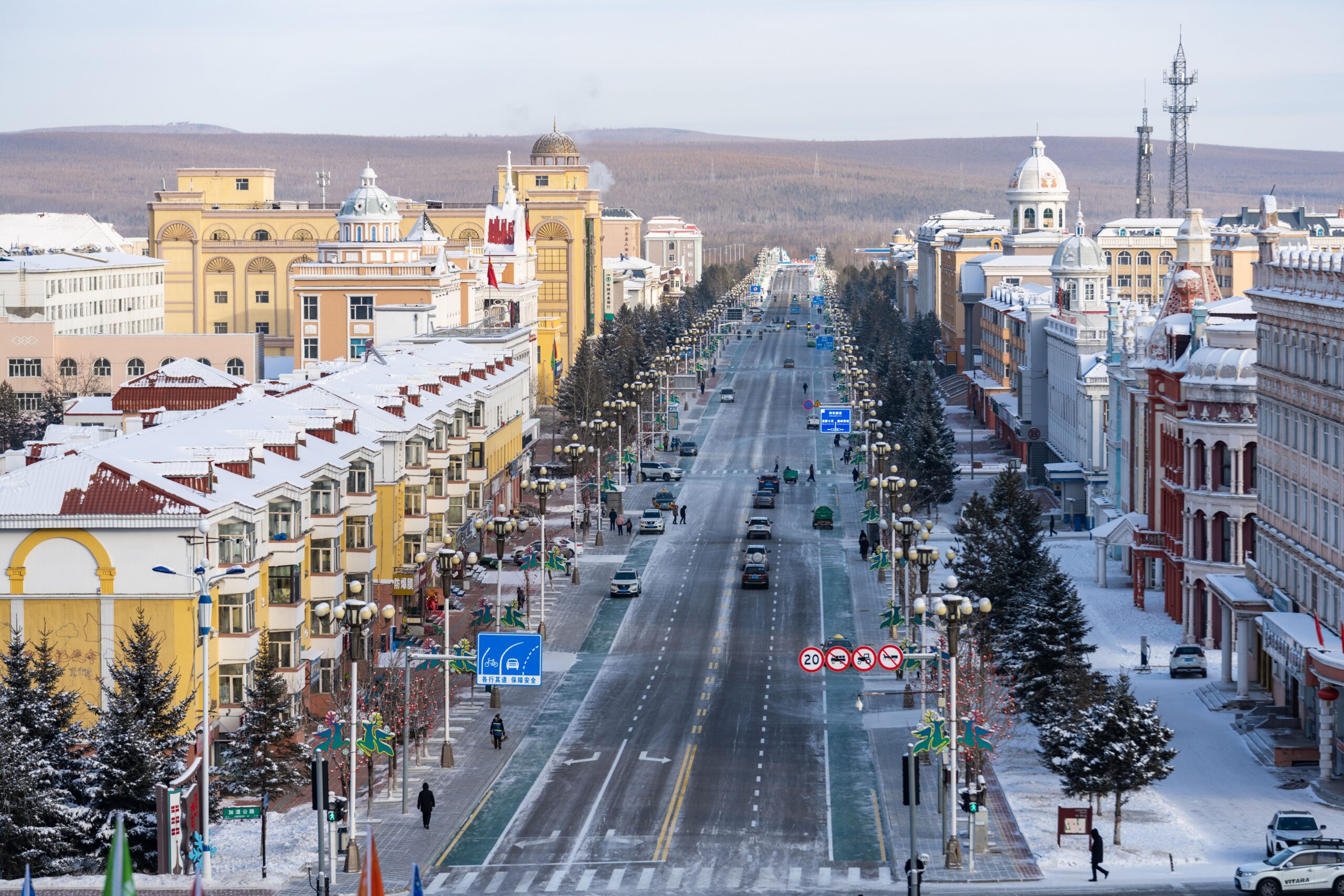
I’m in the snow-capped megacity of Harbin, where the mercury is preparing to make its own daily plunge. It’ll settle at a cool -25 degrees overnight, but make no mistake: this is peak tourist season. It might seem counterintuitive, but despite the freeze, almost everything in China’s “Ice City” happens outside. Lamplit avenues rich with European-inspired architecture buzz with winter revellers. Backstreets thrum with outdoor street food stalls; the Hongzhuan Morning Market, a living museum of north-eastern breakfast foods, opens before first light.
Suffice to say, Harbin is a chillseeker’s paradise, and it’s been quietly mounting its case as east Asia’s cold-climate capital for some time. Here, where temperatures keep low for months on end, winter isn’t just endured: it’s a full-throttle celebration of all things cold, led by a people known as much for their staunchness as their warmth. They are the indomitable spirits of Dongbei, the local term for China’s harsh north-east. Their optimism is infectious, their hospitality famous, and they were my favourite part of the four years I spent living in China. Between their wicked sense of humour and appetite for a good time, I’m yet to meet a more likeable people anywhere on Earth.
Harbin’s tourism miracle is a two-parter. There are history heads who come here specifically for the Russian grandeur: the Byzantine Orthodox churches, the baroque promenades, the strength of its symphony orchestra. But far more are here for the long-running Harbin International Ice and Snow Festival: a frenzied celebration of all things frigid conducted at a scale only China could deliver.Sign up for the Traveller Deals newsletter
The bulk of the festival action occurs west of the city’s cobblestone heart at the Ice and Snow World: a winter theme park decorated with ice sculptures of extraordinary size and detail. Entry for adults is 328RMB ($67), and just about everything in the park is carved from gigantic blocks of ice hauled out of the Songhua River and dispersed over an area of 1.2 million square metres.
According to the state-published People’s Daily, the 2024-25 edition drew an estimated 3.56 million visitors over its 68-day run. A mind-boggling 90 million travellers made for Harbin over that same winter. I will join the throngs just as soon as I finish my Maidie’er ice-cream; a Russian-borne Harbin icon enjoyed just as gaily in subzero conditions as during the city’s dreamy summers.
Both the ice sculptures and the festival itself are the largest in the world, and inside the park, you’ll see frozen interpolations of some of Harbin’s most legendary buildings among storybook ice castles replete with ice slides. In the mellow afternoon light, I’m struck by their diamond-like purity; they almost look thirst-quenching. By night, however, things get Dongbei wild; each sculpture is lit in neon so furious they become visible from the sky lobby of the Ritz-Carlton several kilometres away.
The larger sculptures double as stages. You’ll see colourful Russian folk dancing. You’ll see fashion parades soundtracked by Russian hardbass: a branch of techno born in ’90s Saint Petersburg. There are fireworks. There are dodgem cars on ice. There is ice-skating and ice-fishing and ice-karting and ice hockey and, naturally, ice-cream. This is pure winter maximalism. It’s manic, it’s euphoric, and it’s supercharged by the bracing cold.
The winter cheer continues along the downtown stretch of the Songhua River, right in front of Stalin Park at the Ice and Snow Carnival. Entry here is free and pay-to-play activities dot the river’s frozen surface. You can ride in a hovercraft. You can ride in a horse-drawn sleigh. At a kilometre wide, the whole scene, blanketed in snow and backdropped by a city of 10 million people, looks like a sci-fi moon colony – with one key difference.
The river’s surface is stable enough to drive a car across, and people are doing just that – with wild abandon. For 198RMB per head, you can hop in a car and drift your way across the ice, rally car-style, your driver throwing shrouds of snow into the air with each manoeuvre. I’ve never seen anything like it. Further west along the river, locals meet in more tranquil circumstances at the Workers’ Ice and Snow Park to play curling and bingga: the mindful Dongbei practice of whipping a spinning top across the ice. “Ha! This foreigner is no good at whipping!” offers one elderly gentleman in a thick Dongbei growl.
There are plenty of other ways to experience the Harbin winter party, the calmer International Snow Sculpture Art Expo of nearby Sun Island being one of them. But for the more traditional snow enthusiast, it’s worth noting that the country’s most developed ski fields are just an hour east by bullet train.
Skiing is hardly China’s strongest soft-power asset, but there is snow to be carved. Yabuli Ski Resort, considered the premier skiing destination in this corner of the country, is split into two discrete areas: a government-run section most commonly referred to as the Yabuli New Sports Committee Ski Resort, and the more established Sun Mountain Ski Resort. The former is the cheaper, smaller option, where most of the more challenging runs are reserved solely for developing future champions. Still, if you’re here to learn, three hours’ skiing, including gear hire, will set you back a modest 260RMB. Important: this is a zero-frills set-up. There is little in the way of apres ski, save for a lone convenience store roasting the odd red sausage. (More on them later; they are delicious.)
There are a couple of basic hotels here, but for the real village experience, head to trip.com and book a homestay down the hill in Yabuli Town. Starting at 200RMB, you can spend a cosy night on a kang: a mattress-topped stove bed warmed by a wood fire your host will light underneath you earlier in the evening. Homestays generally include pick-up from the train station and a lift to the slopes and back.
If money is of less concern, you’ll head directly to Sun Mountain Ski Resort. With 16 runs, a Club Med, a string of huts serving hot Dongbei street foods, plus a very remote outpost of hotpot chain Haidilao, Sun Mountain corrals the happy chaos of Dongbei into a much more skiable package. A day on the slopes here, including gear and lift pass, starts at 680RMB.
An all-inclusive night’s stay at Club Med Yabuli, meanwhile, comes in at anywhere from 3000RMB per head, and includes your lift pass, gear hire, three meals, unlimited bar (excluding the top shelf), a group skiing lesson conducted in English, and front-row seats to the hotel’s nightly performances. The experience might be less glamorous than in some neighbouring countries, and often more congested, but it’s nothing if not authentic – and who doesn’t want to smash a fistful of cumin-laced lamb skewers after a day’s shredding?