Devils Tower, Wyoming —
The buzz started in a hay meadow at the foot of a mysterious-looking geological formation. Helicopters and trailers arrived in large numbers, famous faces and a distinguished director settled in near grazing cattle, and the cameras started rolling.
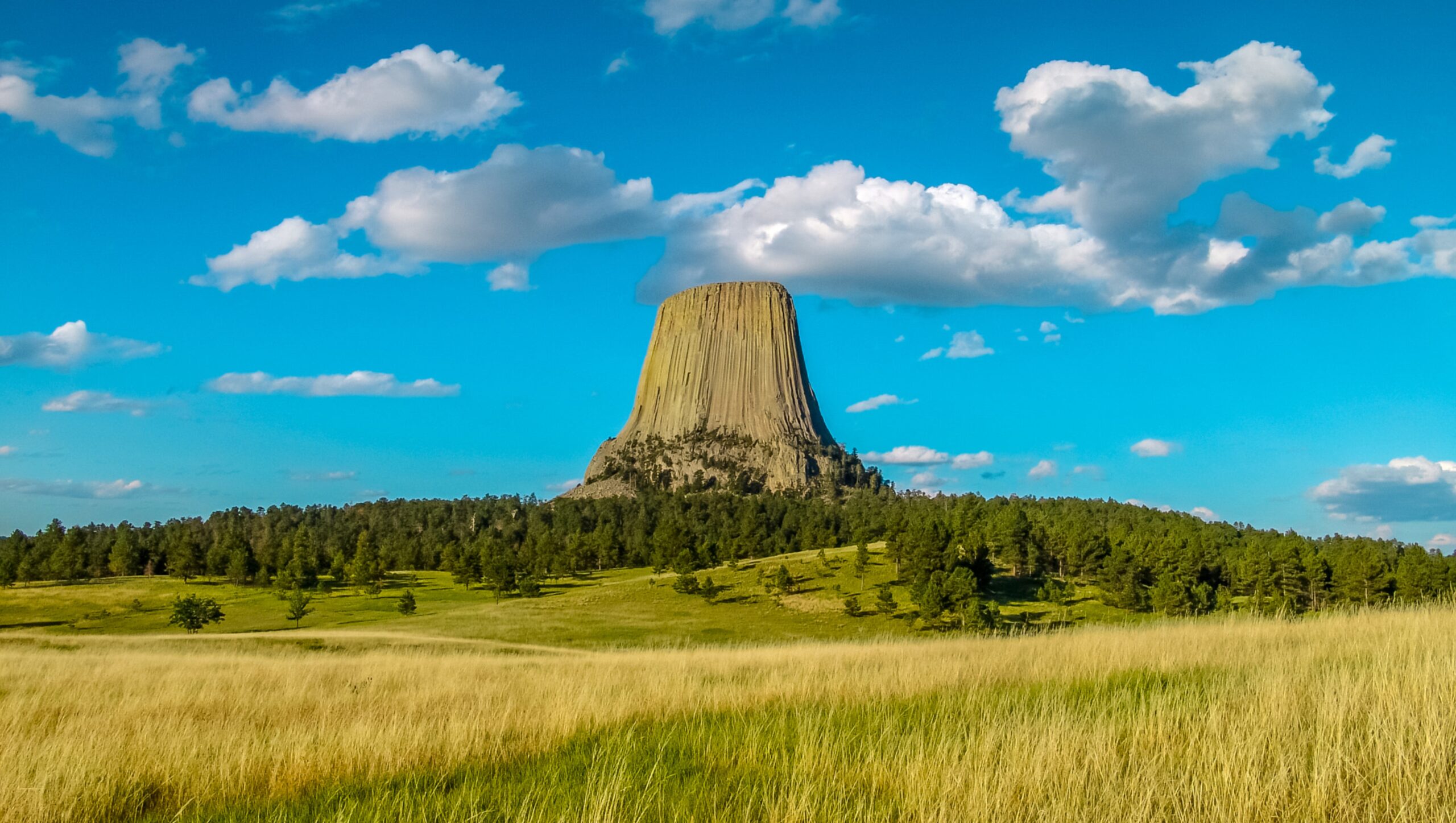
Fifty years ago, Devils Tower National Monument became a beacon for humans entranced by brushes with aliens in director Steven Spielberg’s “Close Encounters of the Third Kind.” And in turn, the 867-foot monolith protruding from the surrounding Wyoming prairie like the stump of the world’s largest tree became a big draw for tourists.
The film stars Richard Dreyfuss as Roy Neary, a Midwesterner who becomes obsessed with an enigmatic form after encountering a UFO. He memorably builds a tower-like shape out of mashed potatoes on his dinner plate before escalating to a full-blown indoor sculpture of the formation flickering at the edges of his consciousness.
Thanks to the film, that form has flickered in the minds of tourists from around the world for half a century.
“Approximately 12 minutes of footage was filmed here in 1976 and then that movie came out the following year in 1977,” said Brian Cole, an interpretive ranger at Devils Tower National Monument, of the portion of the final film shot in the area. The movie was a hit, grossing more than $300 millionworldwide.
“We saw a huge increase in visitation after that movie came out — over 76% increase in visitation from about 153,000 to over 270,000 visitors,” Cole said. “So it really put us on the map, and people even to this day come to the park because of seeing that movie ‘Close Encounters.’”
On the trail of aliens
The strange-looking tower is eye-catching in its own right.
“It’s a geological freak show,” said recent visitor Matt Ingram, who stopped at the tower during a Western road trip with his wife Kimberly. The pair from Chicago was walking along the paved Tower Trail, which includes a 1.3-mile loop circling the monument’s base with excellent views from every angle.
Ingram said the movie served as his introduction to the landmark.
“I was born in ‘70 and I remember seeing that movie and thinking that was pretty cool. When he builds the tower out of mashed potatoes, and the kids are like, ‘Dad, are you OK?’”
Neary was no longer OK with life as he knew it. He wanted answers. And actors in Spielberg’s upcoming alien flick “Disclosure Day,” due in theaters June 12, have suggested that the new film answers some of the questionsraised in “Close Encounters.” There’s even some speculation online that “Disclosure Day” could be a sequel to the 1977 film.
The sci-fi classic was on Devils Tower visitor Kevin Thomas’ mind as well.
“We wanted to find the aliens up there that they left from ‘Close Encounters of the Third Kind,’” joked Thomas, who stopped at the monument in April with his wife Catherine. But the movie they’d seen decades ago wasn’t the reason for their visit, they said. The tower was just a point of interest along a multi-leg trip from Alaska to their home in Michigan.
While the movie boosted the tower’s profile, the formation had already been an established tourist destination for decades. It was the very first US national monument, designated by President Theodore Roosevelt back in 1906. And long before that and to the present day, it has served as a spiritual site for Native American tribes. Trees in the park are dotted with small prayer cloths and prayer bundles, which visitors are asked not to touch, photograph or disturb.
“Geologists aren’t sure exactly how it formed, there’s different theories,” he said. “But what they can agree on is that it was magma. And eventually the magma, it came up from the ground, it cooled and then it hardened. Then it cracked, so that’s how you have the columnar jointing from those cracks. And then it eroded around that.”
The tower is composed of phonolite porphyry, a rare igneous rock, and it is the world’s largest example of columnar jointing, which refers to its massive, often hexagonal columns that stretch hundreds of feet high. Some of the columns are up to 10 feet wide.
The site is popular with rock climbers. Each year, about 5,000 climbers scale the formation, which makes for an impressive spectacle for non-climbers making their way around the tower’s base. It’s the only reliable way to the summit, although a parachutist famously got stranded at the top in 1941, after the rope he planned to use for his descent landed out of reach on the side of the tower.