Friday, November 14, 2025
  • Login
CEO North America
  • Home
  • News
    • Business
    • Entrepreneur
    • Industry
    • Innovation
    • Management & Leadership
  • CEO Interviews
  • Opinion
  • Technology
  • Environment
  • CEO Life
    • Art & Culture
    • Food
    • Health
    • Travel
No Result
View All Result
  • Home
  • News
    • Business
    • Entrepreneur
    • Industry
    • Innovation
    • Management & Leadership
  • CEO Interviews
  • Opinion
  • Technology
  • Environment
  • CEO Life
    • Art & Culture
    • Food
    • Health
    • Travel
No Result
View All Result
CEO North America
No Result
View All Result

CEO North America > CEO Life > Health > Angry people, financial stability

Angry people, financial stability

in CEO Life, Health
- Angry people, financial stability
Share on LinkedinShare on WhatsApp

The origin of anger may be related to the sense of financial stability.

It is a remarkable circumstance that people living in Western countries seem to be very angry. I refer to the countries of Europe, to the outbreaks that came from there and to Latin America. I do not have as much information from other regions, but there seems to be something similar in China, Japan, India, at least through the communication channels that connect us with these nations. And I do not include the Maghreb, the Middle East and Central Asia, because their dynamics are very different.

It is not easy to understand the origin of anger. Some say it comes from an increase in economic inequality, for example. Others, similar online, argue that it is because current generations will not live better than their parents, as it had happened before. They are two different arguments. The first only makes sense in two cases. One, if that inequality implies impoverishment, which would then fall in the case of the second. The other, if envy were a determining feeling in the West.

It is very likely that current generations in developed countries can not live better than their parents, because their parents spent more than they had. The miscalculations of the welfare state, which today are reflected in large public debts in developed countries, are nothing but money that went to that generation, but will pay the current one. The parents lived better than they could, spending resources that the children do not have today. If you want to blame someone for it, you have to claim the excesses of that welfare state, and not today’s fiscal restrictions.

The First World War forced European countries to invest more and more in the welfare of the population. Although Germany had initiated the welfare state much earlier, after the war the United Kingdom became the great promoter of the idea, followed by the continent and even by the western outbreaks (United States, Canada, Australia, New Zealand). The United Kingdom had government spending in the order of 10% of GDP before the war, which amounted to 30% after it, 40% at the end of the Second, with a growing trend that took it to 50% of the GDP in the seventies. It was unmanageable, and the stagnation with inflation that it caused was what allowed the arrival of Margaret Thatcher to power.

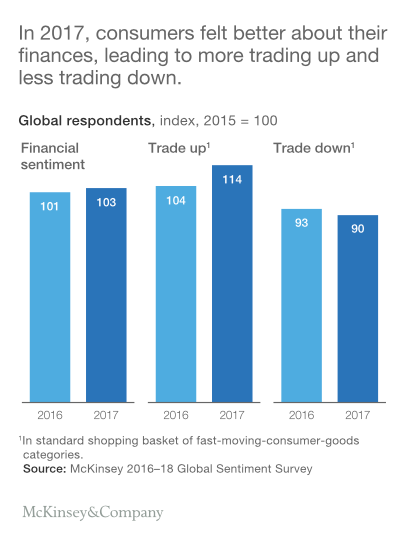
Even though, as McKinsey reports, more consumers around the world are enjoying a sense of financial stability.
- Angry people, financial stability

In the third annual Global Consumer Sentiment Survey, conducted in September 2017 in 29 countries, respondents were more upbeat about their finances compared with the previous year. Fewer consumers said they were delaying purchases, cutting back on spending, and feeling uncertain about the economy. Across the globe, more consumers said they traded up to more expensive brands, while fewer consumers reported trading down to cheaper options (Graphic).

“The results of our latest survey indicate a further strengthening of the trends we summarized in our May 2017 article. For instance, the shift to e-commerce is happening even faster than it was last year, not just in China and India but almost everywhere. And it’s happening not only among affluent consumers but across all income tiers”, wrote Max Magni, Anne Martinez, Rukhshana Motiwala and Alex Rodriguez, McKinsey staff


Tags: angry peoplefinancial stability

Related Posts

‘A wave of truth’: COP30 targets disinformation threat to climate action
Environment

‘A wave of truth’: COP30 targets disinformation threat to climate action

China’s CO2 emissions haven’t risen for 18 months, analysis finds
Environment

China’s CO2 emissions haven’t risen for 18 months, analysis finds

This diet can protect your brain from Alzheimer’s even if started later in life, new study suggests
Health

This diet can protect your brain from Alzheimer’s even if started later in life, new study suggests

Norman Rockwell’s Family Speaks Out About Homeland Security’s Misuse of His Artwork
Art & Culture

Norman Rockwell’s Family Speaks Out About Homeland Security’s Misuse of His Artwork

The Best Things to do in Squamish (By a Local)
Travel

The Best Things to do in Squamish (By a Local)

Energy Supply Considerations for Manufacturers Re-Onshoring to the U.S.
Environment

Energy Supply Considerations for Manufacturers Re-Onshoring to the U.S.

When a company’s enviro claims sound convincing …
Environment

When a company’s enviro claims sound convincing …

The changing face of Mongolia
Travel

The changing face of Mongolia

Four feet higher and rising: Barcelona’s Sagrada Familia becomes world’s tallest church
Art & Culture

Four feet higher and rising: Barcelona’s Sagrada Familia becomes world’s tallest church

Could today’s drop in drinking habits pave the way for a healthier America?
Health

Could today’s drop in drinking habits pave the way for a healthier America?

No Result
View All Result

Recent Posts

  • ‘A wave of truth’: COP30 targets disinformation threat to climate action
  • Delta CEO Ed Bastian calls shutdown ‘inexcusable’
  • Tencent reports 15% jump in revenue
  • The longest government shutdown in history is now over
  • Future of work predictions

Archives

Categories

  • Art & Culture
  • Business
  • CEO Interviews
  • CEO Life
  • Editor´s Choice
  • Entrepreneur
  • Environment
  • Food
  • Health
  • Highlights
  • Industry
  • Innovation
  • Issues
  • Management & Leadership
  • News
  • Opinion
  • PrimeZone
  • Printed Version
  • Technology
  • Travel
  • Uncategorized

Meta

  • Log in
  • Entries feed
  • Comments feed
  • WordPress.org

  • CONTACT
  • GENERAL ENQUIRIES
  • ADVERTISING
  • MEDIA KIT
  • DIRECTORY
  • TERMS AND CONDITIONS

Advertising –
advertising@ceo-na.com

110 Wall St.,
3rd Floor
New York, NY.
10005
USA
+1 212 432 5800

Avenida Chapultepec 480,
Floor 11
Mexico City
06700
MEXICO

  • News
  • CEO Interviews
  • Opinion
  • Technology
  • Environment
  • CEO Life

  • CONTACT
  • GENERAL ENQUIRIES
  • ADVERTISING
  • MEDIA KIT
  • DIRECTORY
  • TERMS AND CONDITIONS

Advertising –
advertising@ceo-na.com

110 Wall St.,
3rd Floor
New York, NY.
10005
USA
+1 212 432 5800

Avenida Chapultepec 480,
Floor 11
Mexico City
06700
MEXICO

CEO North America © 2024 - Sitemap

Welcome Back!

Login to your account below

Forgotten Password?

Retrieve your password

Please enter your username or email address to reset your password.

Log In
No Result
View All Result
  • Home
  • News
    • Business
    • Entrepreneur
    • Industry
    • Innovation
    • Management & Leadership
  • CEO Interviews
  • Opinion
  • Technology
  • Environment
  • CEO Life
    • Art & Culture
    • Food
    • Health
    • Travel

© 2025 JNews - Premium WordPress news & magazine theme by Jegtheme.