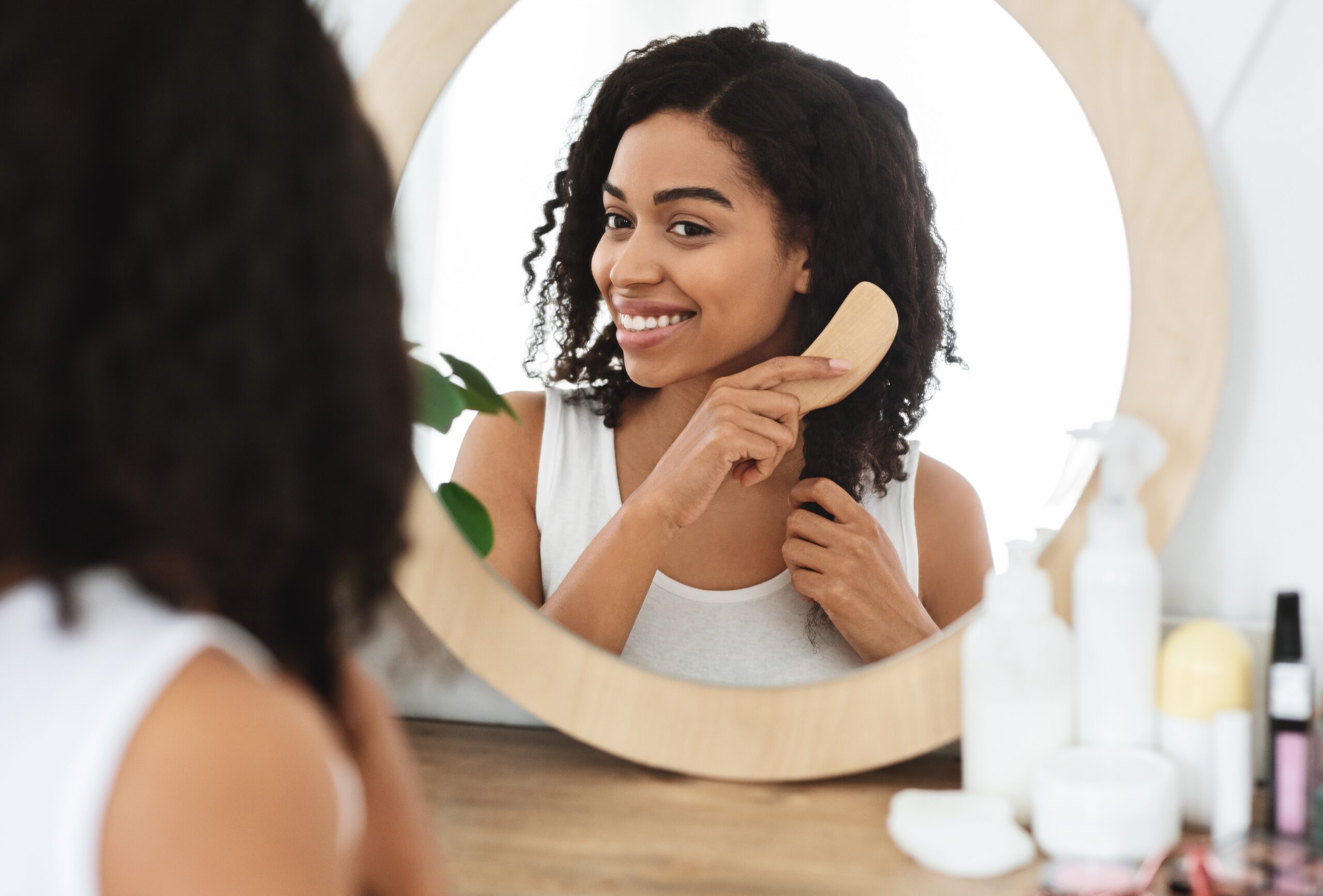
The secret to luscious locks depends on everything from your hair type to the design of your comb.
I’ve had hair straight down to the bottom of my back ever since I was old enough to decide how I wore my hair. Growing up, I brushed it at every chance I got: as soon as I woke up, every time I visited the bathroom, and even if I needed a break from homework.
I’d brush and brush, thinking of Empress Sisi of Austria in the 1800s, with straight brown hair like mine but all the way down to her ankles, who was said to keep hers healthy by giving it 100 brush strokes each night. (A story I believed religiously, until writing this article revealed, much to my disappointment, that it is likely an urban myth perpetuated by grandmothers around the world.)
Now that I’m grown, I give my hair a thorough brush when I shower, and that’s about it. But it still looks and feels the same, at least from what I can tell.
That’s because, while the Victorian tales might hold some truth, the science behind how much you should brush your hair is definitely more tangled, and everybody from physicists to hairdressers is trying to comb through it. The answer depends on your hair type, your brush type, your routine, and more, so read on to find out how to properly brush your locks.
A brush through history
Combs and hairbrushes, and therefore the practice of hair grooming, date back to prehistoric times. “Humans have always used what they had to hand to create tools for both cleanliness and adornment, so brushing would have been important globally throughout history,” says Rachael Gibson, founder of The Hair Historian.
Overbrushing can even cause some damage and hair loss
The idea of 100 brushstrokes likely originated in the Victorian era, when women had very long hair due to the time’s societal expectations: it was considered their “crowning glory” and an integral part of their femininity and worth, says Gibson. A grooming routine would generally involve going through the hair with a comb to detangle it, picking out debris, dirt, lice and head lice, then brushing through it with a hairbrush with natural bristles, usually made of boar hair, to smooth and condition the hair and distribute its oils.
Aristocratic Victorian women would also have fancy capes to protect their clothes from plucked strays and a pot to collect them for later, when they’d make “dead hair doughnuts” to add structure and volume to hairstyles, says Gibson.
The tangled physics of hair
Consider the idea that frequent hair brushing increases hair growth. Over 46% of respondents in a 2025 survey still believed this claim. But that is a myth, according to Nikki Corzine, a hair salon owner in California, US. You cannot make your hair grow faster by brushing it more, says Corzine.
Scientists who have devised formulas to precisely test the impact of grooming on hair damage, in fact, suggest that overbrushing can even cause some damage and hair loss.
One team of researchers created a test to mimic what happens when two hair strands loop around each other into a knot and are then pulled to untangle them. More combing caused hair to crack from the inside, at least for those prone to split ends. While healthier hair fared better, it still started splitting after repeated pressure, with cracks forming from the outside in.
“We believe that’s the main reason for split ends, because in that scenario the hair, being very bent, experiences much higher strains than otherwise,” says study author David Taylor, a professor of engineering at Trinity College Dublin in Ireland. “Indeed, the more we brush it, the more likely it is to get damaged, but actually it’s not so much the number of brushing strokes as the force you use in brushing.”
In various statistical analyses of hair breakage, Trefor Evans from the hair research organisation TRI Princeton also showed that repeated grooming causes “cumulative fatigue damage“.
But, he notes, the up-close lab results don’t necessarily translate into real world effects. Any effects from brushing, for most people, “will be infinitesimal” compared to chemical and heat treatments, say Evans. Brushing and combing damage “is essentially immaterial for most” and is just “drops in the ‘damage ocean'”.
The hidden benefits of brushing
“Gentle, intentional brushing isn’t the enemy,” says Corzine. “The problem isn’t brushing itself, it’s how you brush.”
Keeping hair brushed regularly helps prevent big, difficult knots, matting and tangling from accumulating over time, therefore avoiding harsh brushing, tension and breakage when you do finally get around to brushing your hair. “There’s a whole lot less damage brushing it regularly, once, twice a day, than if you wait a week and then try to do a harsh brush,” says Jared Reynolds, a biochemist who has also launched a haircare brand. He emphasises, however, that testing hair in the lab cannot replicate the natural processes of everyday life.
Regular hair brushing also helps dislodge shed hair, dead skin flakes, and debris stuck on the scalp and head, which, if accumulated, can create a micro-environment that irritates the scalp.
How to brush your hair
The best technique will depend on your hair type. For most people with straight or wavy, non-coily hair, aim to brush at least three times a week, says Nichola Lynch, a hair salon owner from Miami in the US, and potentially as often as twice a day. (Reynolds and Corzine also suggest brushing once to twice a day.)
People with straight or wavy hair types should avoid brushing their hair when it’s wet, says Lynch. Wet hair might feel stronger and thicker, but it is actually weaker.
For those with very curly or coily hair, the advice is exactly the opposite: avoid ever brushing your hair dry, and only work on detangling your hair when you wash it.
Curly and coily hair have very different physical properties than straight and wavy hair, ones which have long been ignored in the scientific literature and hair care industry, according to Michelle Gaines, a chemistry and biochemistry professor at Spelman College in Georgia, in the US, who studies the chemistry of textured hair. She has invented a method for categorising curly hair types scientifically, and found that the presence of certain chemical bonds changes as the hair fibres become more curly, kinky or coiled. This impacts the physics of the hair fibres, including their strength and whether they are more prone to breakage.
Gaines’s preliminary experiments also suggest that the cuticle layers are smaller, spaced closer together and have rougher edges in curly and coily hair than in wavy hair, meaning they don’t retain moisture as well, and they can be more easily damaged and knotted. But more research is needed to confirm this.For those with very curly or coily hair, the advice is exactly the opposite: avoid ever brushing your hair dry, and only work on detangling your hair when you wash it.
Curly and coily hair have very different physical properties than straight and wavy hair, ones which have long been ignored in the scientific literature and hair care industry, according to Michelle Gaines, a chemistry and biochemistry professor at Spelman College in Georgia, in the US, who studies the chemistry of textured hair. She has invented a method for categorising curly hair types scientifically, and found that the presence of certain chemical bonds changes as the hair fibres become more curly, kinky or coiled. This impacts the physics of the hair fibres, including their strength and whether they are more prone to breakage.
Gaines’s preliminary experiments also suggest that the cuticle layers are smaller, spaced closer together and have rougher edges in curly and coily hair than in wavy hair, meaning they don’t retain moisture as well, and they can be more easily damaged and knotted. But more research is needed to confirm this.