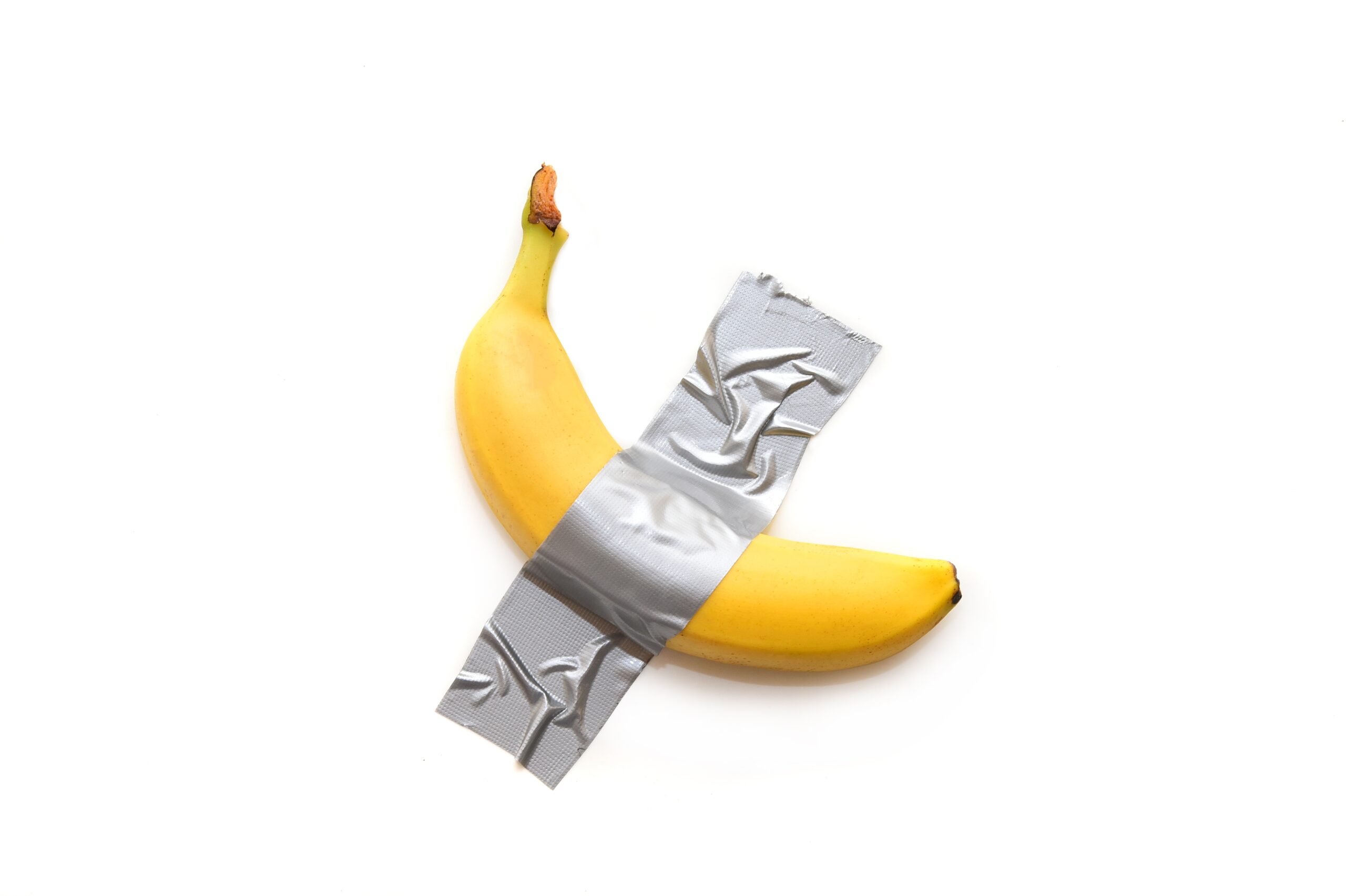
By sticking a banana to a wall with silver duct tape and calling it art, Maurizio Cattelan created one of the greatest cultural controversies of recent times. But the story behind Comedian reveals centuries of notoriety and shock tactics in art.
Leonardo DiCaprio, Michael Bay and Travis Scott were among the celebrities at the VIP opening of Art Basel Miami Beach on 4 December 2019, the day that Comedian made its first appearance.
Big price tags surrounded everyone at the glamorous art fair that morning. A Helen Frankenthaler painting was sold for around $1.65m ($2.16m or £2.14m today), and a Willem de Kooning was available to anyone with a spare $8m ($10.5m or £7.8m today). But for Sarah Cascone, a reporter for Artnet News, the key attraction was Maurizio Cattelan’s latest artwork: a banana stuck to the wall with duct tape.
Within a few days, Comedian had become a viral sensation, attracting scorn, amazement, laughter and a new subcategory of copycat meme involving duct tape and bananas
Later in the day, Cascone wrote the first substantial news story on it, informing readers that two editions of the fruit-based artwork had sold for $120,000 each. Within a few days the third and final edition was bought for $150,000. Each buyer received a certificate of authenticity and instructions on how to display it, including the need to replace the banana regularly.
Throughout the duration of Art Basel Miami Beach, hundreds of other visitors photographed the artwork and posted their reactions online. Within just a few days of its unveiling, Comedian had become a viral sensation, attracting scorn, amazement, laughter and a new subcategory of copycat meme involving duct tape and bananas. In the mainstream press, as well as blogs and YouTube videos, people battled over its aesthetic and intellectual value: those who most hated Comedian loved writing about it the most.
If it was Cattelan’s intention to attract attention to himself, Comedian was a blistering success. Few other works of contemporary art have done what Comedian achieved in just a few hours: gaining fame beyond the art world citadel and becoming globally recognisable. Its renown helped bump up its market value even more. In 2024, the second of the three editions of Comedian was resold at auction for $6.24m (£4.88m). This once again triggered opinion writers, who raged at the wasteful sums of money now being thrown at Cattelan’s artwork.
Yet the irony about Comedian is that everything that shocked people about it had been done before. And when you unpeel the artwork, it reveals the hidden tactics of a master mischief-maker and a dedicated student of the dark arts of notoriety.
A 400-year-old tradition of satire
One of his strategies is provocation. Cattelan clearly realised long ago that in the competitive creative industries, just being skilled or intelligent doesn’t guarantee success. But sparking controversy attracts attention, which means a bigger audience and more potential commissions.
Throughout the duration of Art Basel Miami Beach, hundreds of other visitors photographed the artwork and posted their reactions online. Within just a few days of its unveiling, Comedian had become a viral sensation, attracting scorn, amazement, laughter and a new subcategory of copycat meme involving duct tape and bananas. In the mainstream press, as well as blogs and YouTube videos, people battled over its aesthetic and intellectual value: those who most hated Comedian loved writing about it the most.
If it was Cattelan’s intention to attract attention to himself, Comedian was a blistering success. Few other works of contemporary art have done what Comedian achieved in just a few hours: gaining fame beyond the art world citadel and becoming globally recognisable. Its renown helped bump up its market value even more. In 2024, the second of the three editions of Comedian was resold at auction for $6.24m (£4.88m). This once again triggered opinion writers, who raged at the wasteful sums of money now being thrown at Cattelan’s artwork.
Yet the irony about Comedian is that everything that shocked people about it had been done before. And when you unpeel the artwork, it reveals the hidden tactics of a master mischief-maker and a dedicated student of the dark arts of notoriety.
A 400-year-old tradition of satire
One of his strategies is provocation. Cattelan clearly realised long ago that in the competitive creative industries, just being skilled or intelligent doesn’t guarantee success. But sparking controversy attracts attention, which means a bigger audience and more potential commissions.
Some modern artists (as well as musicians, authors and film directors) saw popular disapproval as the necessary partner of authentic experimentation. Others mistook critical unpopularity as a hallmark of genius, not realising it can also be the red flag of talentlessness. Both recognised its unsurpassed power for self-promotion. And learning from this, Maurizio Cattelan has always leaned heavily into his role as art-world provocateur, doing what he can to irritate and provoke.
Comedian’s aim was to mock the values of art world events like Art Basel Miami Beach, in the spirit of a standup comic making a snarky, industry-targeted one-liner
But Cattelan’s brand of controversy is different to his forebears because it isn’t about artistic process or theory. His most notorious artworks, like 1999’s La Nona Ora (a figure of Pope John Paul II struck by a meteorite) and Him from 2001 (a praying schoolboy with the face of Adolf Hitler) are based on internationally familiar subjects, the kind of things that people who don’t usually frequent art exhibitions will recognise instantly.
There’s nothing elitist or difficult to understand about either of them. They leverage humour as well, using irony to “punch upwards”, and ask questions about powerful individuals with humour. And in doing so, Cattelan follows in an art historical tradition of satire, following pioneers like James Gillray (1756-1815) and Honoré Daumier (1808-1878), both of whom targeted universally identifiable institutions to question and lampoon their power.
‘The shock of the old’
So, why a banana? As well as having a euphemistic shape, and being a familiar prop in slapstick comedy, many artists before Cattelan, including Giorgio de Chirico, Andy Warhol and Guerrilla Girls have depicted bananas in their work. It’s a disarmingly familiar object, on many levels. And the very notion of depicting a foodstuff as a work of art is in itself also a comforting proposition. It has its own venerable history in the form of the still life, which has been an established, if lowly, genre of art since the 1500s.
Traditionally, these types of artworks, like Jacopo de’ Barbari’s Still-Life with Partridge and Gauntlets (1501) (which is among the earliest post-Classical still-life paintings) were supposed to make viewers think about the brief life span of natural life, and how art can make it endure beyond death. De’ Barbari’s and Cattelan’s artworks, although made more than 500 years apart, reveal two essentially identical gestures: objects stuck on a wall for a viewer’s contemplation. Cattelan’s tactic here is the shock of the old.
The only difference is that Comedian displays an actual banana (which can and does rot over the course of around seven days) rather than an artistic representation. But here again, tradition preceded Cattelan. The idea of using a “readymade” (objects from the real world, not crafted by an artist, but platformed as “art”) was more than 100 years old by the time of Comedian.