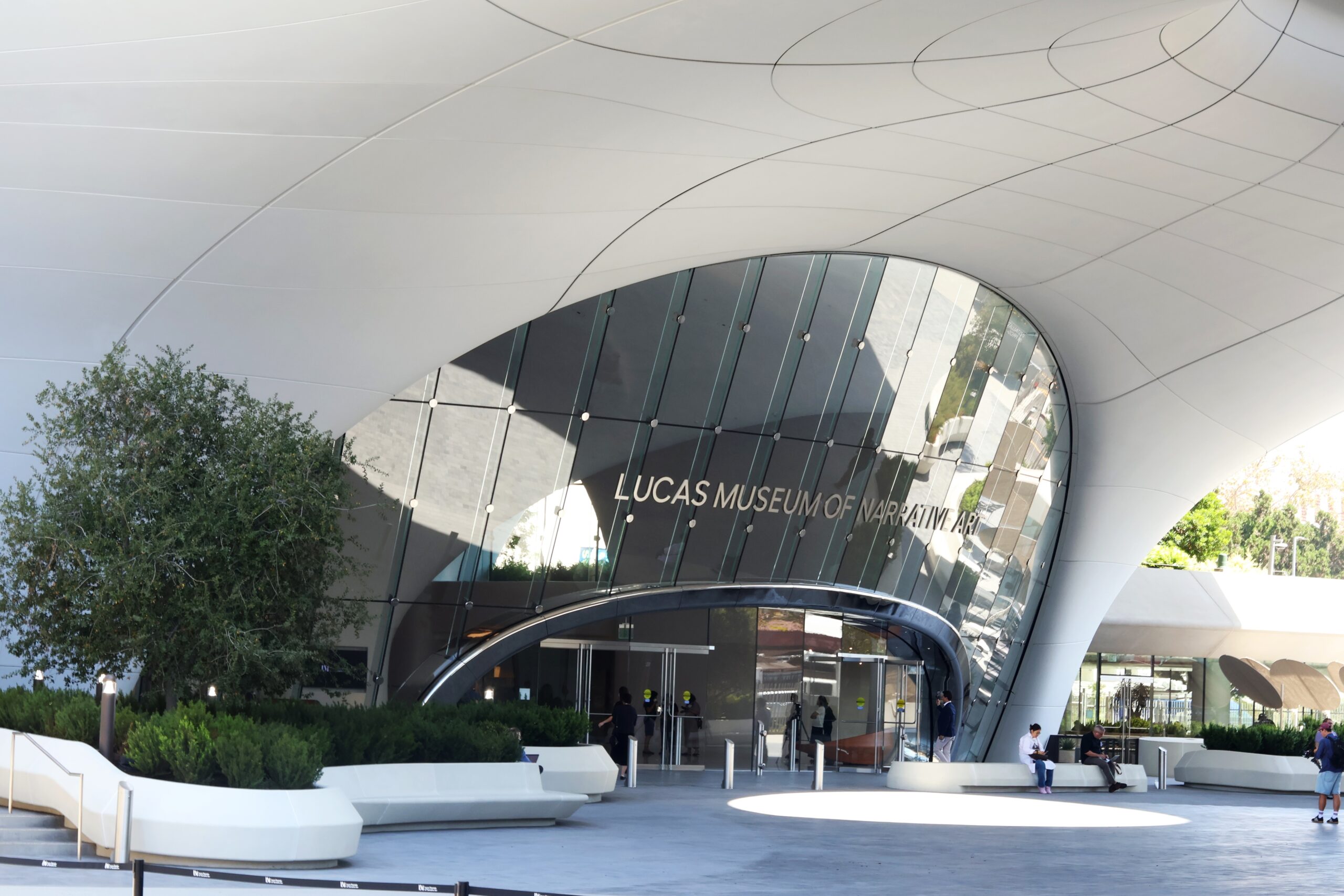
If a picture is worth a thousand words, the Lucas Museum of Narrative Art in Los Angeles has decided it’s not worth writing a single one.
Nearly two decades in the making and costing more than $1 billion, the long-awaited Lucas Museum is finally ready to make its debut, with founding member previews starting next week and its public opening on September 22. The two scrapped plans in different cities (first Chicago, then San Francisco) and the eight years spent building it in LA have certainly added to the hype surrounding the country’s newest museum.
In a promotional video for the museum, cofounder George Lucas says he has always had a problem with the mainstream art world’s rigid delineations between what is and isn’t art. It’s a noble cause, and one that many would now agree with. The past decade has seen profound changes in the art world, with scholars, curators, and critics working to rewrite an art historical canon that has, since the formalization of art history as a discipline in 18th-century Europe, been predicated on hierarchies of artistic media and artists and a neat succession of one movement giving way to another. In the process, innumerable artists and countless approaches have been pushed to the margins, including some of the work on view at the Lucas, particularly illustration.
But you don’t get the sense that the Lucas is making any of these arguments as you walk through its galleries, most of which are on the fourth floor. I started my visit in the gallery dedicated to Norman Rockwell, as good a place as any, given that Lucas has collected his work in depth for decades and that the Rockwell section sets the tone for what’s to come.
The breadth of his Rockwell holdings is quite astounding, extending well beyond this dedicated section. A masterpiece like Shuffleton’s Barbershop (1950), with its tightly cropped view into the titular space at night, still dazzles. It’s no wonder Lucas spent somewhere between $20 million and $30 million to acquire it before it went to auction, courtesy of the Berkshire Museum. Elsewhere are beguiling works like The Gossips(1948), Horseshoe Forging Contest (1940), and The Connoisseur (1962).
In her remarks to members of the press on Wednesday, cofounder Mellody Hobson said that with this museum, her husband, George, “wanted to celebrate the illustrators who have often been underappreciated for their contributions, those who have narrated our lives in pictures, often using a single frame to tell a story.” She is right about that: illustration, with exceptions such as Rockwell, has long been marginalized by mainstream art museums. For that reason, the task before the Lucas is to convince us why these artists belong alongside masterpieces by Artemisia Gentileschi, Lucas Cranach the Elder, and Pieter Brueghel the Younger, all of whom are represented in the Lucas collection and displayed downstairs (more on that later).
The lack of didactics speaks to a larger issue with the Lucas. As a new museum, it has always faced a monumental task: convincing both the public and the art world of its mission and purpose. By declaring itself the “Museum of Narrative Art,” its opening hang needed to make a compelling case for “narrative art,” a term it has essentially revived and one that is not widely used in art historical scholarship anymore. Simply put, it is art that tells a story, though that story can often be hard to interpret if a viewer doesn’t know the important visual cues of the work’s respective zeitgeist; that’s where art history and museums come in. On its website, the Lucas Museum describes itself as “an institution dedicated to the power of storytelling through images,” with Lucas himself adding that “[n]arrative art tells the story of a society—what the common beliefs are that hold it together.”
From a curatorial perspective, there’s no throughline here—the Museum of Narrative Art lacks any kind of narrative. The institution would be better off calling itself the Lucas Collection of Narrative Art, having wholly abdicated what should be an essential role of a museum: providing context, interpretation, and a coherent framework for the works it presents. In its current state, the title feels unearned.
In a way, this should come as no surprise. The Lucas is, after all, a private museum that reflects Lucas and Hobson’s tastes, preferences, and whims. The proposed mission and scale of the project, both conceptually and physically, suggested that the realized institution would be more than a collector’s display case. In hindsight, the $1 billion price tag was perhaps the best indication that the Lucas is, ultimately, a vanity project.
This isn’t to say that a collector-founded museum can’t be well executed. In the US, several of our most august art museums—from the Metropolitan Museum of Art in New York and the National Gallery of Art in Washington, D.C., to the Hammer Museum in Los Angeles and Crystal Bridges in Arkansas—began with the vision of a single collector, reflecting that founder’s connoisseurship and distinct predilections. But those founders ultimately handed over the keys to the kingdom to curators, who were charged with making sense of the collection, helping the public better understand it, and expanding it to fill gaps overlooked because of the founders’ own biases. Perhaps once George Lucas decides to step aside, the Lucas can become the museum it has promised to be.