Katsushika Hokusai’s 1831 masterpiece The Great Wave has become a potent global symbol – yet it also has a “peculiar power to befuddle”. As a new exhibition in London displays its various iterations, what are the clues that help decipher this remarkable image?
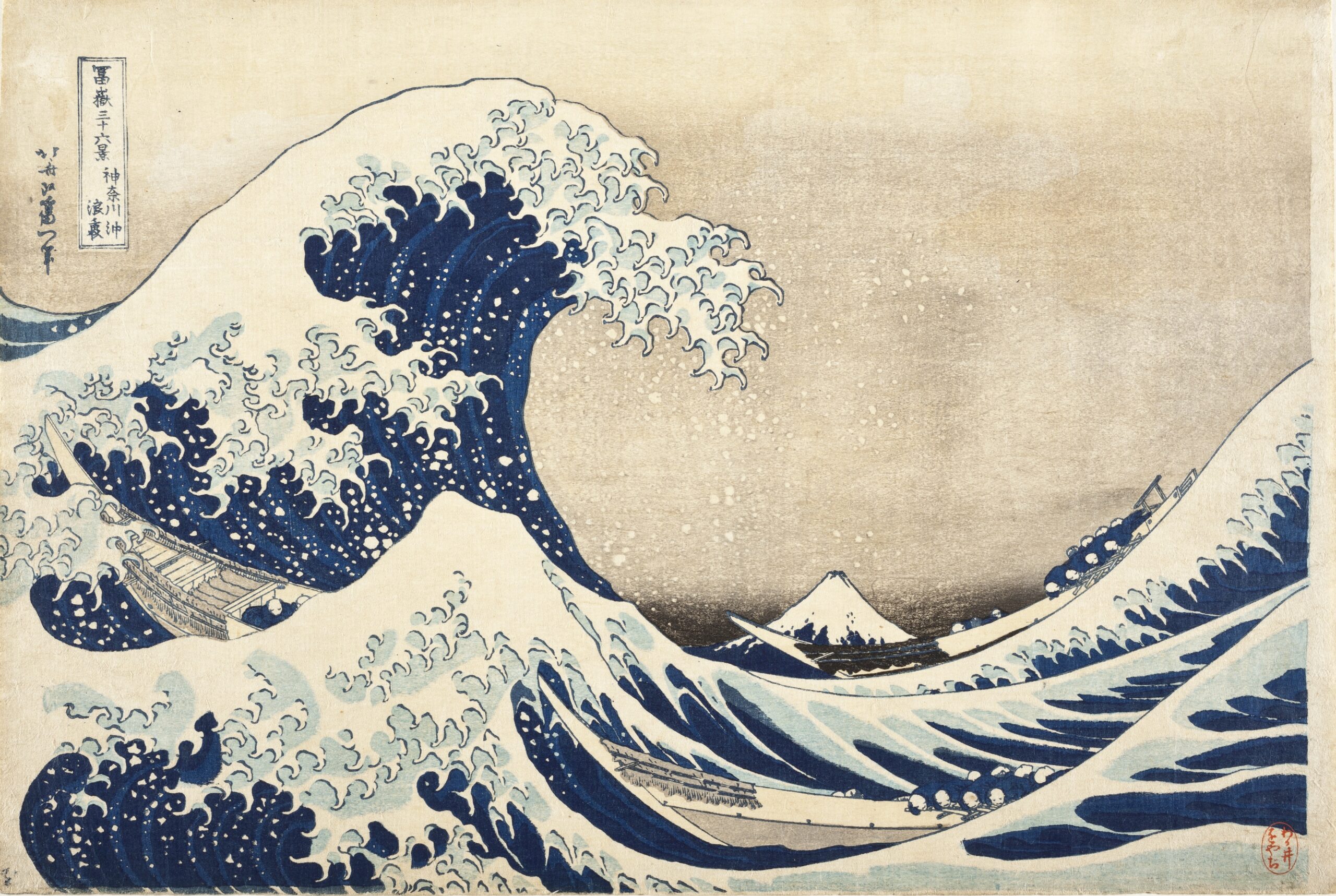
What grips the imagination are the claws curling from the crest of Katsushika Hokusai’s suspenseful 1831 woodblock print, Under the Wave off Kanagawa – better known today simply as The Great Wave. It was precisely these menacing talons that seized the attention of both Vincent Van Gogh and his brother, Theo, when the two discussed the print in an exchange of letters in the 1880s. “These waves are claws”, Vincent and Theo repeated back to each other in September 1888, “the vessel is caught in them, you can feel it”.
For nearly two centuries, the world has continued to feel more than see Hokusai’s extraordinary, relatively small and spare image dominated by Prussian Blue. Alongside Leonardo’s Mona Lisa, Vermeer’s Girl with a Pearl Earring, and Van Gogh’s own The Starry Night, it is one of the most instantly recognisable in cultural history. What is notable about the Van Gogh brothers’ shared reaction to the image is the imprecision in their recollection of what The Great Wave actually depicts.
Look again, and there is not, in fact, just one vessel caught in the waves’ claws. There are three. These long, streamlined cargo barges (or oshiokuri-bune, as they are called in Japan), are not small details that one has to squint to find. Their presence and suspended plight are crucial to the story that The Great Wave tells. And their strange invisibility is indicative of the print’s peculiar power to befuddle even the most attentive of observers.
The Great Wave is comprised of remarkably few elements – the three boats, the surging waves, the lowering sky, and, in the far distance, a small snow-capped Mount Fuji. Yet understanding what is being portrayed in the famous print remains almost mystically elusive.
Is this an image of the sublime power of nature and the puniness of human pursuits, or is it a portrait of mankind’s irrepressible fortitude in the face of imminent disaster? Is The Great Wave a study that contrasts life’s fleetingness (as symbolised by the wave) against the soul’s endurance (as embodied by the mountain)? Or is it an allegory of divine overview, as a protective Mount Fuji peers at us unflinchingly through the swirling aperture of crashing danger?
Today The Great Wave can be found featured in everything from emojis, memes and Lego sets to the Japanese 1,000-yen banknote. Perhaps anticipating its remarkable resonance, the artist created an accompanying series of prints. This series helps to unlock the meanings behind the original Great Wave – and helps explain its pervasive power. Thirty-six Views of Mount Fuji is on display at the Dulwich Picture Gallery in London, the first time the entire series (as well as 10 subsequently added prints) has been shown in the UK.
By the time Hokusai created the series, he was undergoing a remarkable reinvention of identity. Having survived a severe stroke in his late 60s, he became preoccupied with Japan’s highest mountain Mount Fuji, which had long been associated with immortality. He undertook to capture from many angles the shifting temperaments of this object of both worship and pilgrimage. Though none of the other 45 images Hokusai created has fixed itself in cultural consciousness quite as securely as The Great Wave, each print casts light back on the most famous work, drawing our attention to intriguing details and themes that we might otherwise miss.
A fisherman‘s frailty
Consider the print Kajikazawa in Kai Province, which features a figure perched precariously on a rocky promontory at the centre of the image, casting lines into the turbulent Fuji River. Here, Hokusai, who set out in his series to celebrate the eternal in the fleeting, has turned his attention to the struggles of a single fisherman to locate something eternal and archetypal in his toil. The almost subliminal fishing lines that the figure casts into the violent stream, tethered to cormorants, fix him in a delicate geometry of tangents that echo the triangular shape of the mighty mountain behind him.
Inner and outer worlds
Or take the deceptively simple print Fujimigahara in Owari Province, whose sunny serenity may, at first glance, seem at furthest remove from the tempestuousness of The Great Wave. A masterclass in compositional staging, the print reduces Mount Fuji – which had long been revered as a symbol of immortality – to an almost imperceptible sliver of shaved wood scooped by the cooper, who is busy fashioning a large round barrel in the foreground of the print. Bottomless, the still-unfinished barrel becomes a kind of oversized lens through which Mount Fuji is simultaneously glimpsed and eclipsed, framed and forgotten.
Everything is in flux
The cumulative effect of these shifting views of Mount Fuji is a sense of the illusory nature of existence. It’s a theme that became associated with ukiyo-e (or “floating world”) woodblock prints of the Edo period. Perhaps no work in the series amplifies this aspect of The Great Wave more intriguingly than Reflection in Lake at Misaka in Kai Province, which portrays a lone fisherman lying in his boat, surrounded by glassy, smooth water, watched over by a bold and barren Mount Fuji.
Were it not for the broader series title, Thirty-six Views of Mount Fuji, one might well miss the diminutive mountain altogether and mistake its snowy shroud for a smaller, choppy peak of foamy water. In Hokusai’s telling, everything is in flux. Mount Fuji is never one thing or another, but a momentous morphing force whose elastic power lies in its ability to be mirrored in everything we feel and felt in everything we see.