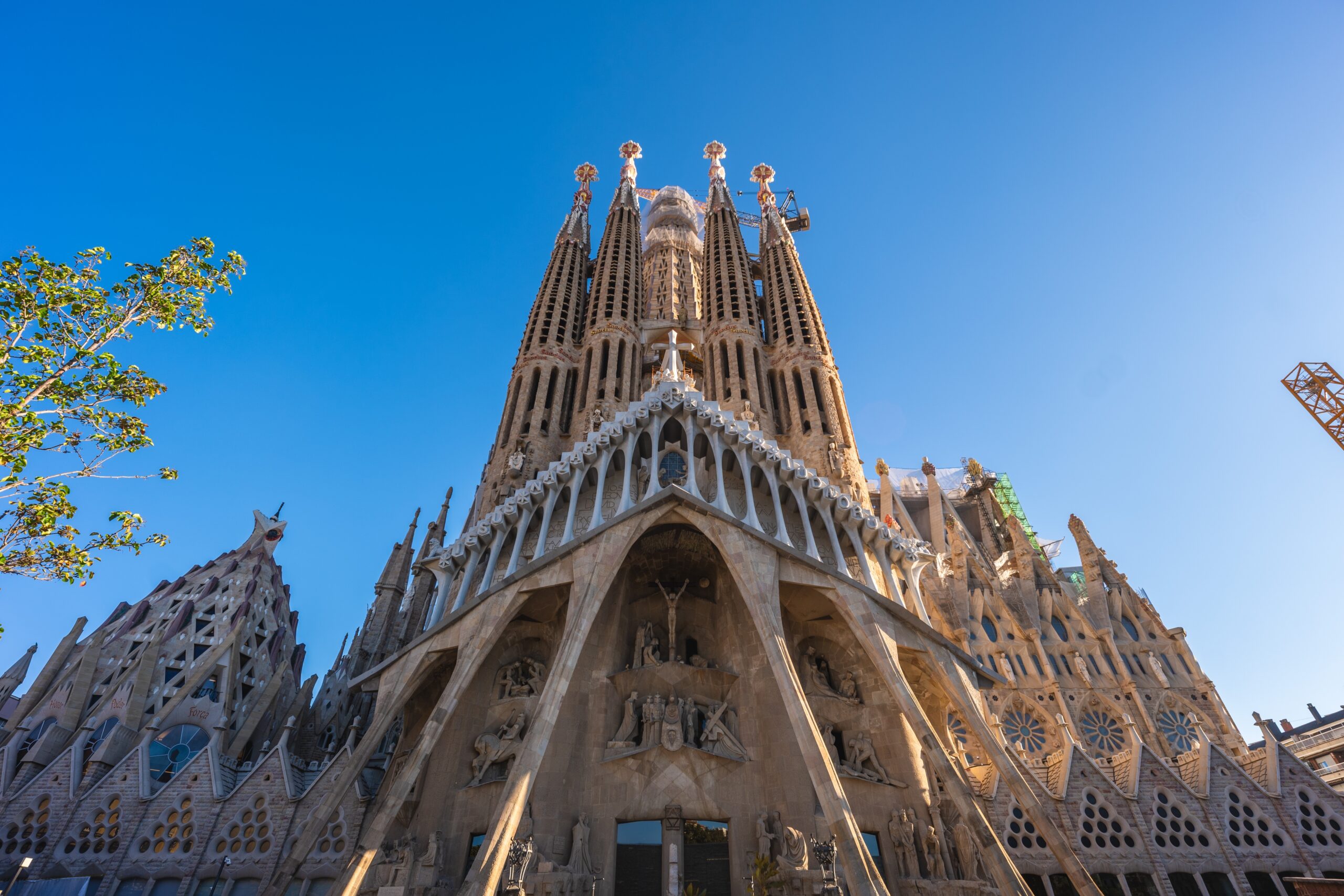
It’s inevitable — everyone looks up. When visitors arrive at Barcelona’s Sagrada Família, their eyes instinctively follow the surreal twisting lines of the basilica’s sculptural towers until they reach the tip of each spire.
Their gazes now extend higher than ever: More than 144 years after construction began, the world’s tallest church reached its final height of 566 feet upon the installation of its last major structural element, a cross atop the central Tower of Jesus Christ, in February.
Delayed by wars, politics and funding shortfalls, Sagrada Família’s imposing but unfinished presence has dominated Barcelona’s skyline for decades. Now, the long-awaited final tower is, at last, ready for its inauguration.
On Wednesday, Pope Leo XIV — the 11th pontiff to reign since the project broke ground — will lead Solemn Mass and a ceremonial blessing. There may still be years’ worth of non-structural work to complete, but 2026 has long been earmarked for this de facto grand opening. The 18th tower’s inauguration marks 100 years, to the day, since the death of the church’s visionary architect, Antoni Gaudí.
A triumph of color, craftsmanship and remarkable geometry, Sagrada Família is a monument not just to faith but to Gaudí’s reverence for nature and mastery of complex engineering. Its completion is a testament to the efforts of the countless designers and architects who had to decipher plans for the church that were largely destroyed in the 1930s.
The project’s complexity was, in many ways, epitomized by its final architectural puzzle piece. With its brilliant white surface reflecting the searing Spanish sun, the cross that crowns the Tower of Jesus Christ (the other 17 towers are dedicated to the 12 apostles, four Evangelists and the Virgin Mary) is as tall as a five-story building and weighs around 100 tons. Installing it was a complex, months-long process.
According to Mauricio Cortés, the architect responsible, Gaudí had imagined a reflective cross that shone during the day and illuminated the skyline at night. Cortés, like all his predecessors, faced two major challenges: remaining faithful to Gaudí’s vision while satisfying stringent engineering requirements (in this case, keeping the spire relatively lightweight).
The cross was manufactured in Germany and delivered to Spain in 14 prefabricated sections made from concrete and stainless steel. The latter material, while not widely used in Gaudí’s time, provided the necessary strength while reducing overall weight. This convergence of history and modernity was one of the many delicate compromises required to bring the architect’s scheme to life.
Once in Barcelona, each section was lifted via crane onto a workshop located 200 feet above ground, directly on top of the basilica’s central nave. There, workers finished the pieces with stone interiors, enameled white ceramic cladding and windows made from locally sourced glass, before the structure was assembled and raised into position.
“Obviously, the times have changed — the technology has evolved, as have the regulations,” Cortés said, touring CNN through the basilica ahead of the inauguration. But the Mexican architect is confident that the church remains true to Gaudí’s original vision. “We believe we’re pretty close to (his plans for) the exterior, for sure,” he added. “With the interior, as he didn’t define it in detail, there’s more room for interpretation.”
Faith in the sky
From the elevated workshop’s vantage point, you can see not only the entire city but also the basilica’s highest architectural features. The roof of the central nave explodes with color, its gables decorated in vibrant ceramics. The bell towers atop both the Nativity and Passion facades — huge walls telling their respective biblical narratives in ornately carved stone — are crowned with insignia-like pinnacles made from mosaics of sparkling Venetian glass.
It is a view Gaudí knew he would never see in his lifetime. When took over the project from architect Francesc de Paula Villar, who resigned amid a disagreement with the project’s developer, he understood that he would never live to see it finished. The scale and complexity of his vision made that almost impossible.
“My client is not in a hurry,” Gaudí famously replied when asked about completion dates. His client was neither the developer nor Barcelona’s faithful, it was God.
The Catalan architect lived long enough to see the first tower completed. But he could never have anticipated the obstacles that would go on to delay the project after his death in 1926.
Two factors proved particularly detrimental to progress: money and the Spanish Civil War.
Controversy simmers
Sagrada Família may now appear complete, but it is far from done. With the Tower of Jesus Christ now built — notwithstanding the interior, which is expected to be finished by 2028 — attention has turned to the Glory Facade.
The third and final of Gaudí’s decorated facades was envisaged by the architect as the basilica’s grand main entrance. Its construction has, however, generated tension with residents living across from the site.
The issue centers on a proposed staircase. Because the entrance portico sits approximately 13 feet above street level, the Construction Board of the Expiatory Temple of the Sagrada Família (the non-profit foundation responsible for the works) has proposed a monumental staircase connecting the basilica to the street while allowing traffic to pass beneath.
Doing so would require significant space, and could involve the demolition of residential buildings directly opposite the church. As such, many local businesses and residents oppose the proposal.