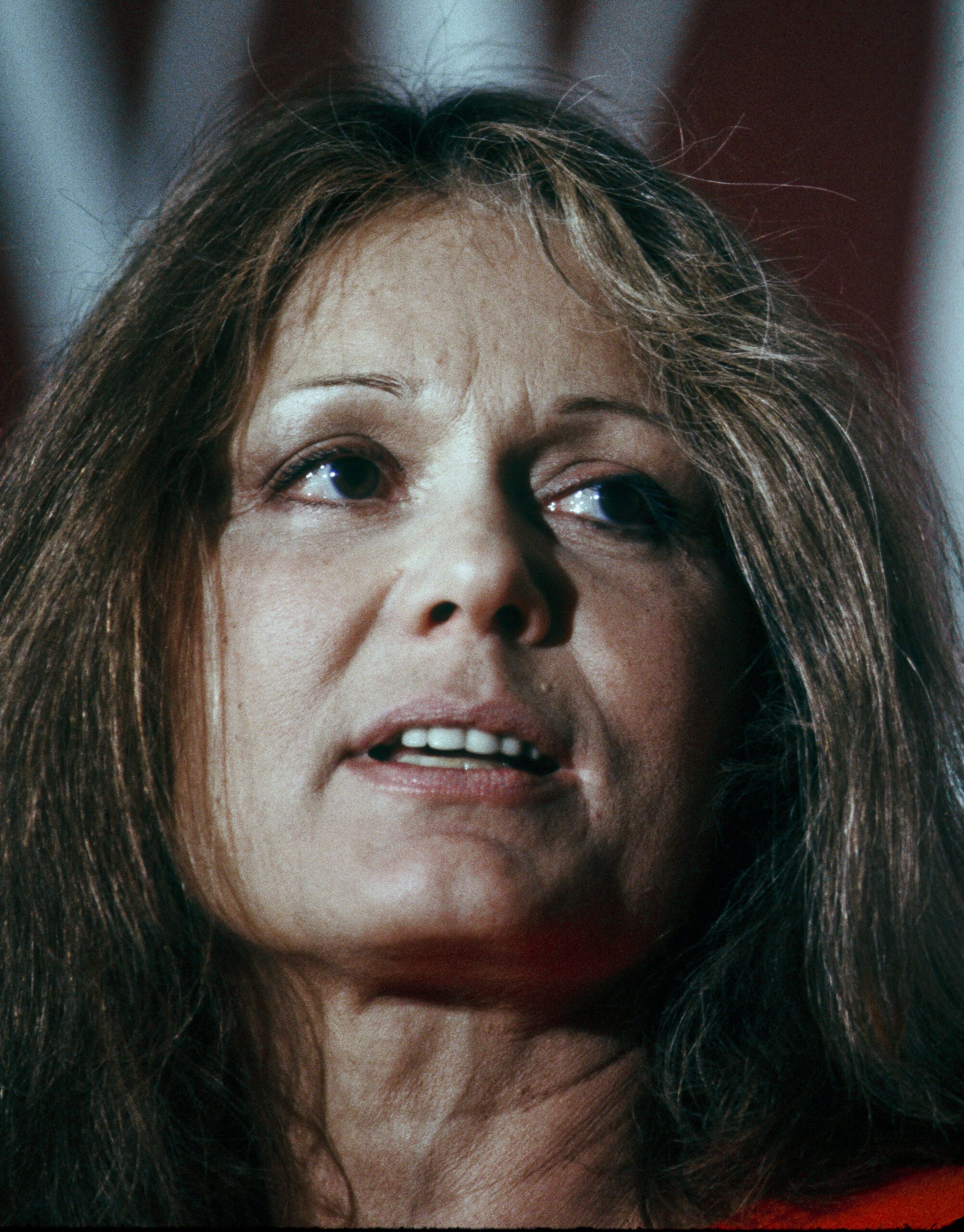
As far as I can tell, the US women’s movement was mostly clustered in coastal cities and university towns until Ms magazine, which Gloria Steinem cofounded and for many years co-managed, made it national. My mother in suburban California was an early subscriber and I was a tween who voraciously devoured every issue. I think it played a role in stiffening her resolve and her sense of her own rights, which led to her leaving my violent father.
Some of the hot takes I’m seeing now on Steinem, and the women’s movement she was at the heart of, act as reminders that a lot of people have no idea of what women’s lives were like before second-wave feminism. Of how women were routinely described as weaker, less intelligent, less rational and less objective than men, and therefore less believable, less qualified to work, testify, participate. No understanding of how utterly disempowered and excluded women were in both law and society, how women were rendered radically unequal economically in so many ways, including exclusion from professions and education and without rights to equal pay, to be free from workplace sexual harassment and discrimination. No memory of how marriage was a relationship of radical inequality in which a woman surrendered many rights and her identity to her husband, not even reserving the right to say no to sex until pressure from feminists made marital rape a crime in a growing number of American states in the 1970s and 1980s.
We now face a huge backlash, maybe even huger than the backlash we’ve always faced, but I believe feminism is just getting going in reversing not centuries but millennia of patriarchy, and I’m grateful for the role Gloria Steinem played in giving those decades of the 1970s to 1990s the transformative momentum that has made my life so much better, in so many ways, than my mother’s, let alone my grandmother’s.
Gloria Steinem understood early on that the feminist struggle would be fought through the media as well as campaigning, and inspired generations of journalists, myself included. As co-founder of Ms magazine, the first in the US run entirely by women, she strengthened the connection between journalism and activism.
Steinem’s feminism was more attentive to race than that of many of her white contemporaries in the “second wave”. Her first explicitly feminist essay, After Black Power, Women’s Liberation, displays a keen understanding of the need to connect feminist struggles with other movements for justice. She wrote about poor women and mothers, and imagined an alliance between radical feminists, middle-class women and “poor women of all colors”, although some of the dated terminology may now appear offensive. Her relationships with prominent women of colour – including Dorothy Pitman Hughes, Shirley Chisholm and Wilma Mankiller – informed every aspect of her work. As she acknowledged: “Personally, I learned feminism disproportionately from Black women.” In 1971, she served as treasurer of the fund for the legal defence of Angela Davis, the Black feminist philosopher unjustly prosecuted for murder who faced the death penalty.
Steinem leveraged her privilege as an educated white woman with access to elite media circles, but could not escape the dynamics of public life that made hers “the face of feminism” within a diverse and collective movement: the names of the women of colour who stood alongside her have not left the same imprint on public memory.
While I admired Steinem immensely, I regretted that her feminism remained so closely aligned with the Democratic party. This led her to defend Bill Clinton in 1998 and minimise Monica Lewinsky’s allegations, before acknowledging this failing two decades later. Her support for Hillary Clintonalso exposed the limits of a feminism centred on representation.
But at a time of rising femonationalism (the use of women’s rights to advance nationalist and racist agendas), Steinem’s legacy reminds us of the urgent need for a feminism rooted in international solidarity and committed to fighting every form of oppression.
A couple of days after Egyptian riot police assaulted me during a protest near Tahrir Square in November 2011, Gloria Steinem emailed me with news of what she called my “girl gang”: feminists and activists from around the world who had been writing to each other to find the best ways to support me. “No matter where you are, please tell me if there is anything at all I can do to make your life easier – or our outrage more effective, with friendship and empathy from your Girl Gang!” she signed off.
I had met Gloria just once, a month before, when the Hammer museum in Los Angeles hosted us for a feminist conversation in front of a live audience. She was a gracious interlocutor who treated me like a peer. We met several times since that conversation, each a reminder of the power of the feminist girl gang.
I was among a girl gang of 25 that she invited to send her questions for an Interview magazine column. My question was about us both being childfree by choice. “I would put the emphasis on ‘free’. It has increased my freedom,” she replied.
I am a feminist who will tell you to fuck off to your face. Kindness and empathy did not make it to my second book, The Seven Necessary Sins for Women and Girls. Gloria blurbed it thus: “Mona Eltahawy’s Necessary Sins is shocking, brave, gloriously unfeminine, and right on time … Reading it will free you, and acting on it will free us all.”
My “sins” – anger, profanity, violence etc – are necessary in our fight against patriarchy. Gloria’s kindness and empathy were like steroids that strengthened us for that fight: batons she passed across feminist generations and borders – and especially vital when that fight against patriarchy leaves us bruised, with broken limbs, and broke. She lent me $1,000 during a particularly tight financial time and I was mortified at how long it took me to repay her. She was unfazed.
Farewell, Gloria. To quote your 2011 email: “you should see the … loving outpouring from your girl gang from around the world!”
I will always be grateful to Gloria for her early support of my play The Vagina Monologues. After she came to see me perform in a little theatre way downtown, she agreed to write the foreword to the book. She showed up decking her red boa at every event we held early on to birth the V-Day movement to end violence against women, gender-expansive people and girls – now 30 years old – into the world. The Vagina Monologues was very outside the mainstream at the time and her support of it helped other people be brave.
She did that same thing for so many women, catalysing their dreams, their visions, their advocacy, their emerging non-profits by lending her support, her strategy, her kindness.
It’s not lost on me that Gloria left this world in the midst of one of the greatest periods of attacks on women’s rights – the destruction of maternal health care; women being forced out of the labour market in the hundreds of thousands, especially Black women; the siege on reproductive rights; rape academies emerging online; the Epstein files still not being prosecuted; and having a convicted felon as president who has been found liable in a civil court for sexual abuse. But if Gloria had anything, she had stamina and infinite hope, and she would want us to remember that the backlash is an indication of our victories and our power.
Now we need to go beyond where we’ve been, to new imaginings in order to fight off the racist, fascist, capitalist patriarchy that is actively working to kill our world.