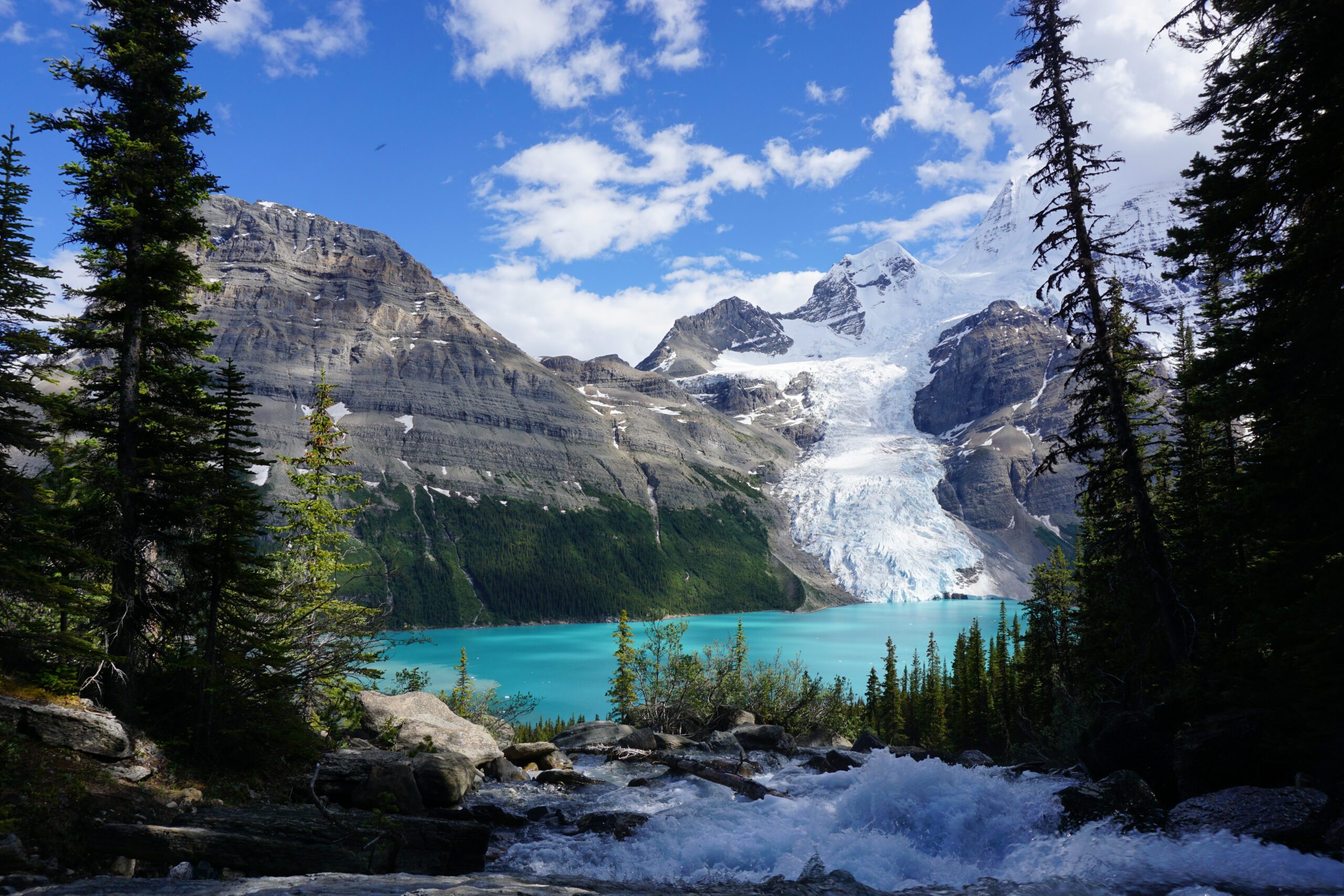
With its glacier-fed waterfalls and turquoise lakes, the Berg Lake Trail is one of North America’s most spectacular alpine treks. Now, a long-awaited backcountry hut is changing the way visitors experience this Canadian classic.
Mud squelches beneath my boots as I move through a tunnel of trees. After climbing a series of steep switchbacks up a valley wall, my legs are burning when spray from a thundering waterfall I can’t see hits my face.
The steady roar of water has rung in my ears since I passed White Falls, the first in a series of cascades cutting through the Robson River Gorge and spilling into the aptly named Valley of a Thousand Falls below. When I finally emerge through an opening in the forest, I see it, rising in the distance behind the powerful rush of Emperor Falls: Mount Robson, the tallest mountain in the Canadian Rockies.
I’m 9.3 miles (15km) deep on the recently reopened Berg Lake Trail in Mount Robson Provincial Park, located just west of Jasper National Park in British Columbia. This 26-30-mile (42-48km) round-trip route is one of Canada’s most famous backcountry trails and reveals some of North America’s most spectacular alpine scenery. I’ve hiked the trail three times, but now, a new alpine hut is letting travellers experience the area in a whole new way: by spending the night in Mount Robson’s shadow.
Beginning at the Mount Robson Visitor Centre, the route rises from towering old-growth forest into a dramatic alpine valley filled with tumbling, glacier-fed cascades. Here, hikers are treated to unforgettable panoramas of Mount Robson before arriving at the turquoise Berg Lake.
In May 2026, after decades of planning, and a year after the Berg Lake Trail reopened after a catastrophic flood, the brand-new Robson Pass Hutopened near the northern end of the trail. Set directly beneath Mount Robson at Robson Pass, the two-storey backcountry hut offers an intimate, close-up view of the iconic mountain that hikers don’t see from most of the trail.
From the building’s front door, Mount Robson rises almost directly overhead. The hut’s opening means backpackers no longer need to carry their camping gear some 12 miles (20km) up the mountain if they wish to spend the night. It also allows them to spend more time in the trail’s upper reaches rather than rushing back down the valley on a day hike. And in winter, it provides would-be campers a much more comfortable base for ski touring.
For Calgary hiker Amanda Elia, the experience of hiking the trail is difficult to put into words.
“It’s simply breathtaking,” she says. “A must-see hike.”
During the three- to four-day journey, travellers pass icefields tumbling into azure alpine lakes, glaciers calving with the force of an avalanche and snowcapped peaks dwarfed by the iconic Mount Robson itself.
Plan your trip
Hikers can reserve backcountry campsites along the trail here and the Robson Hut here. If you’re unable to secure a reservation and are a strong hiker or trail runner, consider tackling the trail in a single day. Running enthusiasts may also be interested in the Mount Robson Marathon, held annually on the second Saturday of September, with 3 mile (5km), 7.4 mile (12km) and half-marathon race options.
Few mountains dominate their surroundings quite like this 12,972ft (3,954m) behemoth, which is capped by glacial fields that plummet some 2,625ft (800m) into the turquoise Berg Lake below. In fact, the first glimpse of the peak from the highway as you approach the park’s visitor centre, can feel almost unreal.
“You need time to process how beautiful it is,” says Elia.
The trail reopened in three phases between June 2023 and June 2025. Throughout its restoration, the aim was to rebuild the trail with climate resilience in mind. BC Parks staff, engineers and contractors worked together to reduce river crossings and limit time spent in floodplains, creating a more sustainable path up towards the new hut.
For hikers returning after the floods, the rebuilt sections have been thoughtfully executed. “All the work put into it is very apparent and well done,” says Sombert, who first backpacked the trail in 2000. Walking alongside him for the first time, Stephanie Dean notices the same attention to detail, reflecting that “it was clear that a lot of effort was put into making it as safe as possible while going over different terrain”.