In Tempe, Arizona, Culdesac is reimagining US cities for people, not cars – and inviting travellers to explore its plazas, paseos and Mediterranean-inspired design.
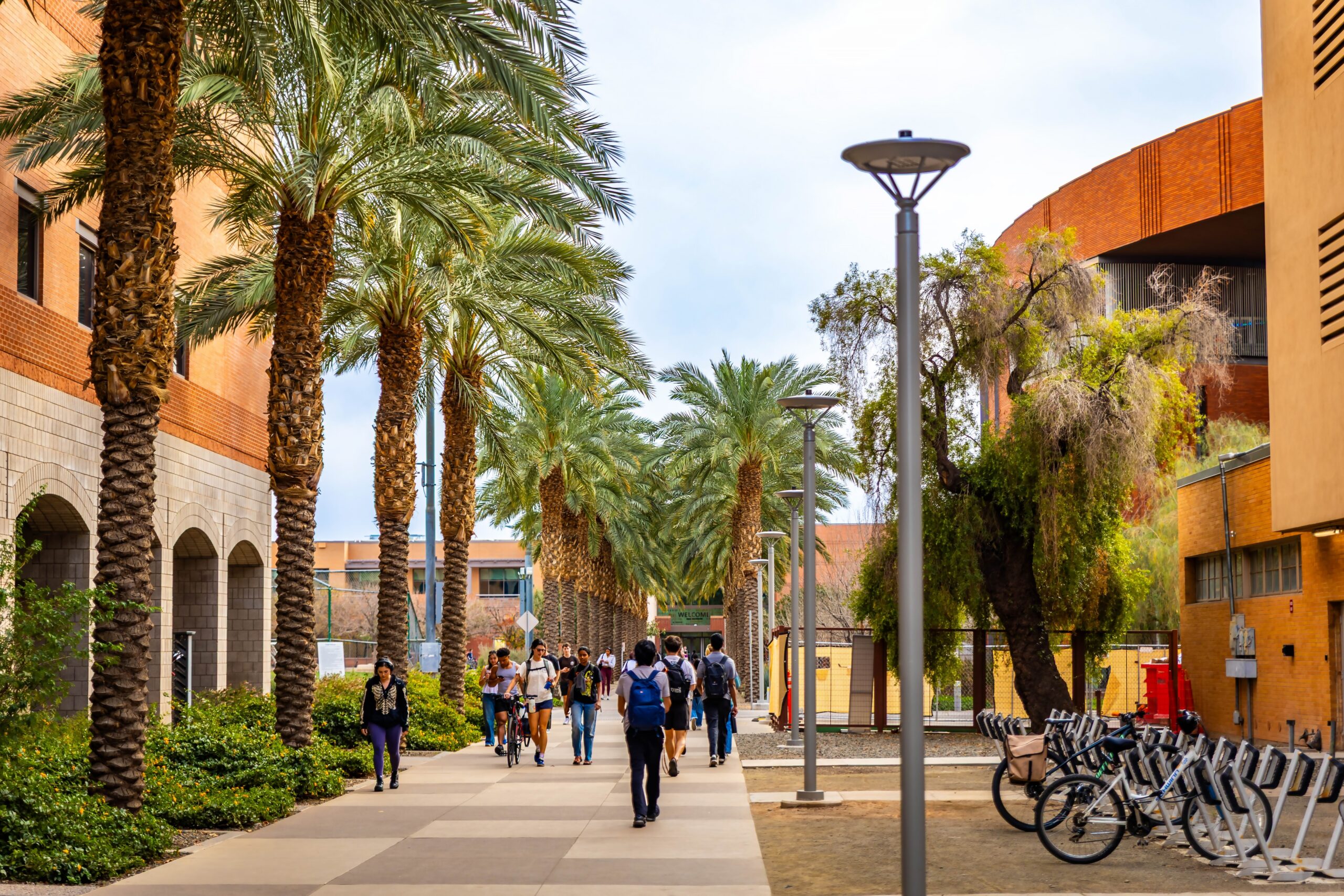
When Sheryl Murdock walks to her apartment in Culdesac – the US’ first modern car-free neighbourhood built from scratch – she feels transported to a Mediterranean island. As she enters the central plaza, which serves as an al fresco communal living room, the blare of traffic fades, replaced by the clink of glasses, the hum of conversation and the thump of a cornhole game. She meanders down narrow pathways between low-slung white buildings crisscrossed with fairy lights, passing pops of colour from cheerful murals and magenta bougainvillea. Although she’s in Arizona, Murdock says, “It’s like being in Greece.”
Architect Daniel Parolek did have the Mediterranean in mind when he designed Culdesac, though he was influenced more by his travels to the hill towns and coastal villages of Italy and France. Travellers and locals love these settings, Parolek says, because “these are places that were built prior to the automobile, so they were designed around accommodating people”. Why then, he asks, do people have to vacation to places like these rather than living in them?
The answer is that societies made a Faustian deal with the automobile. As urban planners calibrated the built environment to the needs of cars rather than people, cities spread out into vast systems of traffic-clogged asphalt that disgorge solo commuters into soul-crushingly monotonous suburbs. Car-centric design has contributed to making metropolises more polluted, more socially isolating, less sustainable and hot as hell.
But the collective consciousness is shifting. Research is revealing that walkable cities make people happier, less lonely, more satisfied with life and physically healthier. Movements are afoot around the globe toward sustainable urbanism, slow travel and 15-minute (or less) cities – such as Nordhavn in Copenhagen and superblocks in Barcelona. For travellers, strolling around Culdesac’s shops, restaurants and outdoor markets offers a glimpse into a future where cities are once again built for people, not traffic.
Culdesac is an especially bold experiment because of its unlikely location: Tempe, a suburb within greater Phoenix, Arizona. This sprawling metropolitan area is cursed with an inadequate public transportation system, which means residents practically need to own a car to get around. So, when Culdesac’s first residents arrived in 2023, many sceptics wondered how a neighbourhood that doesn’t permit private vehicles could survive in such a car-dependent place.
The key is to be “car free, but mobility rich”, says Parolek. The 17-acre mixed-use neighbourhood comes complete with eateries, shops, a Korean convenience store, a doctor’s office, a dog park, a pool, a gym and a coworking space – meaning locals are steps away from many amenities.
For visitors, the light rail stops right outside, linking the neighbourhood to downtown Phoenix and the airport. Self-driving electric Waymo robotaxis shuttle people further afield, while Archer’s Bikes rents e-bikes for exploring Tempe Town Lake or the Desert Botanical Garden.
The prospect of shrinking her carbon footprint by living car-light is what inspired Murdock to move to Culdesac while earning her postdoctoral degree in ocean sustainability at Arizona State University (ASU). The light rail whisks her to work at ASU in 10 minutes and to supermarkets in about the same time. She can pedal her e-bike around Tempe, a designated Gold-Level Bicycle Friendly Community. If she needs to go farther afield, she rents one of Culdesac’s handful of shared electric cars for $5 an hour. “Being in Culdesac has taught me that I much prefer the concept of the 15-minute city,” she says. “I don’t want to have to get in my car to do everything.”
Switching from vehicles to public transportation, biking and walking can cut individuals’ carbon emissions by 2.2 to 3.6 tonnes annually, according to the United Nations. That means that when Culdesac is fully built in a few years, with around 760 units and 1,000 residents, the community could prevent around 3,000 tonnes of greenhouse gases from entering the atmosphere each year.
The neighbourhood was also designed to mitigate heat and curb air-conditioning use. That’s essential in a city that last year sweated through 143 days at or above 100F (38C). To make Culdesac cooler, Parolek and his team at Opticos Design took their cue from sun-soaked locales like Italy, Greece and Mexico. They painted the buildings’ walls and roofs as white as the towns on Mykonos. White paint reflects the sun much better than Phoenix’s typical sand-hued homes, helping reduce the urban heat island effect.
Because no space is needed for driving and parking, the architects could also employ another classic cooling strategy in Mediterranean towns: setting buildings close together. Consequently, Culdesac’s structures almost constantly shade each other, as well as the paved or earthen “paseos” (Spanish for walkways) that connect them. These narrow paseos also act like funnels that draw in breezes. Similarly, all apartments have windows on opposite sides, allowing for cross ventilation.
The shade, airflow, desert-friendly landscaping and absence of asphalt create a microclimate. As a result, in 2023, Harvard University researchers determined that the ground surface temperature within Culdesac was 30-40F (17-22C) cooler than the pavements in the surrounding area.