With his first “starry night” painting in Arles in 1888, Vincent van Gogh transformed an ordinary city square into something extraordinary – here’s how he did it, and what it means.
Before there was The Starry Night, nine months before, to be exact, there was Café Terrace at Night. Painted in September 1888, the luminous portrayal of a lantern-lit coffeehouse in the Provençal city of Arles (to which Van Gogh had moved six months earlier) is capped enchantingly by a deep blue wedge of pulsing, constellated sky.
The very first starry night that Van Gogh ever painted, it would prove to be pivotal for the artist, and not simply because it introduced a fresh fascination with the glimmering coordinates of the cosmos above.
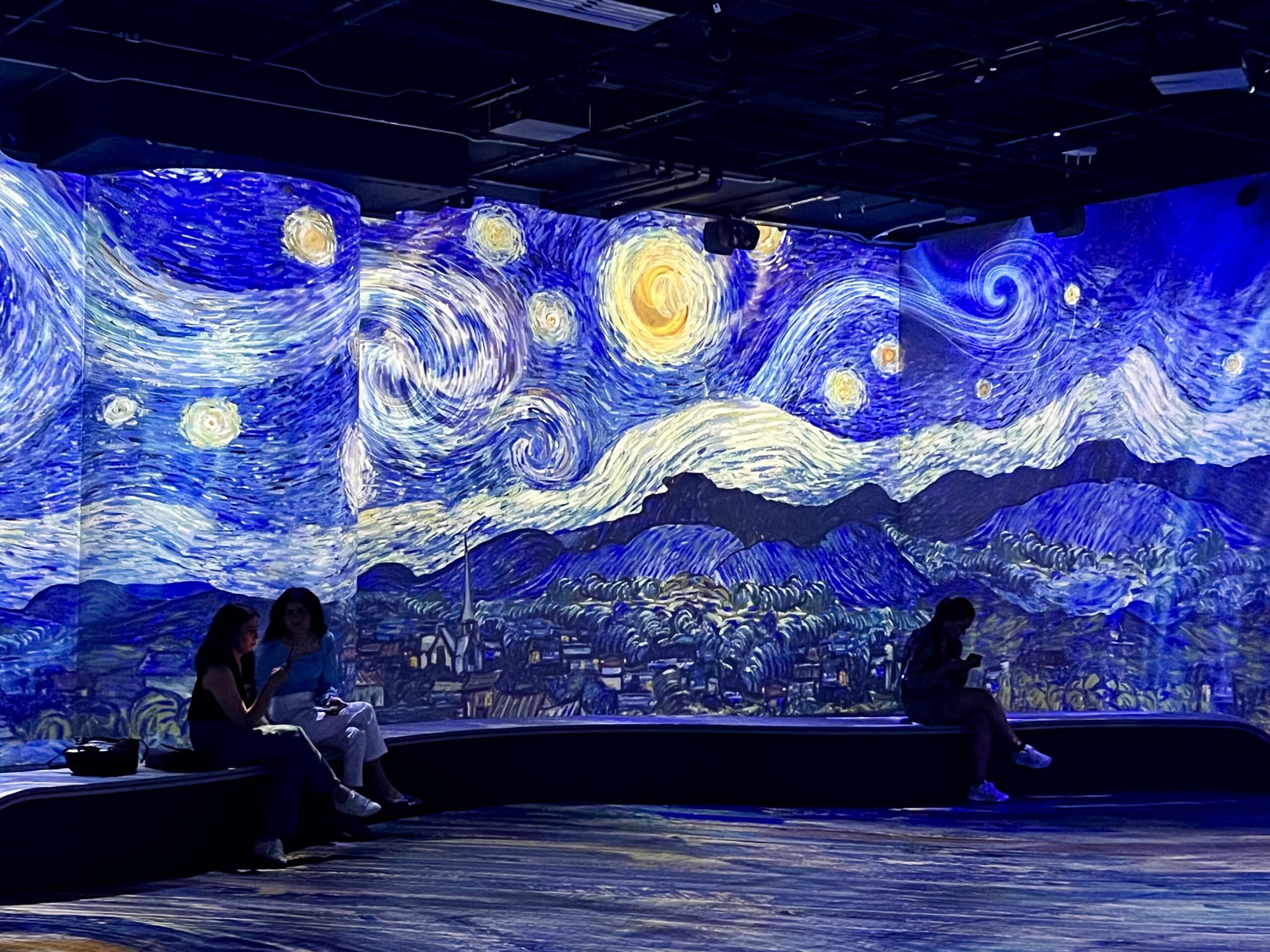
With Café Terrace at Night (now on display in Tokyo as the climactic work in The Grand Van Gogh Exhibition) one can see Van Gogh reinventing both himself as well as the role of the artist as a witness to the universe – to what is past, or passing, or to come.
1. Cobblestones
The foreground of Van Gogh’s canvas, occupying a full quarter of the painting, is a rippling sea of multi-coloured cobblestones that appears perversely to push back from the viewer the titular focus of the image: the café. A letter Van Gogh wrote to his sister shortly after completing the painting suggests that the prismatic splendour of this ragged mosaic of light and stone is the real subject of this section of the work.
2. Columns
At the centre of the painting, visible beneath the electric green boughs of the large tree on the right of the canvas, is a well-lit and finely observed corner shop from which a handsomely dressed couple appear to be walking in the direction of the café opposite it. But that’s not quite how it was.
Van Gogh has studiously swapped in these windows and drawn curtains for a pair of formidable, 1st-Century Corinthian columns, complete with intricate capitals and cornice, and a striking fragment of a pediment, salvaged from the ruins of a Roman temple that adjoined the ancient forum and inserted into the façade of what was the Hôtel du Nord. Prominently visible from his vantage, these spolia, as they are known, or picturesquely repositioned relics from antiquity, would likely have preoccupied the brush of almost any other artist. But they have no place in a painting that refuses to be weighed down by the past. In Van Gogh’s work, you can look back, but it’s best not to stare.
3. Chairs
Imposing props from the past – buried beneath the surface or erased altogether – are not the only absences that disturb Van Gogh’s deceptively straightforward work. Though the painting appears to present a lively social scene, our eyes must hurdle rows of empty tables before they meet any actual cafe goers. What are we to make of all these unoccupied seats near the foreground of the painting, which appear to be arranged as if a spectacle – to be performed in the square between them and where we stand – were about to begin?
According to contemporary accounts, including one published a decade before Van Gogh moved to Arles, Place du Forum (then known as Place du Cestier) witnessed the appalling pomp on 26 February 1399 of the beheading of a rebellious nobleman, Gaubert de Lernet, before an audience that included Queen Marie of Blois, mother of King Louis II of Naples and of the Prince of Taranto. The scaffold, like the forum, may be gone – its history erased and overwritten by time – but the muscle memory of gawking is hard to break.
4. The tower
The canvas’s insistent perspective lines, accentuated by the clever alignment of cobbled gutters and the levitating tabletops, pull the gaze to the back of the painting. It is then pulled upwards by the ascent of a shadowy tower that rises in the distance. By the time Van Gogh visited Arles, this evocative tower, silhouetted by the cobalt blue sky, had itself become a totem of existential reinvention. It began life as the bell tower of the church of Sainte-Anne before being recast, a dozen years before Van Gogh relocated to Arles, as a reliquary for ancient fragments as part of the city’s Musée Lapidaire.
Van Gogh attests to visiting the museum almost upon arrival in the city, and to taking in its impressive collection of Roman inscriptions, architectural remnants, and early-Christian sarcophagi recovered from the nearby necropolis, the Alyscamps, to which the artist would soon turn his brush for a series of four paintings after completing Café Terrace at Night. As a repository of the vanishing past, the Lapidaire tower serves a vital visual function, connecting the fleeting affairs of this world with the infinitude above.
5. The stars
In light of Van Gogh’s willingness to manipulate the contours of the world as he encountered them, it may seem surprising that he should be so meticulous about the placement of the stars in the keystone of sky to which our eyes are ultimately drawn. But scholars have demonstrated that his stellar arrangement aligns precisely with the position of the constellation of Aquarius in mid-September 1888, just when he stood in the Place du Nord and gazed above the Rue du Palais.
Everywhere else in Van Gogh’s painting, the world, like himself, is forever in flux, endlessly evolving into something else. Only the twinkling stars – the seemingly least tangible or fixable property in the painting – are spared revision and belong to a realm beyond correction. They, and they alone, are pure and represent the ungraspable zenith of creative yearning. Writing to his brother a fortnight after finishing Café Terrace at Night, Van Gogh explains his newfound remedy for feeling untethered to the ceaselessly shifting universe around him: “I go outside at night to paint the stars”.