The dramatic rally that sent gold prices above $4,300/oz before giving back some gains has dominated headlines. We believe investors also should consider the secular forces behind many commodity markets, and the potential of broader commodities to offer attractive return potential and to help diversify portfolios.
Despite recent volatility in gold prices, the overall surge in value in the past year has surpassed even that of the S&P 500. Several factors are behind gold’s climb: 1) purchases by central banks, especially in emerging market countries, seeking to diversify reserves and protect against asset confiscation, 2) Federal Reserve rate cuts (both actual and anticipated), as lower rates reduce the opportunity cost for holding gold, and 3) inflows into both physical and financial gold products by high net worth individuals, global sovereign wealth funds, pension plans, and retail investors – all seeking to own real assets after the biggest global price shock in decades revealed the hidden inflation risk in many portfolios.
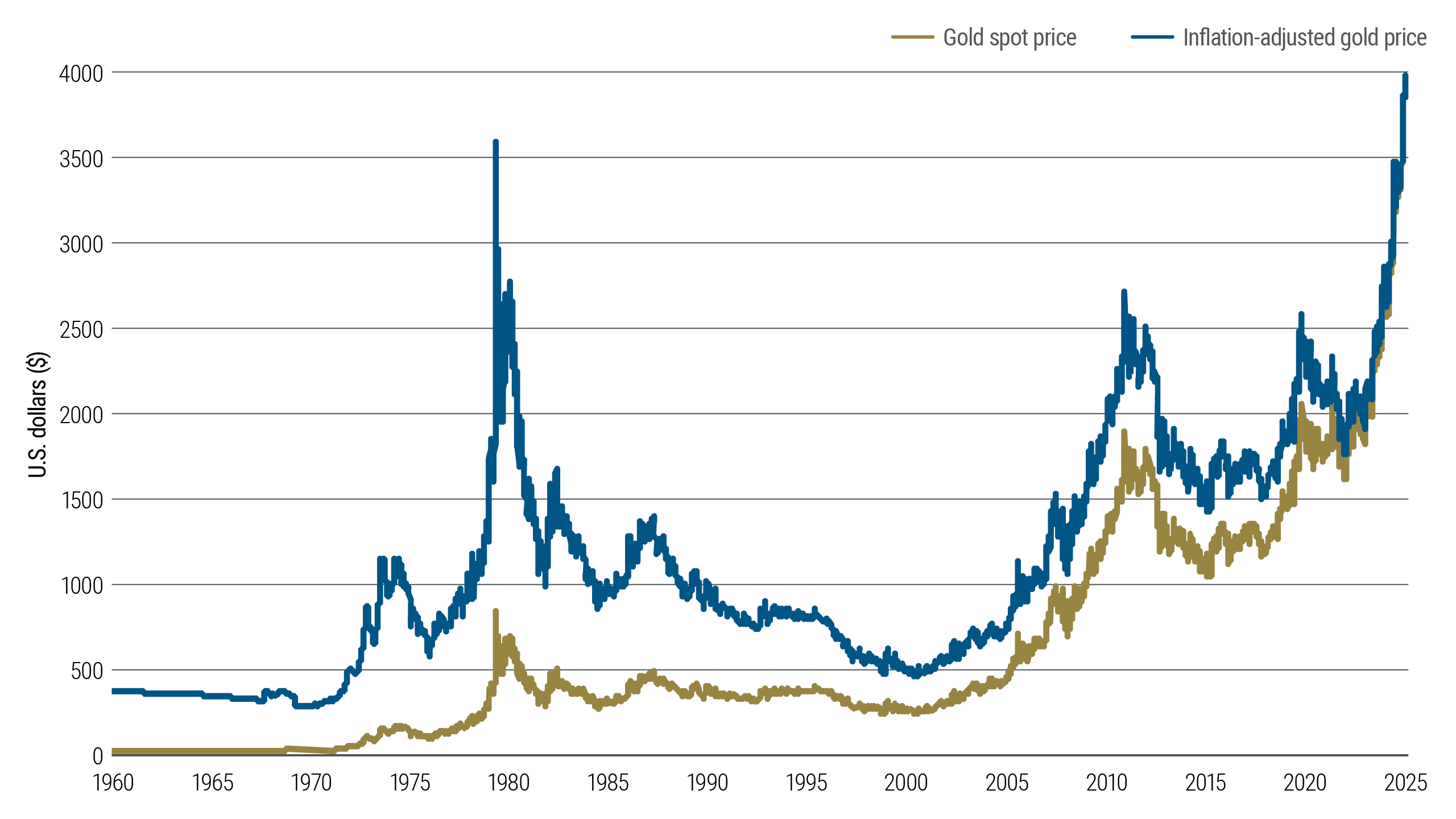
These factors have driven gold (and silver) to the highest nominal price levels in history, and for gold, to the highest real price in the past 45 years (see Figure 1).
Figure 1: Gold set a new inflation-adjusted peak in 2025 More Info
Source: Bloomberg and PIMCO as of 7 October 2025
Gold isn’t the only attractive real asset today
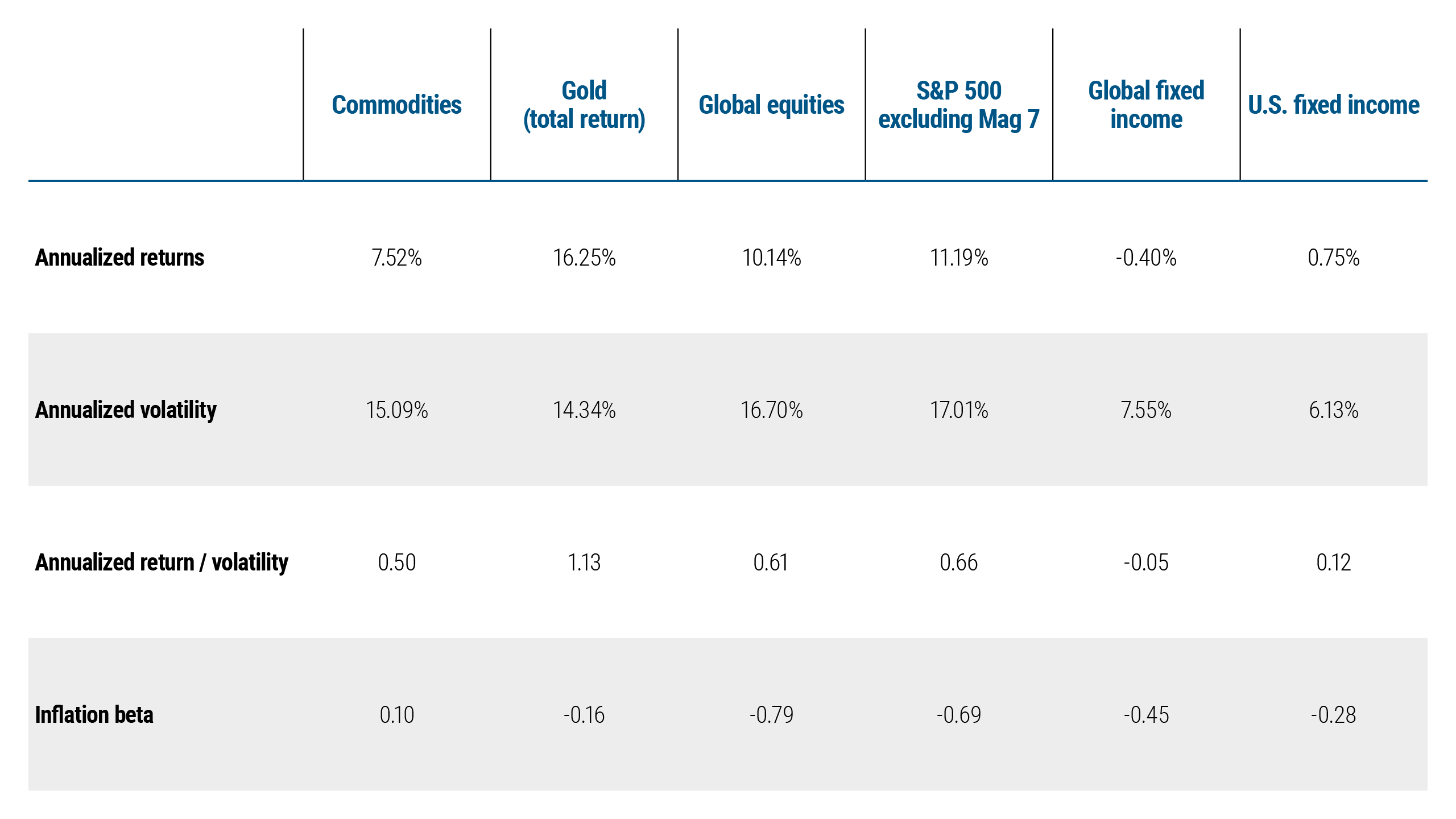
Investors in gold likely reaped considerable benefits during the recent inflationary period, and many of the catalysts supporting gold’s rise are likely to persist. However, gold is not the only real asset that shines brightly as an investment: Broad commodities have outperformed fixed income since 2020, and only marginally trailed global and non-tech U.S. equities (see Figure 2) – with less volatility.
Figure 2: Return and risk data since 2020 highlight appeal of broad commodities More Info
Source: Bloomberg and PIMCO data from 31 Dec. 2019 through 30 Sept. 2025. Asset class proxy indices are as follows: commodities – Bloomberg Commodity Index Total Return; gold – Bloomberg Gold Total Return Index; global equities – MSCI World Index – Global Equities; S&P 500 (proxy for U.S. equities) excluding “Magnificent 7” tech firms; global fixed income – Bloomberg Global Aggregate Total Return Index; U.S. fixed income – Bloomberg US Agg Total Return Index. Inflation beta is defined as the sensitivity of an asset’s return to inflation surprises.
Structural trends bolster commodities: green energy, AI, capex discipline
Commodities’ strong performance this decade does not come as a surprise. Several structural themes are shaping commodity returns, and in our view, will continue to provide tailwinds: the green energy transition, the artificial intelligence (AI) boom, capital allocation behavior from commodity producers, and elevated geopolitical and trade tensions.
The green energy transition is a source of secular demand for both industrial metals and energy. Wind farms, electric vehicles, and solar photovoltaic plants require more minerals to build than their fossil fuel counterparts. For example, an onshore wind plant requires nine times more mineral resources than a gas-fired plant.
As such, demand growth for the raw resources to support the transition will likely remain positive. For perspective, China used to account for nearly 60% of global industrial metals demand. Then a real estate recession significantly stunted that demand. However, the shift was notably offset by rising demand for resources supporting the global energy transition – and demand growth has remained positive, albeit at a slower pace.
Furthermore, the AI-driven transformations in the global economy create an additional demand tailwind as they require massive expansion in the supporting infrastructure – data centers, utilities, and energy capabilities – which in turn require massive amounts of resources such as industrial metals and traditional and renewable energy.
On the supply side, global investment in industrial metals and traditional energy supplies has been declining for several years. Global metals capex as a share of revenue is at a multidecade low. Mining companies have made record dividend payments instead of massive investments in projects that could take years to become profitable. And mining projects that used to take five years now take 10 years or more due to their negative impact on the environment and social issues. In energy, poor performance by U.S. shale corporates in the 2010s led many energy companies to prioritize balance sheet repair and returning capital to investors, which has capped the rate of production growth. Most energy producers today reinvest the lowest share of free cash flow into production capacity.
Finally, ongoing uncertainty in geopolitical hotspots, including areas that produce significant raw resources and provide processing and shipping, is a secular driver generally bolstering commodities – albeit with considerable volatility as well.
Investment takeaways: Commodities are compelling
For investors seeking to capitalize on these secular trends, hedge their purchasing power, and diversify their portfolios, broader commodities may be a compelling allocation and a complement to any gold exposure.
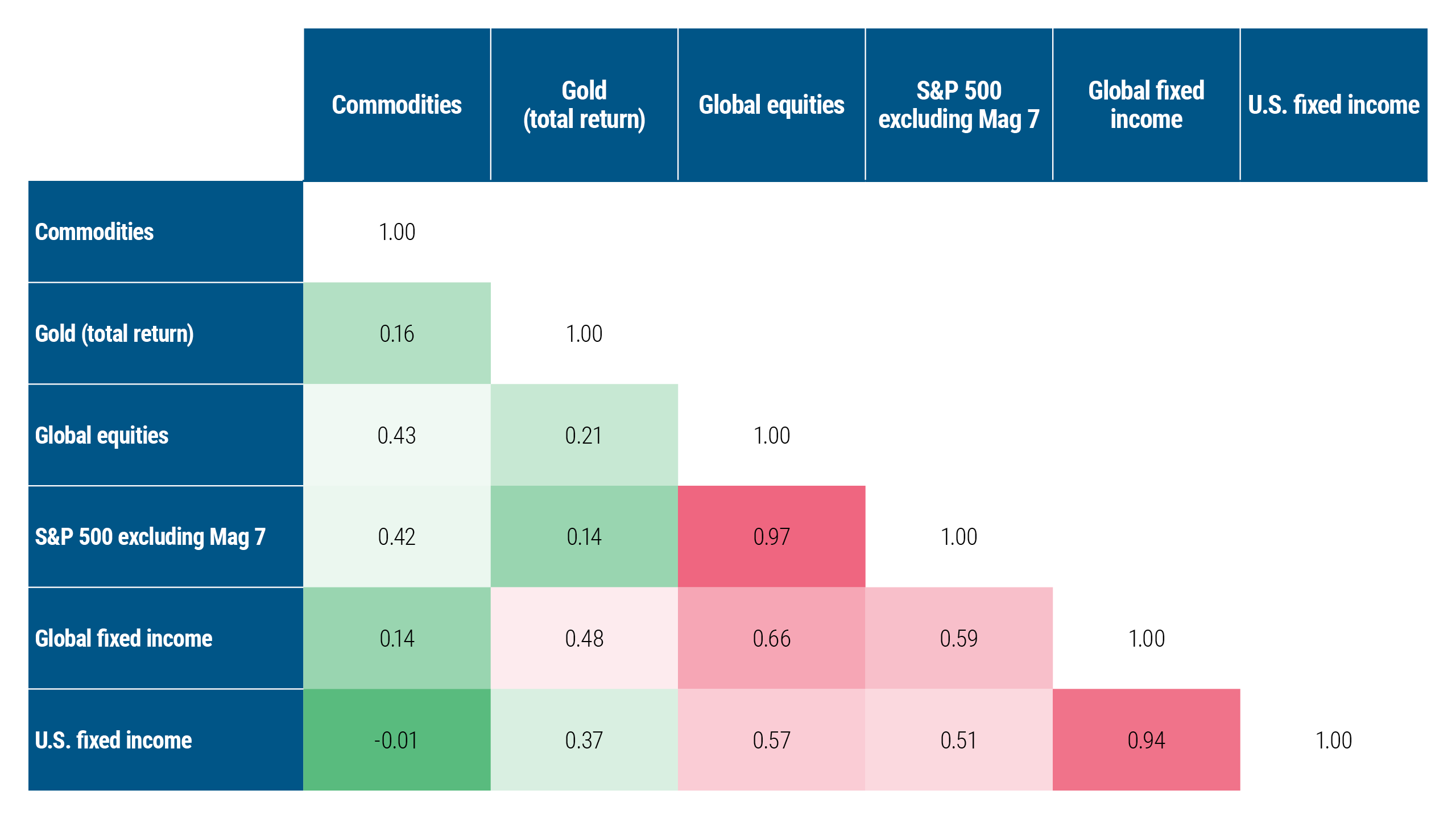
We believe this is especially true for diversifying versus fixed income. While gold has a low correlation to equities, its correlation to fixed income is less muted given its inverse relationship to real yields (see Figure 3; learn more in our piece on understanding gold prices). Conversely, broad commodities have a minimal correlation to fixed income as well as a significantly greater sensitivity to inflation surprises relative to gold, as well as to nominal assets (see the inflation beta shown in Figure 2, above) – lending emphasis to commodities’ resilience as an inflation hedge.
Figure 3: Return correlations across key asset classes since 2020 show diversification appeal of broad commodities More Info
Source: Bloomberg and PIMCO data from 31 Dec. 2019 through 30 Sept. 2025. See Figure 2 for asset class proxies.
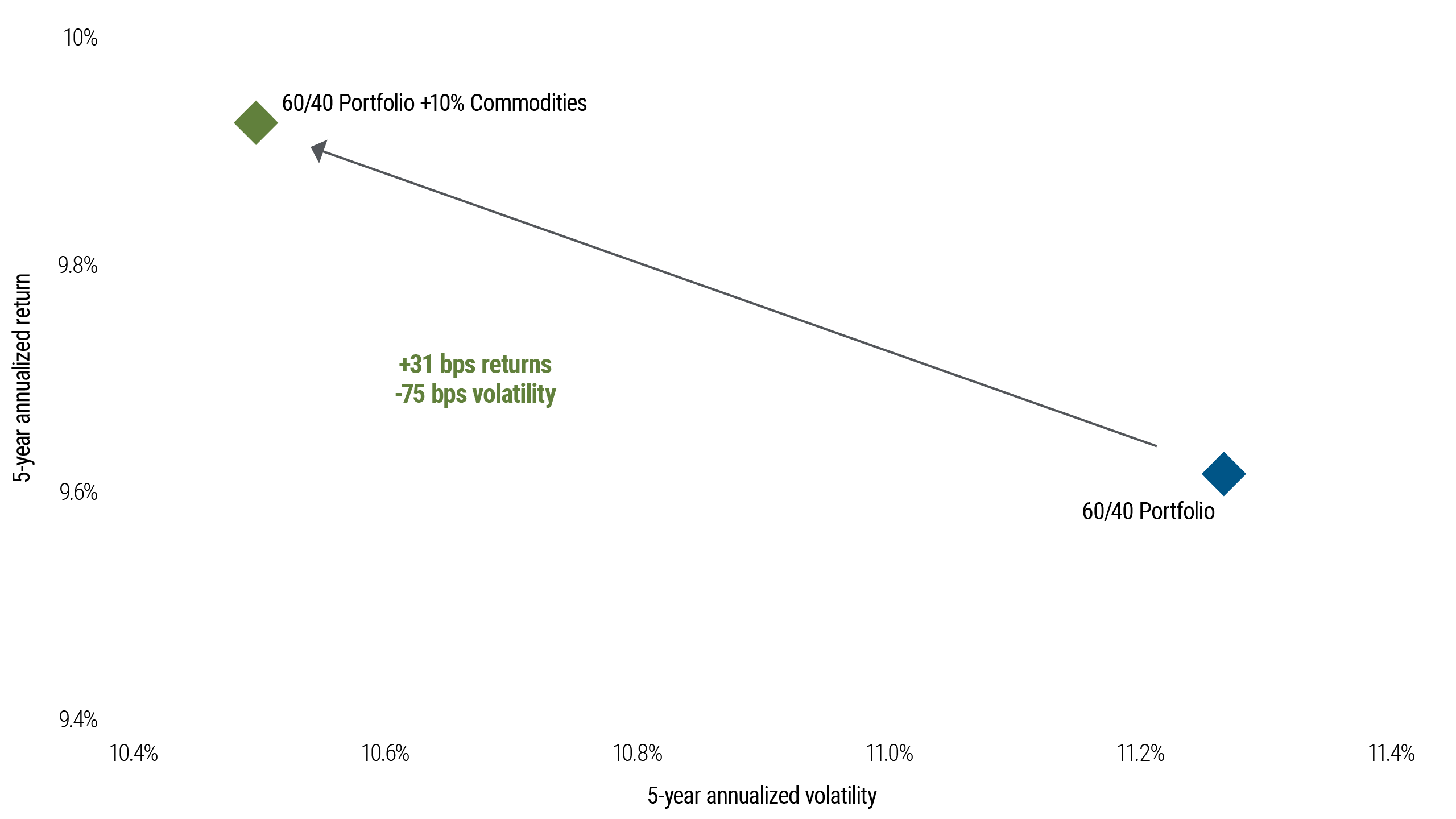
Macroeconomic and market developments across the global economy this decade have offered a real-world example of the textbook case for hedging inflation via both commodities and gold. Historically, adding commodities has tended to improve portfolio returns and lower overall portfolio volatility versus a traditional 60/40 portfolio of equities and fixed income (see Figure 4).
Figure 4: Commodities have helped boost portfolio returns while trimming volatility More Info
Source: Bloomberg and PIMCO as of 30 September 2025. Calculations are based on a 10% addition of commodities sourced from bonds in a 60/40 portfolio (60% stocks proxied by S&P 500 Total Return Index and 40% bonds proxied by Bloomberg US Aggregate Total Return Index).
History has shown that inflation does not need to be rising or even particularly high to warrant owning liquid real assets, and that in periods when inflation is just above the central bank targets, real assets may demonstrate their benefits of not only reducing volatility but supporting returns. While we all know that past performance does not guarantee future results, we expect the secular forces of recent years to persist, underpinning commodity returns for years to come.