In his 2024 book Co-Intelligence, Ethan Mollick asks: “If AI is already a better writer than most people, and more creative than most people, what does that mean for the future of creative work?” (p. 117). This question highlights what sets generative artificial intelligence (AI) apart from earlier technologies. Generative AI can create text, images, video, and code from a single prompt. However, people still need to guide the process, check the quality of the output, fix mistakes, and take responsibility for the final result. Mollick calls this setup the “human-in-the-loop” model.
Generative AI can handle many tasks that usually require skills common among highly educated workers. AI might support these workers’ expertise, or it could replace them by taking over some of their tasks. Research shows that working with AI can boost performance. For example, GenAI can help with creative problem-solving, make customer-support workers more productive, and help consultants finish certain tasks faster and better. However, these benefits are not guaranteed and depend on the specific task. AI has a “jagged” technological frontier, meaning it does some tasks very well but struggles with others just outside the frontier. For example, today’s AI models can excel in mathematical competitions but cannot correctly tell time.
As AI starts to do tasks that people used to see as uniquely human, it raises questions about more than just productivity and jobs. It also makes us think about what makes work meaningful and worthwhile. Meaningful work is important for well-being, effort, and labor supply. If AI generates the idea or creates the first draft and people only review and improve it, will they still feel their work matters? And will they still want to put in effort?
In our new working paper, we present what we believe is the first causal evidence on these questions. We ran the same preregistered experiment in nationally representative surveys in the United States (N=1,511) and the Netherlands (N=2,117). Both countries have high rates of AI use at work: 43% of U.S. workers and 36% of Dutch workers say they use AI on the job. Since the surveys used similar structures and methods, we could analyze the results together. The experiment produced similar effects in both countries, and pooling the results increased our statistical power.
We told participants about a small public health issue: many people do not drink enough water. Then, we asked them to help come up with a campaign slogan to encourage healthier drinking habits. Before showing them any slogans, we asked how meaningful they thought the task was. On average, participants in both countries rated the task’s meaningfulness at about 5 on a scale from 1 (“not at all meaningful”) to 7 (“extremely meaningful”).
After this first question, participants looked at three campaign slogans. We randomly told half of them that a marketing professional made the slogans, and told the other half that AI marketing software made them. Both groups saw the same slogans and rated their creativity and persuasiveness using definitions we provided. By keeping the slogans the same and only changing who we said made them, the experiment shows the effect of attributing creative work to AI.
After participants rated the three slogans, we asked again how meaningful they thought the task was. For each person, we measured the change in task meaning by subtracting their second rating from their initial one. By comparing this change between the AI-label and human-label groups, we could see the effect of attributing the work to AI.
At the end of the experiment, we gave participants the option to propose their own slogan. Because this contribution required additional voluntary work, we used it as our measure of effort. This allows us to test whether attributing the earlier creative work to AI makes participants more or less willing to contribute an idea of their own.
Respondents found the task less meaningful when they thought that the slogans were AI-generated (Figure 1). Compared to the human-label group, the AI-label group saw a drop in task meaning of about 0.07 standard deviations. Respondents in the AI-label condition were also less willing to contribute a slogan of their own by 3.4 percentage points. Because 26% of participants provided a slogan—and some were remarkably creative—the estimated effect is substantial: a 13% decrease relative to the baseline.
The differences in effort we find might help explain why AI’s big productivity gains in experimental studies have not yet led to large improvements in overall economy-wide productivity. Delays in putting AI into practice are part of the reason, but our paper suggests worker motivation also plays a role. If AI helps people produce more but makes them less motivated and willing to put effort, organizations might not get all the benefits AI can offer. While our experiment does not directly test this bigger economic idea, it points to a mechanism that needs more attention.
Figure 1: The effect of AI attribution on task meaning and effort
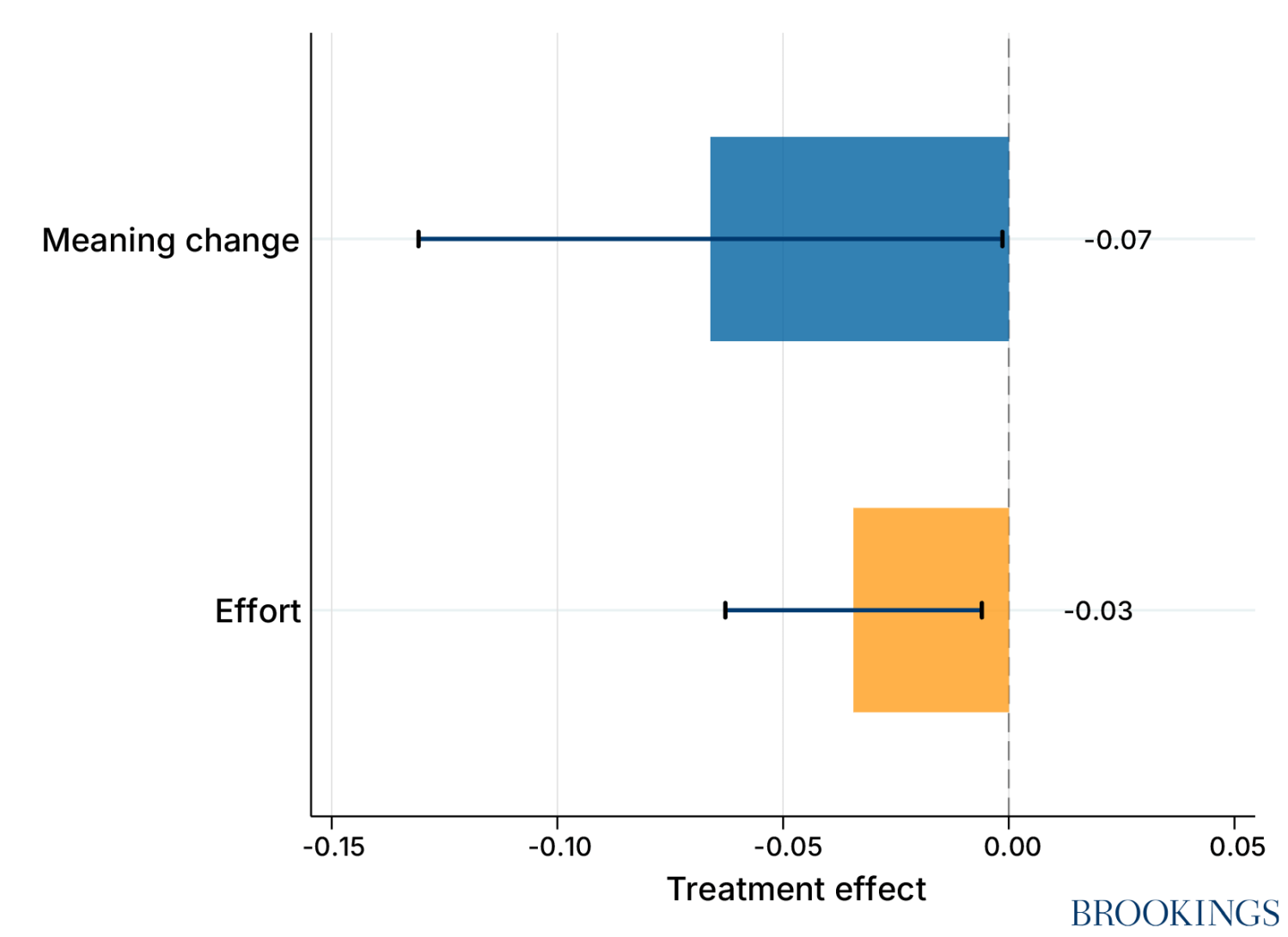
Notes: Authors’ calculations based on data from Nikolova et al. (2026) for the combined samples from the Netherlands and the United States. Meaning change equals post-treatment task meaning minus pre-treatment task meaning and is standardized. Effort is a binary variable that indicates the probability of providing a slogan idea. The bars show OLS estimates of the effect of AI-labeled rather than human-labeled output. Error bars show 95% confidence intervals based on robust standard errors. Both models control for age, gender, education, employment status, marital status, household income, and the Dutch-sample indicator.
The label (AI vs. a marketing professional) also affected how participants judged the quality of the slogans. Respondents rated the same slogans as less creative and less persuasive if they were AI-labeled (Figure 2). Those in the AI-label group also reported less trust in AI’s ability to make creative and persuasive slogans. So, participants judged both AI and its output more harshly, even though the slogans were the same.
Although our findings are interesting, they should be interpreted with care. The experiment looked at a short but realistic creative task, not a full work process in a real organization. Participants judged output labeled as AI-made, but did not work directly with an AI system. Furthermore, although the task-meaning results are small, the effect sizes for effort are sizeable. Overall, our findings imply that simply labeling work as AI-generated can change how significant individuals find a task and how much they want to contribute to it. Even small effects could add up if workers see AI-generated output often.
Consequently, our results highlight a challenge for organizations adopting AI. Improving technical performance may not suffice if workers lose a sense of ownership over the task or see little value in adding their own ideas. Employers should therefore design human-AI workflows that preserve human agency, make individual contributions visible, and give workers meaningful responsibility for the final output. The central question is not only what AI can do, but also whether people still feel that their own contribution matters.
Figure 2: The effect of AI attribution on trust and slogan quality evaluation
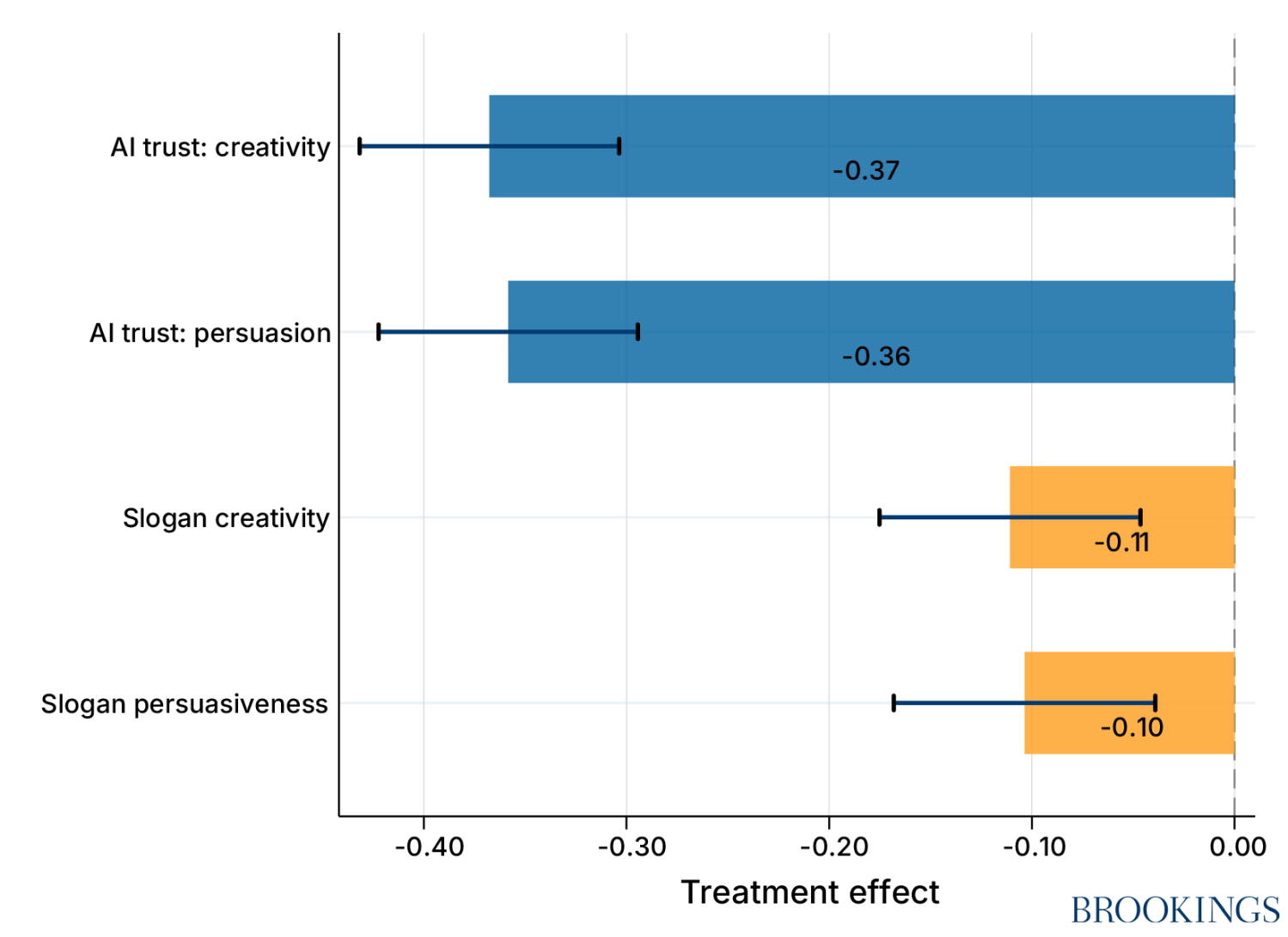
Notes: Authors’ calculations based on data from Nikolova et al. (2026) for the combined samples from the Netherlands and the United States. The figure shows OLS estimates of the effect of AI-labeled rather than human-labeled output on trust in AI and assessments of slogan creativity and persuasiveness. Creativity and persuasiveness scores represent averages across the three slogans. All outcomes are standardized. Error bars show 95% confidence intervals based on robust standard errors. Models control for age, gender, education, employment status, marital status, household income, and the Dutch-sample indicator.
This brings us back to Mollick’s question about the future of creative work. Our results do not show that AI will make work as a whole less meaningful. However, they do suggest that people may find particular tasks less important and put in less effort if they think AI has already done the creative work, even if they do not trust AI or like its output. For human-AI collaboration to succeed, it is important not only to improve AI’s abilities, but also to give people a clear reason to stay involved.