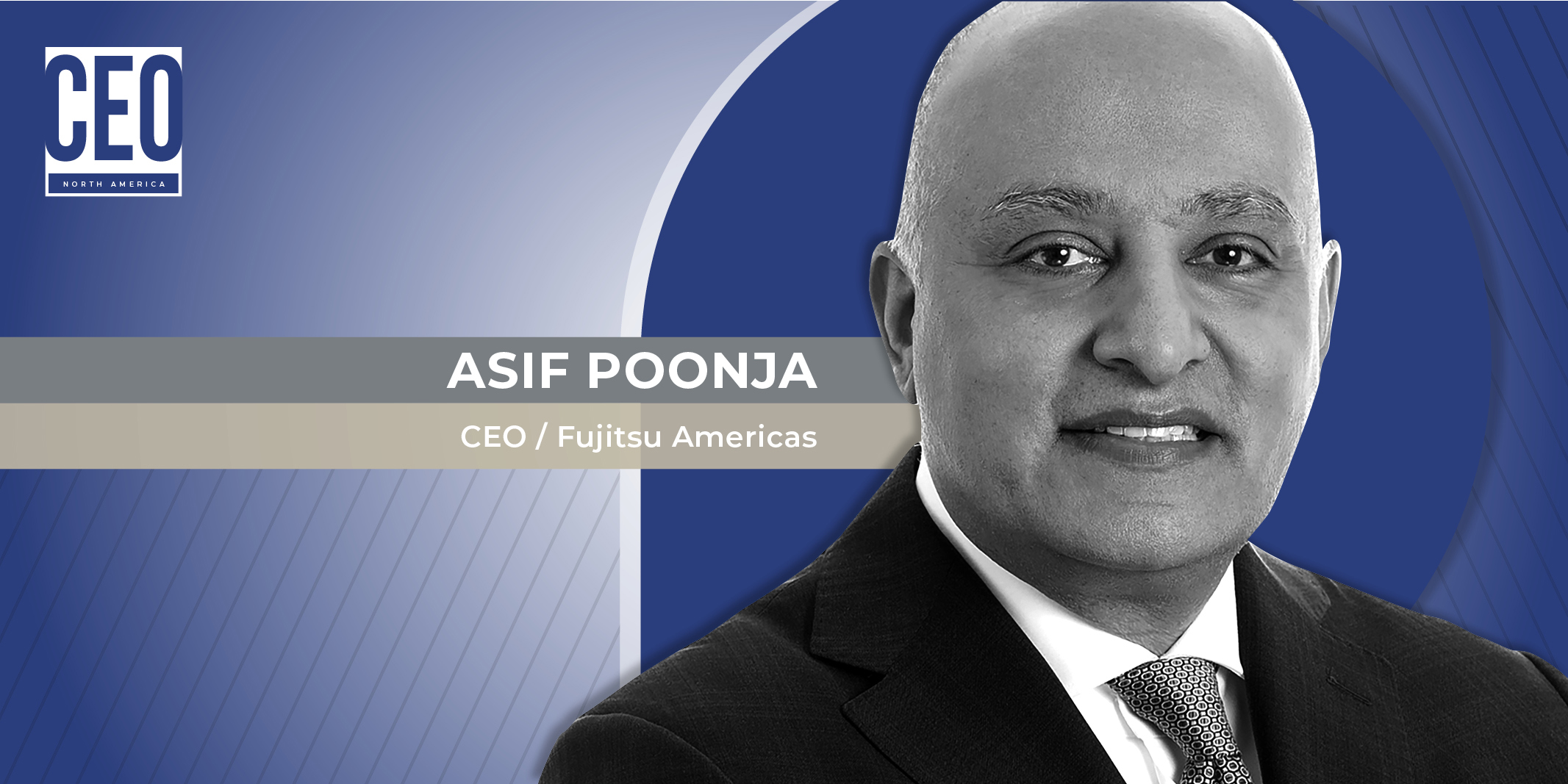
Asif Poonja
CEO / Fujitsu Americas
Fujitsu Americas CEO Asif Poonja explains how a leaner, services-only business, backed by a Japanese technology giant, plans to go from challenger to market shaper.
Three years after pulling Fujitsu’s Americas business out of hardware and pivoting entirely to services, CEO Asif Poonja is ready for a bigger fight. He is realistic about where the company stands. Globally, the Japanese group is a tech heavyweight and a key architect of the global modern economy; in the Americas, it’s fighting much larger consulting and IT giants. Poonja, who took the top job in April 2023 after nearly a decade with the firm, wants to close that gap.
“We’re large globally, but we’re smaller compared to some of the big players in the Americas,” Poonja tells CEO NA. “But our ambition is not to just participate in the Americas technology market. We actually want to shape it.”
When he took the helm, the former chief technology officer and head of customer markets had just completed a massive transformation. Fujitsu had exited products, data centers, retail hardware and field services, roughly half its regional business, to focus almost entirely on services. The next chapter was execution, built around Fujitsu Uvance, a global model focused on consulting and rebuilding corporate operations to survive a volatile, AI-centric market.
Now, the company has entered a new phase: expanding that model consistently across the region.
Fujitsu has invested more than $20 million in the Americas over the past year to strengthen its consulting and business capabilities, and it is drawing on the group’s research in AI and quantum computing. It has also brought its global delivery unit more closely into regional work, with the aim of combining local market knowledge with Fujitsu’s global reach.
“We want to expand also from individual technology projects at a customer to long-term business partnerships. So how can we be in a managed service environment or an application service environment over a 3-, 5-, 7-year term?”

“How many companies can bring all of those together into one?” he says. “There’s not many out there.”
Scaling in a Turbulent Market
That scaling push is unfolding in a tough environment for IT services. Large global consultancies such as Accenture are experiencing heightened volatility as the sector navigates AI disruption. At the same time, large Indian outsourcing firms are under pressure as geopolitical and economic shifts change how clients buy technology, and as AI reshapes the foundations of the industry.
For Poonja, this fallout hits close to home. Canada and the US, which “used to be best of friends,” now show markedly different buying patterns, he says. On recent visits to US manufacturers, he saw both sides of the trade fight. One steel producer, with an all-domestic supply chain, is seeing strong momentum. Another, located near the border, is struggling because several of its products come in from Canada and now face 50% tariffs.
“These are challenges we’re working through with the customers,” Poonja says. But Fujitsu’s answer isn’t to lead with the technology.
The company focuses on the client’s business problem, and once the challenges are clearly defined, Poonja’s team brings in the tools to solve them, from consulting and modernization to AI and delivery capabilities across the group.
Poonja says that discipline is easier to apply now that the hardware businesses are gone and the Americas strategy is more closely aligned with the global organization.
With fewer distractions, Fujitsu Americas is better able to navigate geopolitical challenges and absorb shocks.
“We’re 100% or 99% services business, so we know what we’re doing,” he says. Fujitsu’s breadth, from consulting to global delivery to core research, is what Poonja believes sets the company apart. It also lets the Americas operation balance its bets at a moment when clients are cautious and seeking to mitigate risk.
Global uncertainty is rewriting the rules for IT services. Tariffs, trade spats and the AI explosion have broken the industry’s old pecking order. Some firms are thriving; others are stuck. Poonja isn’t sugarcoating the challenge for Fujitsu. He points out that while some competitors are barely keeping their heads above water, firms such as Deloitte and Cognizant are flying. “I think it’s how you play it,” he says.
“We want to be stronger. We want to build more scale. And we want to continue to think about differentiated services.”
Bringing Global Scale to Local Challenges
Poonja is taking cues directly from Tokyo’s new playbook. Fujitsu recently replaced its three-year planning cycle with a 10-year plan called Management Vision 2035, launched in May this year. One of its pillars is building global industry lines, so that expertise developed in one region can serve clients facing the same problems elsewhere.
“One government, or one manufacturer, or one financial services company in one part of the world has the same issues in another part of the world,” Poonja says.
In the Americas, Fujitsu’s strengths include public-sector work in Canada, manufacturing in the US and financial-services work for Japanese companies operating in the US. In the Caribbean, Poonja points to government projects, including work in Trinidad and Tobago and Jamaica.
The executive wants to connect those businesses with Fujitsu’s much larger operations in Japan, where public-sector work alone is a huge business. He recently took a group of government officials to Japan “to share with them the world of the possible.”
The goal, he says, is to share stories, resources and talent across regions, so that local economic swings don’t limit what Fujitsu can deliver. And when the regional team doesn’t have an answer, the global network can bring an expert in.
Fujitsu’s Japanese heritage is an asset in itself, Poonja argues, particularly as trade relationships are reconfigured. Japan is a major trading partner for both Canada and the US. When Prime Minister Mark Carney led a large Canadian delegation to Japan earlier this year, Fujitsu hosted one of the visit’s major events.
“There are those ties that can help, being a Japanese company. Not a Canadian, not a US, not a Caribbean company, but kind of outside the realm, and having a good relationship across,” he says.
Clients also value Japanese standards of execution and governance once they get to know the company, Poonja says. “I think our bigger challenge is getting to know us. But once they get to know us, it’s incredible.”
“Great product and service earn the margin. Disconnected systems quietly give it back. Fujitsu brings decades of retail operating knowledge and GK’s store technology; ServiceNow brings the platform underneath it. Together we’re building stores that protect those margins and absorb whatever comes next.”
Ellie Quartel / AVP, Retail Industry GTM, ServiceNow
A Disciplined Path to Growth
Acquisitions remain part of the plan. Fujitsu has yet to make a major purchase in the Americas, but Poonja says there has been a lot of work behind the scenes. The company wants more scale and more differentiated services, and it’s being selective.
He points to GK Software, the German retail cloud company Fujitsu acquired in 2023, as an example. Fujitsu is now helping GK’s US division scale and exploring what else the group can add in the retail sector.
This slow approach is intentional, meant to shield the Americas operation from a chaotic market. For the past year and a half, the tech sector has been drowning in noise about how software-as-a-service is dying, or how AI will wipe out offshore developers. The whiplash has led many executives to move more cautiously on large acquisitions. Poonja says he is betting on the technology market stabilizing, even if the geopolitical landscape stays volatile.
“We’re not willing to do growth at any cost,” he says. “If it means waiting a year or two, and we continue down the organic engine, we’re okay with that. We want to do it the right way and not make a mistake.”
The organic engine is changing too. Fujitsu is shifting from traditional sales teams to consultative conversations led by architects and forward-deployed engineers, a model it has tested with several clients over the past few years. “The model’s sticking,” Poonja says.
He also wants more of the business to come from long-term partnerships, managed services and application services contracts running three, five or seven years, rather than one-off projects. Supporting a client’s operations day to day, he says, lets Fujitsu learn the business and suggest improvements, instead of moving “in, and then out.”
Artificial intelligence underpins every facet of this strategy. While large-scale SAP implementation remains a cornerstone of Fujitsu’s regional workload, Poonja views legacy setups as obsolete. “SAP without AI, to me, is meaningless,” he says. The company is leaning on its proprietary AI toolsets to aggressively automate data scrubbing, speed up deployments and compress testing cycles. The ultimate goal is a dramatic reduction in project timelines. As Poonja puts it: “A project that might take 14 months, can we do it in 9 months?”
“What we’re trying to do now is bridge the gaps across regions, because one government, or one manufacturer, or one financial services company
in one part of the world has the same issues in another part of the world.”
Fewer and Deeper Partnerships
Streamlining the business has made partners more important, Poonja says. Fujitsu’s recent wins with the governments of Jamaica and Canada, and its work in Trinidad and Tobago, all involved partners. Fujitsu was the prime contractor and did most of the work, while specialist partners filled specific gaps.
At the global level, Fujitsu is moving toward signing partner agreements once, rather than negotiating them region by region, Poonja says. That means the talks happen between senior executives on both sides. Those relationships pay off in ways that go beyond cost, he says, from extra resources and specialized talent to direct access to a partner’s senior executives when a critical deal stalls.
In the Americas, Poonja has become more selective about who makes the inner circle. Fujitsu used to count six strategic global partners in the region. Poonja narrowed the top tier to three, after two of the six “weren’t stepping up.” “It was a one-sided conversation,” he says. “It was wasting our time.”
What he wants instead, from partners and clients alike, is commitment that lasts. Poonja recently visited a West Coast client that has worked with Fujitsu for more than 15 years and brings in millions of dollars in revenue a year. “How many customers do you have like that in the services space?” he asks.
That’s the kind of relationship he wants to multiply across the region. Three years ago, Fujitsu Americas had to shrink to find its focus. Now, with that focus in place and the weight of the global group behind it, Poonja is aiming higher: using technology, particularly AI, to help clients modernize, grow and transform, and stay with them for the long haul.
“That’s really the desire that I’ve put in front of our leadership team,” he says, “and that we’re driving right now.”