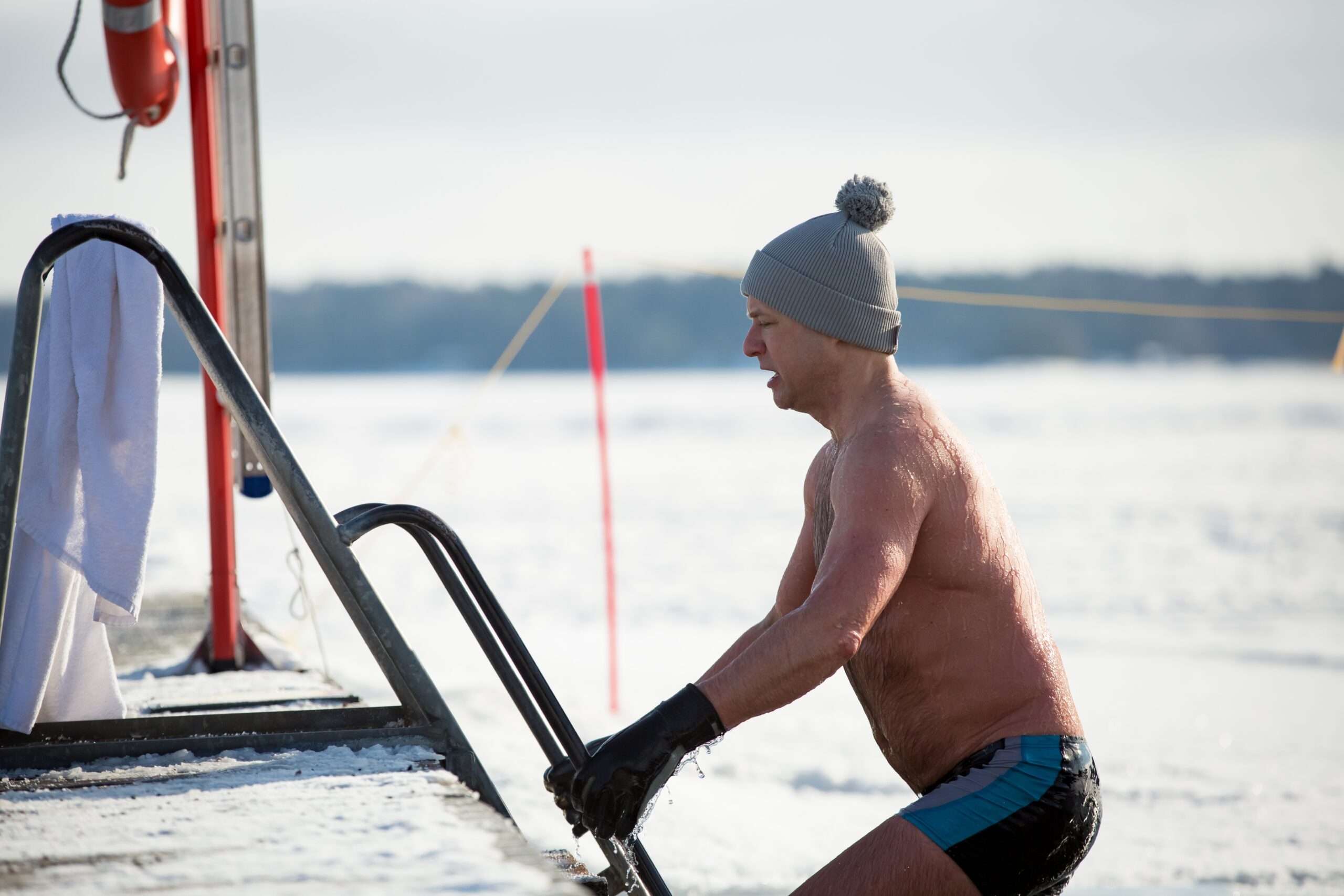
It’s a February afternoon in Helsinki, and I’m standing at the edge of a dock in my bathing suit. My heart starts to thump even before I see the dry-erase board listing today’s water temperature: 1 degree Celsius (33 degrees Fahrenheit). This will be my coldest dip yet, I realize, as I spot stray sheets of ice floating a few feet away. Donning a wool hat and neoprene booties and gloves, I drop my robe and descend the steps into the Baltic Sea. I gasp as the water touches my legs, and it’s not until I’m halfway in that I remember to breathe.
“You’re doing so great,” Katja Pantzar calls out encouragingly, already up to her neck in the water. While this is not my first cold plunge, it is my first time winter swimming with Pantzar, who inspired me to try my first cold water dips in Helsinki seven years prior. Finnish born and Canadian raised, Pantzar moved to Helsinki more than two decades ago and has swum year-round in the sea nearly every day since.
I take deep breaths through an intense round of pins and needles until I start to go numb. This isn’t so bad, I laugh. After two minutes, we’re both already out of the water. This is when it gets good: a wave of elation passes over me and I start to feel electric, as if a new life force is pumping through me. In mere minutes my body and mind seemingly have sped through extremes, and all that’s left is a rush of euphoria.
For the eighth consecutive year, Finland has been named the happiest country in the world, according to the World Happiness Report. A Nordic country with a third of its landmass above the Arctic Circle, Finland experiences 200 days of winter and two months where the sun never rises above the horizon. But this “natural shock therapy,” as Pantzar calls it, just might be one of the secrets to Finnish happiness despite the dark days and a harsh and fairly inhospitable climate.
The World Happiness Report weighs factors such as healthy life expectancy, freedom to make life choices, a trustworthy government, GDP per capita, social support, and more for its rankings. Finland scores high in these categories, but it’s also Finns’ love for ice swimming that allows them to revel in tough times and find joy in the extremes, Pantzar believes. She credits her daily swims in the sea for helping her to cope with her anxiety and depression, lowering her stress and boosting her energy.
Ice swimming, or winter swimming, is a 300-year-old tradition in Finland and is intertwined with another one of the country’s age-old wellness rituals. Finland is the birthplace of the sauna and the home of contrast therapy—alternating between heating up in a sauna and then cooling down with a plunge in icy waters, or even a roll in the snow. In Pantzar’s latest book, The Power of Hot and Cold: From Sauna to Sea, she shares how this Finnish method of pairing a steamy sauna and a cool dip boosts well-being and a deeper connection to nature and community.
¡Closely tied to the tradition of cold plunging is sisu, a national concept that roughly translates to grit or perseverance (or as Pantzar tells me, being “bad ass”). Sisu is about the pleasure driven from doing something seemingly uncomfortable, like swimming in frozen lakes and the sea. It’s about the joy that comes from doing hard things.
Ever since I first plunged into the icy sea seven years ago in Finland, I’ve become hooked on taking cold plunges when I travel. In Antarctica, I walked into the iceberg-dotted sea from shore on my Hurtigruten cruise not once, but twice. On Vancouver Island, I swam in glacial-fed lakes and rivers with a cold plunge guru at Clayoquot Wilderness Lodge. While visiting my family on Bainbridge Island, Washington, I now take chilly dips year-round in the Puget Sound with the Fire and Flow sauna community. And earlier this year, on my way to Helsinki again, I spent a few days in Oslo jumping into the fjord from the floating saunas on the harbor.
Perhaps humans have become too comfortable, professor Mike Tipton, of the Extreme Environments Laboratory at the University of Portsmouth, suggests. One of the world’s leading experts in the science of cold water immersion, he believes that the growing appeal of cold water swimming worldwide is that it’s a shake-up our bodies need. We control our environment so we’re comfy and sedentary, but this means physiologically we’re unchallenged and unhealthy as we were designed to experience temperature changes, he posits. We need to get uncomfortable—“use it or lose it”—to keep our physical systems thriving.
Cold plunges are the jolt I need to bring me back into the present; whatever I had on my mind is quickly wiped away. For a brief few moments, I’m reminded that no feeling is final, as the poet Rainer Maria Rilke famously said. I’m alive, along with all these other people in the water cheering me on. If this isn’t happiness, then I don’t know what is.