2025 was a rough year any way you slice it: an unstable economy, ravaging climate disasters, the return of President Trump to the Oval Office—and all the chaos that entails—and a viciously divided political climate sporadically punctuated by previously unthinkable violence.
Narrow the focus to the art world and none of those pressures disappear. In fact, perhaps more than ever, the art world seemed intertwined with all of them. The Los Angeles fires were most destructive in neighborhoods where both collectors and artists live; the Trump administration made one of its signature policy planks bringing US museums and arts institutions to heel; advancements in AI technologies swept through creative industries first; and even the particular flavor of market volatility brought on by widespread tariffs seemed tailor-made to upend a globalized art market.
All in all, an exhausting year. But—if you’ll permit me—a bit of hope? For every gallery that shut down or closed a location, another seemed to open. And, as art dealers reminded me all year, when the world gets dark, artists rise to the challenge, leading the way forward. With 2026 slated for a Venice Biennale curated by Koyo Kouoh, as something like a final gift before her passing, perhaps there is a light at the end of this tunnel. —Harrison Jacobs
AI Reveals New Nazca Lines
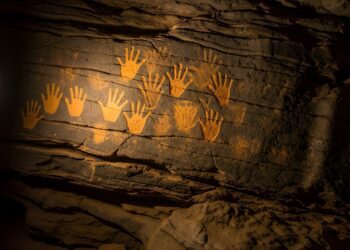
So large most can be seen in their entirety only from the air, the mysterious geoglyphs known as the Nazca lines were created around 2,000 years ago by the Nazca people of Peru. In the century since the giant drawings became a focus of research by modern archeologists, nearly 900 figurative and geometric Nazca glyphs have been identified; most have been discovered through modern technologies such as aerial photography, satellite imagery, and, beginning in 2019, artificial intelligence.
While much recent focus on AI has been on its dangers, it has proved a game changer in the field of archeology. In 2025, an international team of researchers led by Japan’s Yamagata University and IBM announced that since 2022 over 500 new glyphs had been detected using AI trained to search aerial photos. —Anne Doran
The EU Tried to Make Art Tax Sexy—and Succeeded
For nearly a year, Europe’s art market had braced for the impact of Directive 2022/542, a new European Union rule designed to simplify the bloc’s spaghetti-tangle of a VAT system. The directive, which went into effect on January 1, allows member states to apply reduced VAT rates on art sales, provided they remain above 5 percent, while scrapping older, more convoluted systems. Implementation, however, has been uneven. France and Germany wasted no time in adopting reduced rates of 5.5 and 7 percent, respectively. Other nations, including Holland, plan to raise VAT on art, while Italy took its time in finalizing its approach (the Italian government finally bowed to pressure in July, cutting VAT on art sales to just 5 percent, the lowest in the EU).
Lower VAT rates stand to reshape Europe’s art landscape. Dealers have said that even small differences can influence where collectors choose to buy. As dealer Thaddaeus Ropac told ARTnews, Germany’s former 19 percent VAT had long hindered its market, and the slashed rate, now at 7 percent, should shift activity across borders. France’s new, streamlined 5.5 percent VAT replaced its more complex “margin system.” Belgium reduced its VAT to 6 percent for almost all art transactions after dealers pushed back against a proposed 21 percent tax. Supporters of lower VAT argue that art is a cultural good and that its economic spillover outweighs tax losses. Early signs suggest France’s simplified system is already reinforcing Paris’s appeal to international galleries, while dealers at Italy’s Artissima this fall said the new rate boosted sales. —George Nelson
A Nazi-Looted Painting Appears—and Disappears—in Argentina
As in past years, Nazi-looted artworks periodically made headlines in 2025, though only one gripped the attention of the public, largely because the story around it felt stranger than fiction. During the doldrums of summer, a Dutch journalist revealed that he discovered an “unreturned” painting by Giuseppe Ghislandi—its attribution is disputed—in a real estate listing for a home in Mar del Plata, Argentina. That home, it turned out, was owned by Patricia and Alicia Kadgien, the daughters of a former Nazi who died in Argentina, and the painting was once held by Jacques Goudstikker, a Jewish art dealer who fled the Netherlands during the rise of the Nazis. Following the report on the painting, the work quickly disappeared before Patricia ultimately gave it over to a local court. As Nazi-looted artworks go, the painting is neither the most valuable nor the most expensive, but the scandal surrounding it is a reminder that pieces plundered during World War II still remain at large—sometimes in the most unexpected of places. —Alex Greenberger
OpenAI Launches A New Model of ChatGPT and the AI Image Floodgates Open
If last year marked an inflection point in the proliferation of artificial-intelligence tools, with the launch of several sophisticated text-to-video generators, 2025 was the year they blasted into the mainstream. That shift began in March, when OpenAI CEO Sam Altman announced that the company’s flagship platform, ChatGPT, could now produce images natively. Users no longer needed a specialized platform—they could simply use the one they were already hooked on.
The power of the new capabilities was immediately apparent when a Seattle software engineer kicked off a viral trend of transforming images into the style of Studio Ghibli films like Howl’s Moving Castle, Princess Mononoke, and Spirited Away. While there had been AI-generated images that swept the internet before—most notably the 2023 deepfake of Pope Francis in a white puffer jacket—the Ghibli craze was different. It marked a truly native AI meme that captured the zeitgeist, made all the more uncanny given Studio Ghibli founder Hayao Miyazaki’s very clear and well-documented disdain for the technology.
Still, the craze demonstrated the unique power of an AI-driven trend: regular users transformed themselves into Ghibli characters, quickly followed by the White House and the Israel Defense Forces leveraging the technology to circulate Ghibli-fied propaganda. The whole episode made one thing clear: we are entering a new, stranger, and darker digital culture than the one we just left. —Harrison Jacobs
French Crown Jewels Stolen from the Louvre Museum in Paris
On Sunday, October 19, around 9:30 a.m., robbers broke into the Louvre Museum‘s Apollo Gallery using a cherry picker and an angle grinder to steal nine pieces of jewelry worth an estimated $102 million in less than eight minutes. One artifact, a crown once belonging to Empress Eugenie, was dropped outside of the museum during the robbery and, despite sustaining damage, experts believe it can be restored. The eight stolen jewels, however, have yet to be recovered, as four suspects remain in police custody. The Louvre heist both captured global attention and became a symbol of wounded national pride in France for the failure to protect some of the country’s most precious cultural treasures. Though alarms in the Apollo Gallery reportedly functioned properly and went off during the heist, it highlighted the museum’s “very inadequate” and “outdated” security systems. The Louvre now plans to bolster its personnel and cyber security in the coming months and years, but there still remain concerns about how to safeguard cultural heritage, while maintaining a balance of security and access. —Francesca Aton
Read through the full article by Francesca Aton, Andy Battaglia, Daniel Cassady, Maximilíano Durón, Alex Greenberger, Harrison Jacobs, Leigh Anne Miller, Tessa Solomon, Brian Boucher, George Nelson, Anne Doran / ART News