Discomfort, both physical and emotional, can be a major deterrent to self-growth. That’s why plenty of behavioral researchers treat it as an obstacle to maneuver around.
But could discomfort be an important tool for self-development? Cornell’s Kaitlin Woolley and Chicago Booth’s Ayelet Fishbach tested this idea in a series of experiments involving hundreds of subjects, and they find that discomfort can be a motivator rather than an obstacle.
“Instead of seeing discomfort as unrelated to the goal or as a signal to stop, people will start perceiving it as a sign of progress,” the researchers suggest.
Across a field experiment involving the famous Chicago improvisational comedy enterprise the Second City and four online experiments, the researchers asked some participants to seek out discomfort and take it as a measure of progress toward their goal.
In the field experiment, Woolley and Fishbach partnered with the Second City Training Center. They recruited 557 improv students from 55 classes and tested whether instructing the participants to lean into awkwardness or discomfort led them to take more risks. The students in the discomfort group were told that “feeling uncomfortable is a sign that the exercise is working” and that “your goal is to push past your comfort zone.”
Two other groups got different instructions, with one group told simply to “see if the exercise is working” and another to “push yourself to develop new skills and feel yourself improving.” The researchers then watched each class play a game called “Give Focus,” in which one person who “has focus” moves around the room and acts at will while other players are frozen in place. The person who has focus can pass it to someone else after some duration, short or long. Most learning happens when people are holding focus, says Woolley, so the longer they hold it, the more they learn.
Woolley and Fishbach analyzed video recordings of each class. They find that those who were asked to seek discomfort inhabited the focus role longer and took more risks—for example, by walking fast and jumping around rather than walking normally—thus providing evidence that leaning in to the awkwardness allowed them to make more progress.
The researchers replicated the findings in four follow-up experiments involving participants they recruited online. Each scenario that participants were placed in—writing expressively about an important emotional issue in their lives, reading headlines and synopses of COVID-19 news articles, and being open to and reading about political views different from their own—allowed the researchers to examine the role of seeking discomfort. As with the improv setup, the follow-up experiments demonstrate that participants who were asked to seek discomfort were more motivated to continue whichever emotionally difficult task they were asked to do.
No pain, no gain
Participants who were instructed to seek discomfort and see it as a sign of effectively taking in new information were more open to reading the opposing political party’s views than those who were told to learn something new.
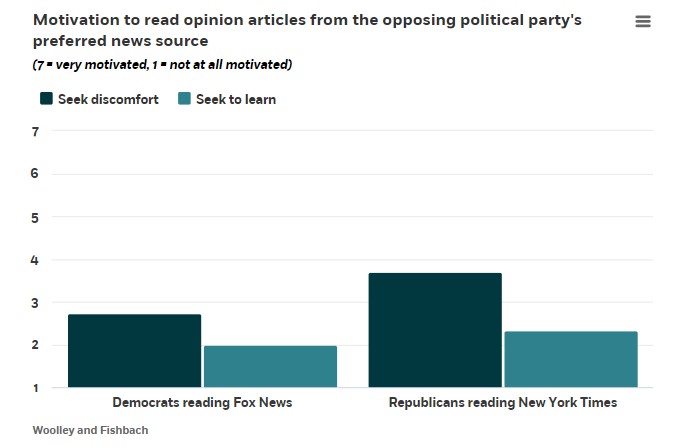
Whereas in three of these experiments Woolley and Fishbach told participants that feeling uncomfortable was a sign the exercise was working, in a final setup, in which participants were asked to read personal statements from victims of gun violence, the researchers included a group who were given no such prompting. In this way, Woolley and Fishbach were able to test whether asking people to seek discomfort automatically prompts them to reappraise those feelings as a form of progress, or whether they have to be told to do so. They find that even these participants—who, unlike the others, weren’t told that discomfort was “a sign of taking in new information”—were more motivated to read about gun violence. This suggests that when people expect an experience to be uncomfortable, they may spontaneously reappraise discomfort as a positive cue, the researchers write.
People are highly motivated by immediate gratification. But many paths to self-growth involve short-term discomfort and long-term gains. So when people can find a positive spin on otherwise negative cues, those cues should become more motivating, the researchers argue.
Woolley and Fishbach make sure to point out the danger of taking it too far. Just like sharp and unexpected pain can be a cue to stop exercising, emotional pain can be a signal to take care with your mental health, they write.
But taken cautiously, adopting a “no pain, no gain” mentality when you know something will make you feel awkward, sad, scared, or uncomfortable can boost your motivation to stick with it.
—
(Courtesy Chicago Booth. By Kasandra Brabaw)