
Concerns about private credit have intensified in recent months. Investors are grappling with questions about weakening credit quality, stale valuations, looser underwriting, redemption risk in certain types of funds, and the impact of AI‑driven disruption. Much of the anxiety has centered on corporate direct lending – especially business development companies (BDCs) and semi-liquid vehicles.
This narrow focus, however, can miss the bigger picture. Private credit is a broader and more diversified asset class, offering a range of differentiated risk exposures. Beyond traditional corporate senior secured lending, private credit spans asset-based finance (ABF) and specialty finance, real estate, and special situations, each with distinct drivers of risk and return. Taken together, these distinctions point to a more nuanced set of investment implications, which can be grouped into a few key themes.
Direct lending fundamentals: Opaque by design, signaling caution by proxy
By design, direct lending portfolios – and private assets more broadly – are not publicly disclosed, which makes it harder to assess their underlying fundamentals. In the absence of transparency, market participants have relied on proxies. BDCs have emerged as a particularly useful reference point, given that they report quarterly and provide relatively detailed information on their holdings.
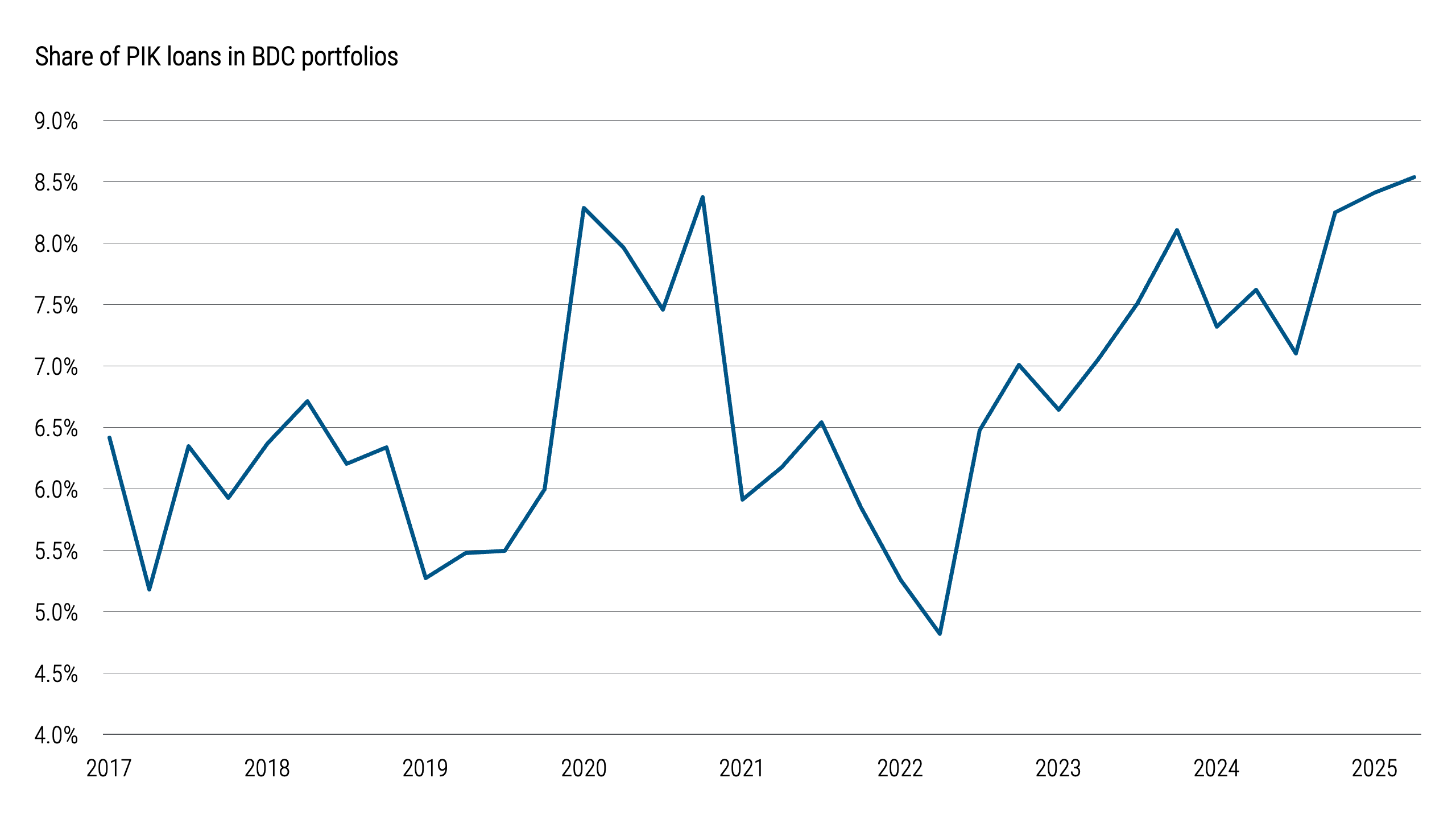
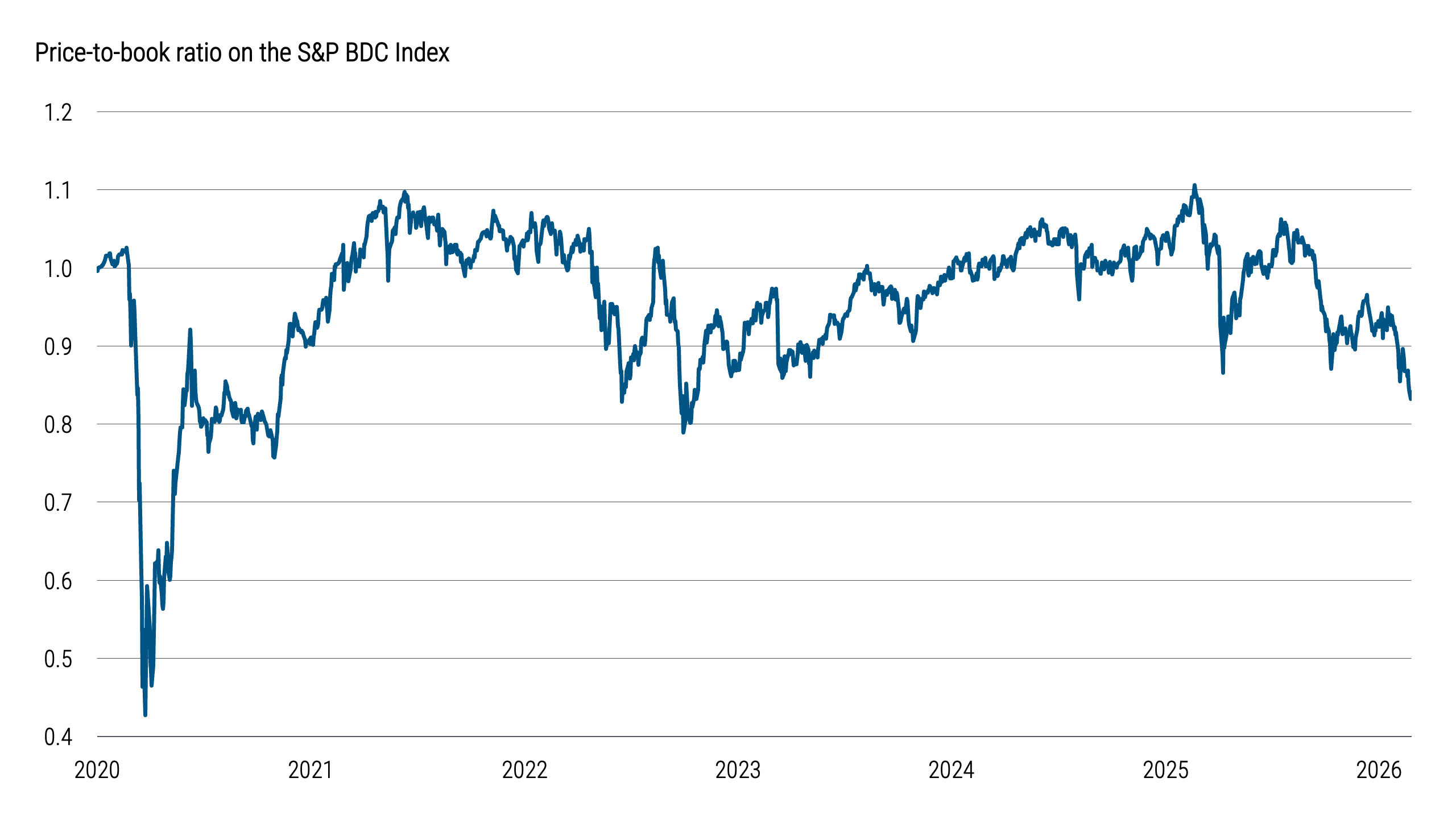
Figure 1 shows that the share of payment-in-kind (PIK) loans, in which borrowers pay interest with additional debt, has been rising since 2022. Meanwhile, recent price action in public BDCs suggests investors are demanding higher compensation to guard against a variety of risks, including potential stale price marks and deteriorating fundamentals. As shown in Figure 2, BDCs now trade at the largest discount to their book value since the post-COVID recovery began.
Figure 1: The share of PIK loans in BDC portfolios rose in 2025 near post-COVID highs More Info
Source: PitchBook LCD and PIMCO as of Q3 2025
Figure 2: BDCs are trading close to their largest discount to book value since the post-COVID recovery started More Info
Source: Bloomberg and PIMCO as of 24 February 2026
Larger deals, software heavy and alpha light
Total assets under management (AUM) in North American direct lending portfolios has increased roughly sevenfold over the past decade, from $93 billion in 2015 to about $644 billion by year-end 2025, according to Preqin. Any asset class that experiences such rapid growth is prone to developing imbalances, and direct lending is no exception.
As capital inflows surged, demand for loans increasingly outpaced supply, fueling greater borrower- and sponsor-friendliness – and thus a gradual weakening of underwriting standards. At the same time, the sheer volume of capital committed to direct lending has supported larger transactions since 2023 – deals that would historically have been financed in the broadly syndicated loan market.
This shift has increased overlap in the borrower base, a dynamic often loosely described as “convergence.” What was once a market almost entirely dedicated to middle-market borrowers has thus taken on quasi-syndicated characteristics, with large deals often underwritten by a group of lenders.
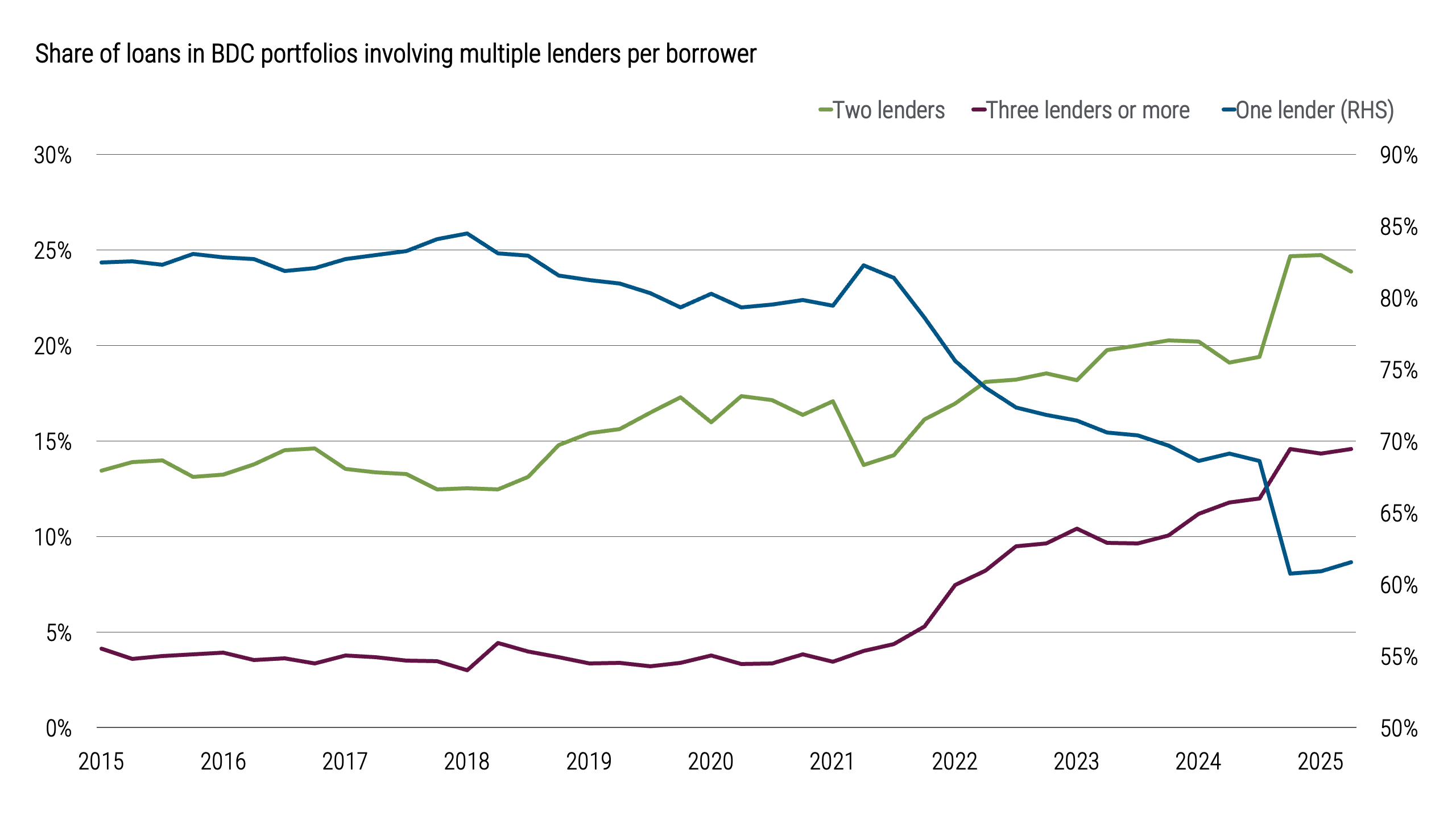
This evolution has mechanically increased portfolio overlap across managers. Here again, BDC portfolio data corroborate this dynamic. The share of traditional single-borrower/single-lender transactions, long the hallmark of middle-market lending, has declined in recent years, while larger loans involving multiple lenders have become increasingly prevalent (see Figures 3 and 4).
Figure 3: The share of traditional single-borrower/single-lender transactions in BDC portfolios has declined More Info
Semi-liquid structures: No systemic threat in U.S., but a wake-up call on selectivity
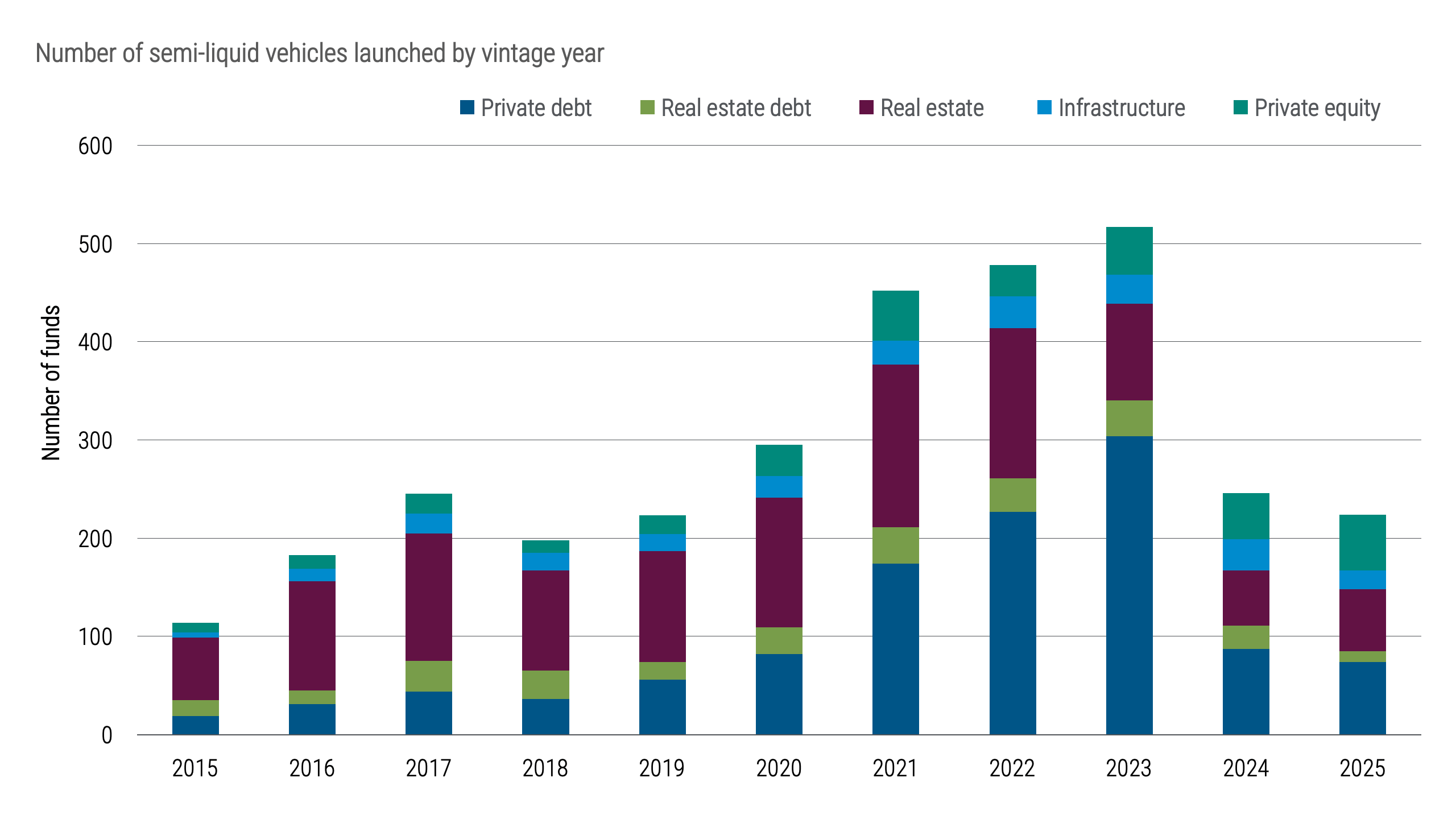
In addition to non-traded BDCs and private real estate investment trusts (REITs), the semi-liquid universe expanded rapidly from 2019 to 2023 to include evergreen and interval funds (see Figure 7). This growth has been driven by the uptick in investors’ appetite to deploy capital into private markets in real time rather than to be constrained by discrete vintage cycles, though the bulk of private assets continue to be largely invested in vintage funds (see Figure 8).
Figure 7: Semi-liquid vehicles have experienced material growth in recent years More Info
Source: Preqin and PIMCO as of December 2025. Non-traded BDCs and private REITs are not included.
Figure 8: The bulk of private market assets remain invested in vintage funds More Info
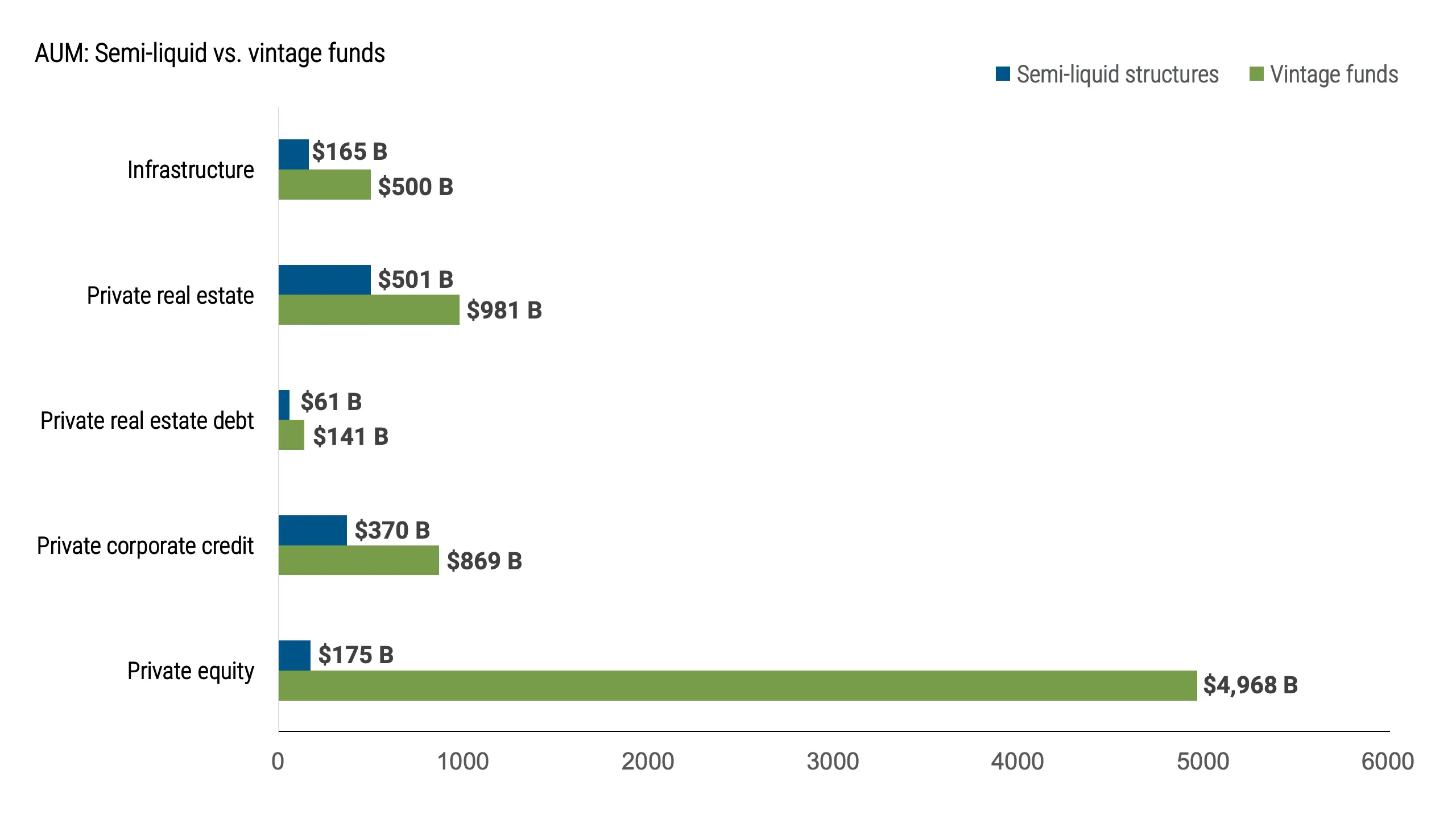
Source: PitchBook LCD and PIMCO as of Q2 2025. Total AUM in semi-liquid vehicles, including non-traded BDCs and private real estate investment trusts (REITs), versus vintage funds. We only include funds with at least $100 million of AUM.
While the risk of a true “bank-run” dynamic in these vehicles is generally low, given explicit contractual limits on redemptions and the ability of managers to gate flows, semi-liquid does not mean fully liquid. As with traditional vintage funds, investors must still assess their own liquidity needs and tolerance for constrained access to capital, particularly during periods of elevated volatility. The recent scrutiny on redemptions in semi-liquid direct lending funds has brought this distinction into focus, underscoring that liquidity is conditional, rather than guaranteed.
What is often less appreciated, however, are the meaningful differences within the semi-liquid universe itself. While these vehicles offer investors the option to deploy capital on a rolling basis, they operate under different regulatory regimes and differ when it comes to giving investors access to liquidity.
By contrast, interval funds eliminate this optionality. Repurchases occur at pre-determined intervals and are capped at a fixed percentage of the stated net asset value (NAV), providing investors with certainty of execution on the terms offered.
To be clear, interval funds are not more liquid. Rather, they are less ambiguous and more transparent: Liquidity is explicitly limited, rule-based, and applied systematically rather than discretionarily.
Private credit’s other lanes still offer value
Private credit extends well beyond direct lending and continues to merit a place in well‑diversified portfolios. As the cycle matures, the relative appeal of ABF as a diversifier is likely to continue to increase, precisely because returns are driven more by collateral and structural protections than by pure earnings growth.
The opportunity set spans a wide range of exposures across the economy, including residential and commercial real estate, consumer credit, and specialty finance. And unlike direct lending, which is predominantly non‑investment‑grade corporate credit, ABF may provide investment‑grade‑like risk profiles that are less capital‑intensive for large allocators such as insurance companies. The result is a large and still underappreciated opportunity where diversification and downside resilience, rather than headline yield alone, underpin the investment case.
Recent PIMCO research using public securitized products as rough beta proxies for ABF – an approach that abstracts from both liquidity premia and manager selection alpha – suggests that potential ABF risk-adjusted returns are not only more attractive than direct lending but also exhibit greater resilience to market downturns and lower sensitivity to fluctuations in risk sentiment, as proxied by equity returns.