Empathy is a customer service superpower. It’s so much easier to get on the same page with a customer if you actually understand, feel, and visualize the customer’s experience.
But here’s a question and concern: Can you actually train employees to have empathy?
Absolutely. Not only can you train for empathy, you can provide tools to employees that will help them convey empathy as well.
You just need to know how.
Try role-playing to experience how a customer might feel.
The way to train for empathy is to solve for the most common barriers that can block it.
Often, customer-facing employees have never experienced anything similar to the situation that’s facing their caller. If this is the case, what’s helpful is to give those employees a chance to walk in the shoes of your customers.
Case in point in healthcare call centers: the employees who answer the phones and provide scheduling may have no shared personal experience of what the person on the other end of the phone line (who is almost certainly apprehensive and very likely in pain) is up against.
These schedulers often work out of separate, nonclinical buildings, and are therefore unlikely to encounter even a single patient face to face.
How to solve this disconnect? The training solution I recommend is to simulate clinical moments using role-playing and video.
Another stumbling block is the challenge involved in recognizing that time may move differently for your customer than it does for us when we are providing customer service to that customer.
Again to use a healthcare example, a patient with a full bladder (and/or in any other kind of discomfort) is going to experience the wait time for relief from a nurse as being far longer than the nurse would naturally experience without developing an empathetic view of the difference in situation.
Training on this and role-playing can go a long way to help cue employees into the pacing of the customer, as well as considering that the situation may call for more urgency than it strikes you as requiring.
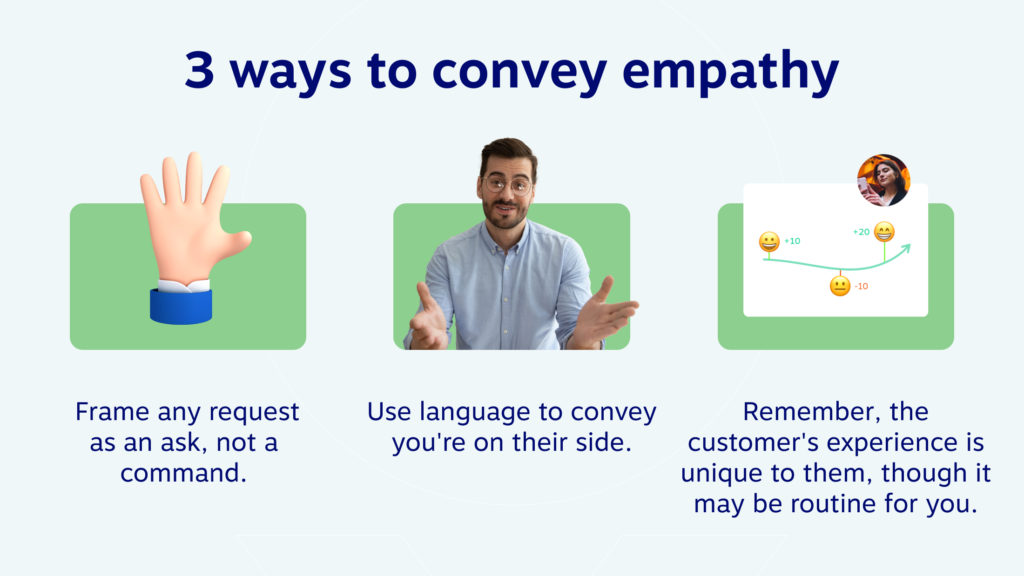
3 practices to convey empathy:
Employees succeed best with customers when they are trained not only to be empathetic but to reliably convey that empathy to their customers.
Here are three ways a customer-facing team member can practice empathy.
1. Frame any request you make to a customer (e.g., for more information) as an ask, not a command.
For example, baldly demanding “Date of Birth?” is less than ideal; “May I have your date of birth?” is a notable improvement, even though it only requires four extra syllables.
2. Pay attention to the language you use with a customer, using language to convey that you’re on the customer’s side.
In particular, watch out for defensive language that may crop up, and practice replacing it with a better choice of words.
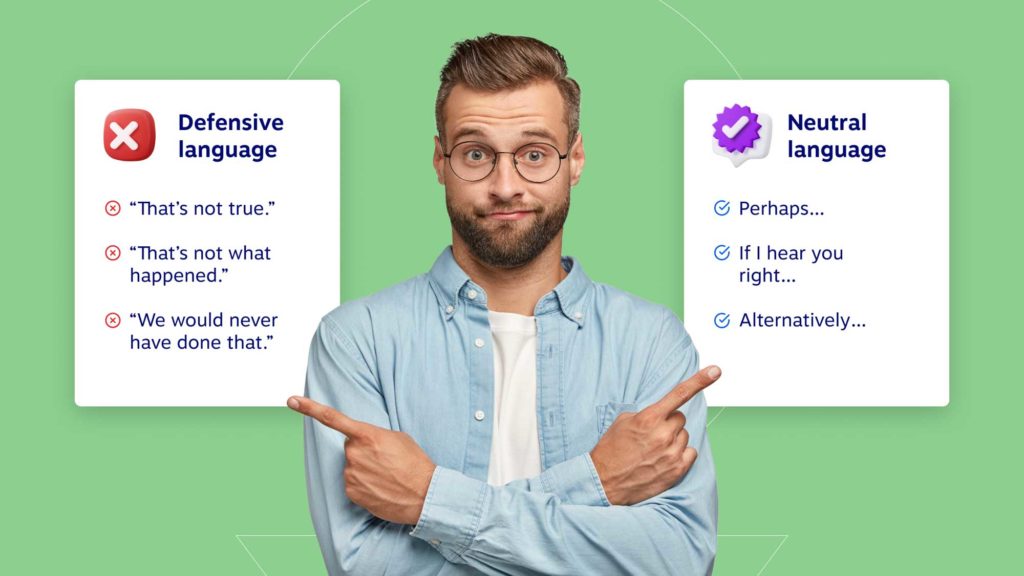
Customer service recovery (how you react to customers who complain) is a particularly important place to make sure your cues convey empathy. A great place to start in getting this right is to replace your instinct to use defensive language and to make use of neutral, positive language.
Replace defensive language, such as is found in these following phrases…
• “That’s not true.”
• “That’s not what happened.”
• “We would never have done that.”
• “You should have ______ [called in earlier, read the manual…]”
…with non-defensive, more neutral language:
- Perhaps…
- If I hear you right…
- Alternatively…
3. Strive to keep in mind that this customer’s interaction is a unique experience for them – even though it may feel routine for you.
It’s important to “reset” before every customer interaction; it will keep you from rushing the customer, using shorthand or jargon that they may not understand, and from sounding jaded – even if you’ve had 15 similar calls today!
Once you develop your empathy for sensing what a customer is experiencing, and you polish your ability to convey this empathy, it’s remarkable how much smoother your interactions with customers will be. And this can lead to truly great business results.
Courtesy Netiva.com By Michah Solomon. Article available here.