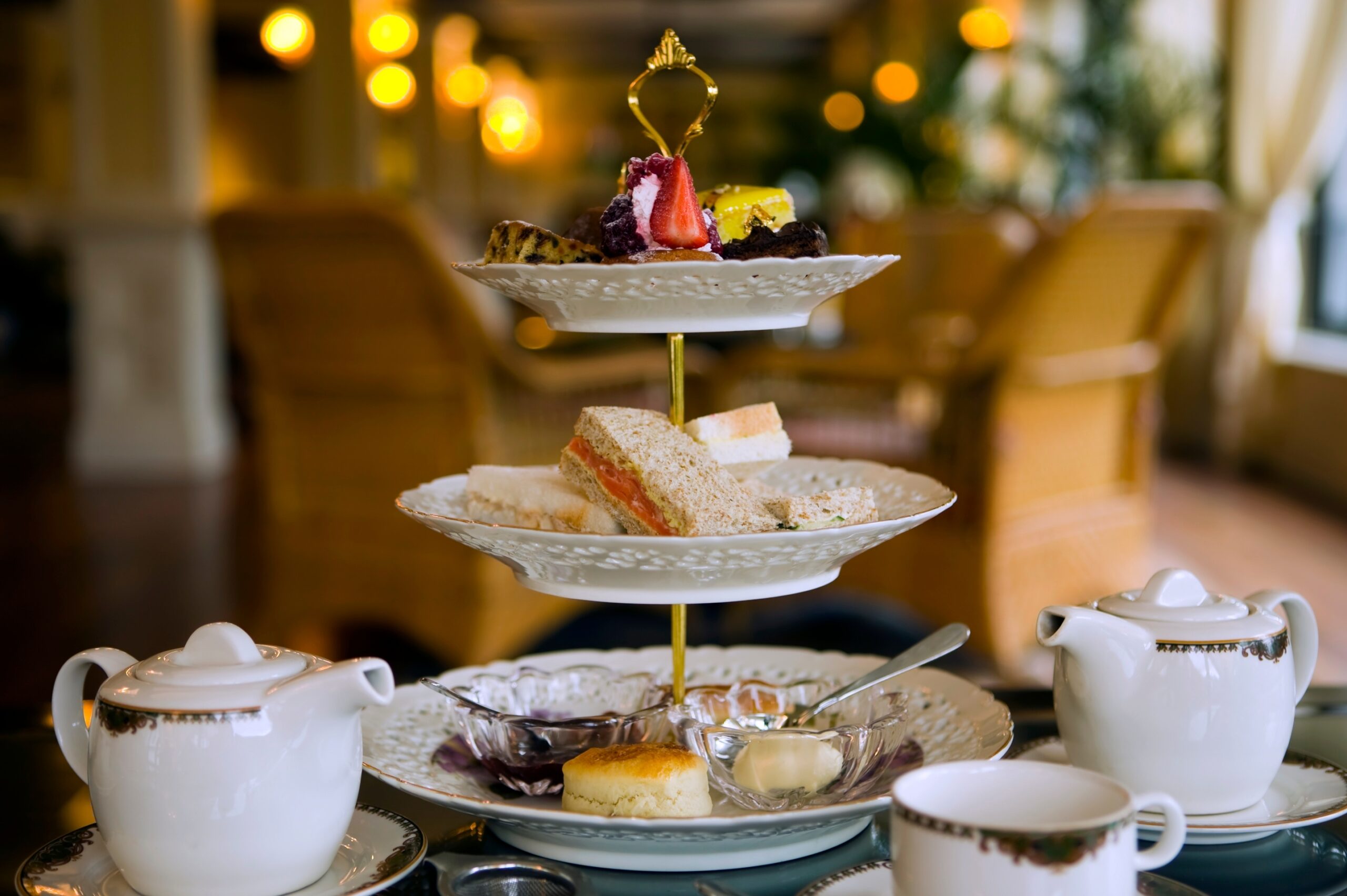
“Under certain circumstances there are few hours in life more agreeable than the hour dedicated to the ceremony known as afternoon tea,” wrote Henry James in “The Portrait of a Lady.” “Teatime” is one of those quintessential English phrases that stirs up images of steaming silverware pots being ferried across vast lawns and dished up to characters straight out of “Downton Abbey,” politely nattering behind towering tiers of delicate gateaux and finger sandwiches.
But there is more to teatime than cucumber sandwiches with “Downton’s” Dowager Countess of Grantham, and pots of tea on the ceiling with giggling uncles in “Mary Poppins.” This is a complex beast, awash with finicky rituals, multiple iterations and evolving etymology. Time, then, to put on a brew and drink it all in.
Peckish aristocrat sparks a craze
It began with a rumbling stomach, or so the story goes. One afternoon in 1840, at around 4 p.m. Anna Russell, the duchess of Bedford, complained of a “sinking feeling,” according to the British Museum. She was hungry — and there were still four hours to go until dinner time. Unwilling to wait it out, the peckish aristocrat requested her maid embellish her usual pot of tea with a scattering of snacks.
Tea, the drink, had enjoyed overnight success in England too. When Catherine of Braganza came over from Portugal in 1662 in her new role as queen of England, she brought with her the daily habit of taking tea. Until then, the drink had only been taken as a medicine in England, but with Catherine’s seal of approval, it swiftly became a quaffable fashion accessory for the moneyed classes. Two centuries on, Anna Russell had raised the stakes for teatime. Whatever the original snacks had been, they were soon augmented into a diverse roll call of sweet and savory morsels. Sandwiches — cut fussily into fluffy fingers — were filled with tomato, asparagus, shrimp, caviar or even oysters. Cake varieties included seed, Russian walnut, Dundee, currant buns, Swiss rolls, Battenberg and macarons. Daphne du Maurier’s 1938 novel “Rebecca” captures the delicious vagaries of the afternoon tea:
“Those dripping crumpets, I can see them now. Tiny crisp wedges of toast, and piping hot, floury scones. Sandwiches of unknown nature, mysteriously flavored and quite delectable, and that very special gingerbread. Angel cake, that melted in the mouth, and his rather stodgier companion, bursting with peel and raisins. There was enough food there to keep a starving family for a week.”
Daphne du Maurier, “Rebecca”
From the tasty throng, favorites emerged. One preferred sandwich filling was cucumber — often peeled, sliced thinly and accompanied by cream cheese. Though cucumbers didn’t necessarily make the most thrilling of sandwich fillings, they were a status symbol. If you could grow cucumbers, it meant you could afford an expensive glass hothouse. In Oscar Wilde’s farcical 1895 play “The Importance of Being Earnest,” cucumber sandwiches are name-checked no fewer than five times.
Victoria sponge cakes were rendered light and fluffy by the addition of newfangled single-action baking powder, which arrived in 1843, courtesy of the chemist and food manufacturer Alfred Bird. It was Bird’s baking powder, and another, even more revolutionary invention, namely the steam train, that served to popularize another stalwart of the afternoon tea: the scone.
The “West Country” cream tea is said to have originated at Devon’s Tavistock Abbey; workers restoring the damaged abbey after it was attacked by Vikings in 997 C.E. were rewarded by Ordulf, Earl of Devon, with servings of bread, clotted cream (an extra thick and unctuous full-fat cream), and strawberry preserve. (You might argue that Ordulf had beaten Anna Russell to the afternoon tea by some centuries.)
The lowdown on high tea
It’s not just the lords and ladies who are depicted nibbling on scones and sipping lapsang souchong in “Downton Abbey;” down in the bowels of the manor, the servants gather for a less lavish feast, one known as “high tea.”
While tea, the drink, had started out as an impossibly expensive luxury for the English, 1784’s Commutation Act slashed import tax on tea leaves from 119% to 12.5%, making the beverage more accessible, if still on the pricey side. As Swedish writer Erik Geijer claimed in 1809, “Next to water, tea is the Englishman’s proper element. All classes consume it.”
High tea found a foothold in the north of England, where many heavy industries and coal mines were situated, although it was enjoyed throughout the country: Thomas Unwins’ painting, “Living off the Fat of the Land, A Country Feast,” portrays a clamorous scene of rustic bliss in which hunks of bread, meat and cheese are devoured, and tea is heartily slurped — one woman doing so from a saucer.
Just as the higher echelons of Victorian, and then Edwardian, society stepped out to places like the Langham and the Ritz for afternoon tea, so “teashops” arrived on the scene for everyone else. In 1864 the Aerated Bread Company (ABC) opened its first tearooms, serving an affordable menu that combined the delights of afternoon tea with sturdier, high tea fare such as cold meats and pies.
But while afternoon tea was a showy stopgap before dinner was served later on in the day, the high tea was dinner. This explains why many English folk (particularly those in the north) still refer to dinner as “tea” — whether that’s a roast dinner, a curry or a “chippy tea.”