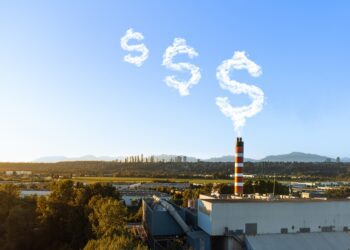
BLACKROCK CO-FOUNDER LARRY FINK STOPPED using the term ESG in 2023, saying the acronym for environmental, social, and governance had become “weaponized” by the far left and the far right.
But the world’s largest asset manager did not stop considering the risks and opportunities of the low-carbon transition, an approach BlackRock says is “consistent with its fiduciary duty.” Wharton professor Serguei Netessine said that’s an illustration of greenhushing.
“He famously changed the language while saying his underlying investment approach would not change,” he said. “The vocabulary had become different.”
Greenhushing is the focus of Netessine’s new co-authored working paper, which finds that when firms communicate less than what is externally observed about their sustainability work, they experience higher subsequent abnormal stock returns. Meanwhile, firms that communicate more than what is observed about their work — known as greenwashing — tend to experience lower subsequent abnormal stock returns.
“Greenwashing is when you talk more than you do, and greenhushing is when you do more than you talk,” said Netessine, a professor of operations, information and decisions and senior vice dean for innovation and global initiatives.
The findings are consistent with investors placing more weight on externally observed conduct than on the volume of environmental communication, he added. Importantly, the study does not find that silence alone creates value. Greenhushing is a relative gap: Limited communication matters here only when it is backed by stronger externally observed environmental conduct.
The paper is titled “Value of Silence: Determinants and Consequences of Greenhushing.” Co-authors are Sonam Singh, marketing professor at the University of South Florida’s Muma College of Business; Ashwin Malshe, marketing professor at the Carlos Alvarez College of Business at the University of Texas at San Antonio; Yakov Bart, marketing professor at Northeastern University’s D’Amore-McKim School of Business; and Anatoli Colicev, chair of marketing, strategy, and analytics at the University of Liverpool.
“Greenwashing is when you talk more than you do, and greenhushing is when you do more than you talk.”— SERGUEI NETESSINE
The Politics of Greenhushing
The study’s findings appear counterintuitive because traditional disclosure theory predicts that investors value transparency. More information from the company can reduce information asymmetry and lead to higher stock valuations. But that relationship may have changed. The study finds that the measured conduct-communication gap was modestly but significantly larger after 2017, a period the authors treat as a more politicized disclosure regime.
“Management chooses to say relatively little because talking has become costly,” Netessine said. “You make an environmental claim, and it can attract political criticism, it can attract regulators and lawyers, it can attract unrealistic expectations. And some companies simply don’t want to tell competitors what they are doing.”
Previous research has measured greenhushing and greenwashing through indirect proxies. This study takes a different approach. The authors describe it as the first large-scale study to combine environmental discussion in earnings calls with external assessments to measure the misalignment between external conduct and managerial communication. The team analyzed more than 30 million sentences from the earnings calls of 3,727 U.S. firms between 2005 and 2021. They compared the volume of environmental discussion with TruValue Labs’ environmental Pulse Scores, which summarize the valence of recent public information from news outlets, regulators, and civil-society sources about firms’ environmental policies, actions, and outcomes. The score is an external signal, not a direct audit of emissions or operations.
In the authors’ most fully adjusted model, a one-standard-deviation increase in greenhushing is associated with a 2.29 percentage point increase in three-month cumulative abnormal returns, equivalent to about $238 million for the average sample firm. An equivalent shift toward greenwashing is associated with a 2.29 percentage point decrease in three-month cumulative abnormal returns.
The study finds that greenhushing is more likely among firms with greater financial leverage and those operating in more competitive industries. One possible explanation, Netessine said, is that highly leveraged firms may be more sensitive to risk and have less room for error, while firms in highly competitive industries may not want to tip their hand about sustainable practices that are saving them money or helping them offer better products or services.
Read the full article by Serguei Netessine / Knowledge at Wharton