Artificial intelligence is upending more than the tools marketers use—it is rewiring how organizations work. As companies begin scaling AI beyond the pilot phase, the bottleneck is no longer the technology itself but its implementation.
The leadership challenge of implementation comes down to reconfiguring workflows, rethinking roles, and bringing people through change.
While AI is not changing the roots of marketing—understanding customers, building brands, and creating value are still core principles—it is altering how marketers apply those fundamentals. What’s different is how companies organize people and technology to deliver those outcomes.
“As marketers now move to implement AI, success requires thinking about change management, not just buying tech and tools,” says Jim Lecinski, a clinical professor of marketing at the Kellogg School.
Lecinski shares five priorities for companies looking to turn AI adoption into meaningful business results.
Find the right problem
Many marketing teams have now moved beyond just dabbling with AI and buying all the latest tools. Many companies are now scaling the technology—and focusing it where it makes the most impact.
Recent surveys by Lecinski and McKinsey found that 86 percent of marketing leaders believe AI has promise, while 60 percent already use it regularly to save time and generate new ideas for growing the business.
But as companies scale, a clear divide is emerging between companies where the leaders have a clear strategy and those that are still testing ideas and hoping something sticks.
The laggards’ approach, according to Lecinski, is to try a bunch of experiments, spin up pilot programs, and see what happens. Instead, he advises leaders to take a more-intentional approach.
“Leaders at the forefront of applying AI to marketing start with a clear set of priority use cases,” Lecinski says. “They know where they’re pointing this tool and what they’re intending to accomplish, such as growing topline revenue, generating productivity savings, or decreasing friction.”
Redesign the work
While finding the right use cases is important, however, the more-difficult step is integrating those AI uses into the company’s everyday work. Technology is no longer limiting the strategic use of AI; the bottleneck is implementation.
The temptation for marketing leaders may be to roll out AI tools first and have employees incorporate them into their workflows. But organizations that merely bolt AI onto existing ways of working rarely achieve transformational change.
Only 28 percent of the organizations in Lecinski’s survey are rethinking their workflows to accommodate the tech. As a result, just 10 percent of marketing leaders say they are recouping major value from their investments in AI.
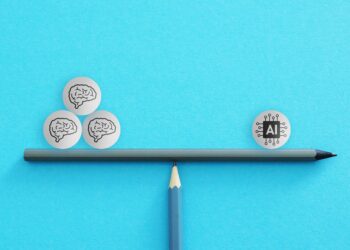
But a separate Deloitte survey found that 93 percent of AI investment has gone into technology and only seven percent into the people who will be responsible for that implementation.
“This isn’t just about the next tool we need to license,” Lecinski says. “It’s about how we bring people along. It’s a human challenge, a change-management challenge—and that means it’s a leadership challenge.”
Make it stick
When organizations frame AI primarily as a cost- or labor-cutting exercise, employees naturally worry about what that means for their jobs, making adoption harder rather than easier. And efficiency alone rarely inspires people to embrace change.
“Management says, ‘Use AI,’ and you bobblehead ‘yes’ in the all-hands meeting,” Lecinski says. “Then you go back to doing what you were doing before because it doesn’t seem to be in your own self-interest.”
“This isn’t just about the next tool we need to license. It’s about how we bring people along. It’s a human challenge, a change-management challenge—and that means it’s a leadership challenge.”
—
Jim Lecinski
Ensuring adoption requires embedding AI technology across an organization not through a one-off rollout, but by the ongoing revamp of how work gets done. And that revamp has to happen before any team restructuring.
“You have to rewire workflows,” says Lecinski. “You can’t just train people once a year with prompt training. You have to do continuous coaching. There’s a lot of hard work to get there, but that’s the leadership vision.”
Rethink your organization’s shape
Establishing and communicating that vision includes a broader rethink of how work gets done.
Lecinski divides work into three layers: execution, orchestration, and decision-making. Execution, he reckons, will increasingly become AI-led, with humans working in partnership. Decision-making though, will remain firmly in human hands. The biggest change yet may come in the middle, where people and AI will increasingly orchestrate work between teams and functions.
That shifts the leadership challenge. “The right question for leaders is not what should be the size of the organization but what should be the shape of the organization,” says Lecinski.
Some companies are already sketching out the blueprint. At some drive-throughs, McDonald’s is using an AI voice assistant to take customers’ orders, allowing employees to spend less time on the headset and more time preparing orders.
Get that balance wrong, however, and resistance quickly follows. The U.S. insurer State Farm knows this all too well. Its use of AI has prompted concern among insurance agents who fear the technology is there to replace rather than support them—a reminder that AI implementation is ultimately a leadership challenge, not simply a technological one.
“The layers of work won’t change,” Lecinski says. “But how that work gets done—and who, or maybe what, does that work—is going to radically change.”
Create customer value
While most marketers’ first forays into AI were about boosting productivity within the company—summarizing meetings, drafting emails, analyzing reports, saving staff time—the leaders who are truly transforming their marketing function are using AI to create value for customers.
“The goal is to attract more customers, encourage them to buy more often, and increase the value of every purchase,” says Lecinski. “Those are the classic levers for growing the top line—not just shrinking costs.”
Some firms are already putting that philosophy into practice. IKEA, for instance, is using an AI-powered tool called Kreativ, which lets customers scan their homes, then receive personalized design recommendations. The goal is to help shoppers buy with greater confidence, boost customer satisfaction, and encourage customer loyalty.
Meanwhile, Ace Hardware is deploying AI to augment the expertise of its store associates, helping them diagnose customers’ problems and recommend the right products.
“The common thread is that neither Ace nor IKEA are looking to use AI as simply a way to eliminate work,” Lecinski says. “Instead, both are investing in tools that reinforce what already sets their customer relationships and brands apart.”