
Tuesday, November 17, 2026
  • Login
CEO North America
  • Home
  • News
    • Business
    • Entrepreneur
    • Industry
    • Innovation
    • Management & Leadership
  • CEO Interviews
  • Opinion
  • Technology
  • Environment
  • CEO Life
    • Art & Culture
    • Food
    • Health
    • Travel
No Result
View All Result
  • Home
  • News
    • Business
    • Entrepreneur
    • Industry
    • Innovation
    • Management & Leadership
  • CEO Interviews
  • Opinion
  • Technology
  • Environment
  • CEO Life
    • Art & Culture
    • Food
    • Health
    • Travel
No Result
View All Result
CEO North America
No Result
View All Result

CEO NA Magazine > Opinion > Understanding Alternative Credit Opportunities

Understanding Alternative Credit Opportunities

in Opinion
Private credit unlocked: the new growth engine in finance
Share on LinkedinShare on WhatsApp

Alternative credit is illiquid financing provided to borrowers of capital who cannot access public or require non-standard, customized loan terms. Bottom of Form With increasing regulation around the practices of traditional lenders, alternative credit has emerged to play a more pivotal role in helping institutional and high-net-worth investors reduce reliance on the equity risk premium and drive investment returns. Accessed predominately via limited partnerships (LPs) with required “lock-up” periods, the alternative credit market has seen significant growth in recent years and presents investors with an opportunity to earn attractive returns.

What drives demand for alternative credit? 

Since the global financial crisis, regulators and governments around the world have increased their scrutiny of the lending habits of traditional banks. While these changes have created a more robust and resilient banking system, traditional lenders no longer take the same types of risks and have been forced to retreat from certain lending practices.

This change has created an interesting opportunity for investors and has, in part, driven the emergence of alternative credit. Categories of lending within alternative credit include direct lending, mezzanine distressed debt, and specialty finance. Capital may be loaned to an entity such as a corporation, or invested in an asset like real estate or infrastructure. This type of lending is well positioned to demand higher rates of interest due to the increased risk-exposure.

Alternative credit investments are primarily accessed through limited partnerships (LPs) that prohibit investors from redeeming their capital for a period of time (often years) after inception; however, some firms now offer hybrid structures, which provide exposure to illiquid assets but with greater liquidity for investors.

What is direct lending? 

PIMCO refers to direct lending specifically as the practice of privately investing in senior debt, typically of middle-market corporations, with the investor essentially assuming the role of a traditional lender. The term can also be used to describe many forms of lending outside of corporate, including commercial real estate, residential real estate, and other consumer lending.

Similar to other alternative credit investments, this strategy can enhance investment portfolios by providing a differentiated source of return versus traditional credit. Investors may also expect to earn a premium in return for the illiquidity and increased complexity of their investment.

What is the J Curve? 

Investors typically expect to receive a higher return over time from alternative credit than from traditional credit investments due to its illiquidity and complexity. However, similar to private equity, the return profile of some alternative credit strategies may follow a particular trajectory, often delivering negative returns and cash flows in the early years with the eventual goal of turning those into positive years after its launch. This pattern is referred to as the J Curve, so named because the shape of the curve resembles the letter “J” (see chart below). As a reminder, all investors should remember that there is no assurance that any investment will achieve its objectives, avoid loss or generate profits.
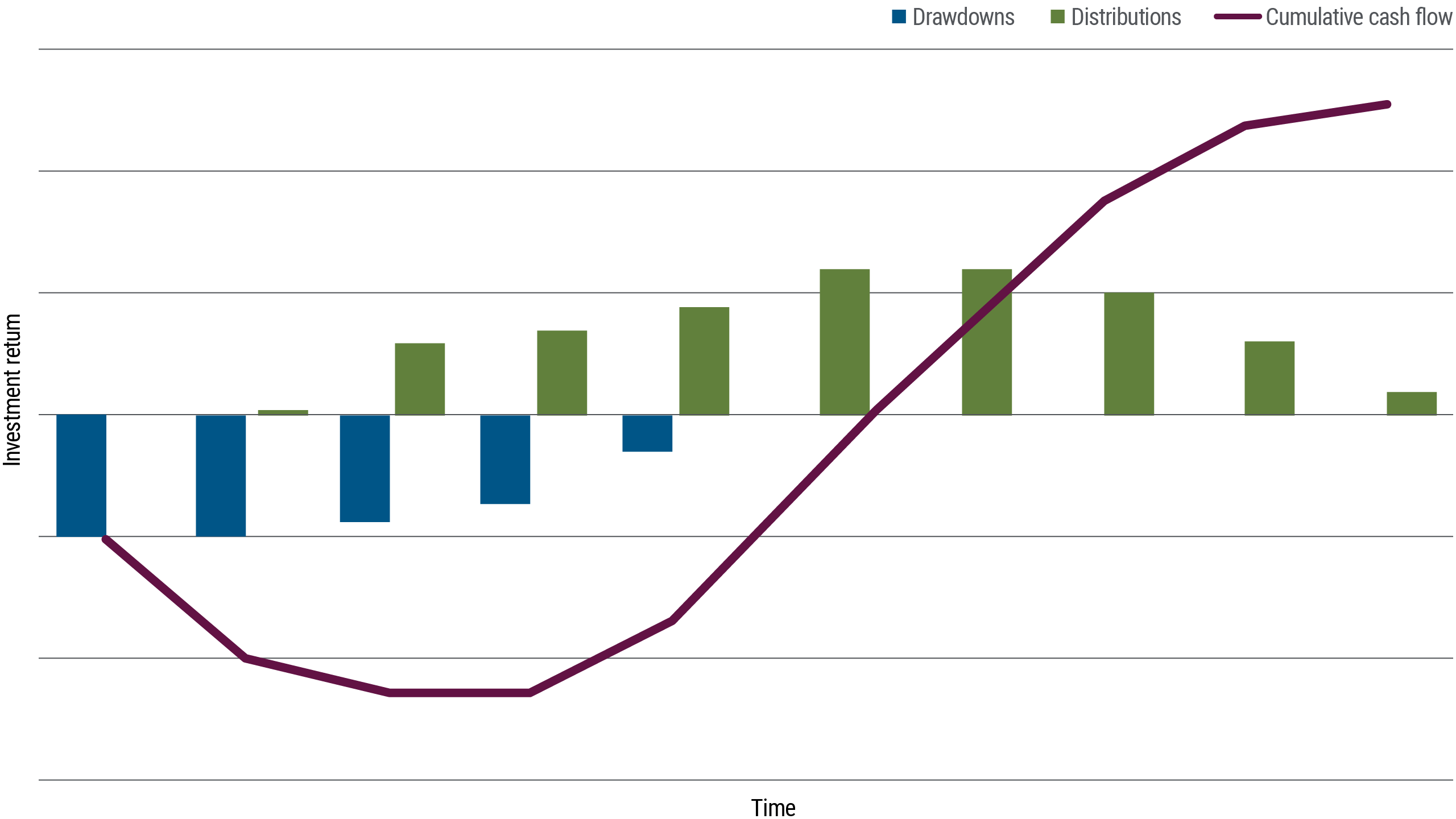
The figure shows a bar chart with an overlay of a J-curve. The chart shows how the investment return profile of some alternative credit strategies often deliver negative returns and cash flows in the early years, with the eventual goal of turning those into positive years after their launch. There is a 10-year horizon, with the chart depicting negative returns for the first five years, shown by blue bars dropping from a center horizon line halfway up the Y-axis. Distributions, shaded in green, are shown to peak in Years Six and Seven, then drop to almost zero by Year 10. Cumulative cash flow, shown by an overlay of a line, is negative for the first six years, bottoming around Years Two and Three, then becomes positive after Year Six.

For Illustrative Purposes only

The J Curve may be relevant to some alternative credit strategies. It demonstrates the initial period of active investing when a private fund draws down a large portion of its available capital to invest. In turn, this causes a negative return and limited cash flow. After this initial investment period is finished, if and when the private fund begins to generate returns, there is the potential for a sharp increase in value causing the ‘uptick’ in the J Curve.

When investing in alternative credit strategies, it is important that investors are aware of the concept of the J Curve and the impact it can have on their overall portfolio outcomes. They must be comfortable with the potential loss that may be realized in the short-term in exchange for the potential for long-term gains.


Read the full article by PIMCO

Related Posts

3 Key Takeaways from Trump Tax Cuts on US Consumer Spending
Opinion

How high-income earners can reduce taxes before year-end

What great artists can teach us about great leadership
Opinion

What great artists can teach us about great leadership

8 Leadership Strategies from Top Performers
Opinion

Reimagining Organizational Transformation Strategies for Today’s Companies

The real value of vendor partnerships for CIOs
Opinion

How board dynamics and behaviours impact governance

Building Executive Presence in Today’s Workplace
Opinion

Building Executive Presence in Today’s Workplace

What Executive Presence Means for Women in Leadership
Opinion

What Executive Presence Means for Women in Leadership

Leading With Grounded Confidence
Opinion

Leading With Grounded Confidence

Onboarding Best Practices: Maximum Value From New Hires
Opinion

Onboarding Best Practices: Maximum Value From New Hires

Lead for Sustainable Performance
Opinion

Lead for Sustainable Performance

Reaching new heights: Understanding the nuances and potential of affluent consumers in a changing market
Opinion

5 generational shifts reshaping family wealth planning today

No Result
View All Result

Recent Posts

  • How high-income earners can reduce taxes before year-end
  • Intel sued by shareholders following 29% stock plunge
  • Nvidia stock falls as execs push for Huang’s return
  • Buffett donates $5.5 billion, urges kindness in Thanksgiving letter
  • Lilly to acquire Calytrix Bio in $1.5 billion deal

Archives

Categories

  • Art & Culture
  • Business
  • CEO Interviews
  • CEO Life
  • Editor´s Choice
  • Entrepreneur
  • Environment
  • Food
  • Health
  • Highlights
  • Industry
  • Innovation
  • Issues
  • Management & Leadership
  • News
  • Opinion
  • PrimeZone
  • Printed Version
  • Technology
  • Travel
  • Uncategorized

Meta

  • Log in
  • Entries feed
  • Comments feed
  • WordPress.org

  • CONTACT
  • GENERAL ENQUIRIES
  • ADVERTISING
  • MEDIA KIT
  • DIRECTORY
  • TERMS AND CONDITIONS

Advertising –
advertising@ceo-na.com

110 Wall St.,
3rd Floor
New York, NY.
10005
USA
+1 2125 9933 0330

UK
Collingwood Buildings,
38 Collingwood Street,
Newcastle Upon Tyne
NE1 1JF

  • News
  • CEO Interviews
  • Opinion
  • Technology
  • Environment
  • CEO Life

  • CONTACT
  • GENERAL ENQUIRIES
  • ADVERTISING
  • MEDIA KIT
  • DIRECTORY
  • TERMS AND CONDITIONS

Advertising –
advertising@ceo-na.com

110 Wall St.,
3rd Floor
New York, NY.
10005
USA
+1 2125 9933 0330

UK
Collingwood Buildings,
38 Collingwood Street,
Newcastle Upon Tyne
NE1 1JF

CEO North America © 2024 - Sitemap

Welcome Back!

Login to your account below

Forgotten Password?

Retrieve your password

Please enter your username or email address to reset your password.

Log In
No Result
View All Result
  • Home
  • News
    • Business
    • Entrepreneur
    • Industry
    • Innovation
    • Management & Leadership
  • CEO Interviews
  • Opinion
  • Technology
  • Environment
  • CEO Life
    • Art & Culture
    • Food
    • Health
    • Travel

© 2026 JNews - Premium WordPress news & magazine theme by Jegtheme.