
Horizontal integration means growing at the same level of your industry by combining with competitors, while vertical integration means expanding up or down your own supply chain to control more of how your product is made and sold.
The right choice depends on whether you want market share or supply chain control.
What is the difference between horizontal and vertical integration?
The difference is direction.
Horizontal integration expands a company sideways, combining with rivals that sell similar products at the same stage of the value chain.
Vertical integration expands a company up or down its own value chain, taking ownership of suppliers or distributors it once paid other firms to provide.
| Dimension | Horizontal integration | Vertical integration |
|---|---|---|
| Direction of growth | Sideways, same market level | Up or down the supply chain |
| What you combine with | A direct competitor | A supplier or a distributor |
| Primary goal | Market share and scale | Control over supply and cost |
| Main benefit | Reduced competition, wider reach | Supply stability, margin control |
| Main risk | Antitrust scrutiny, market concentration | High capital cost, new operations to run |
| Typical example | Two hotel groups combining | A carmaker buying its chip supplier |
Vertical integration runs in two directions.
Backward integration moves upstream, toward raw materials and suppliers.
Forward integration moves downstream, toward distribution, retail, and the customer.
Horizontal integration has no such split, because the company stays at one level and simply gets wider.
Integration, acquisition, or merger: How they relate
Integration is the strategy.
A merger or acquisition is one way to achieve it.
Horizontal and vertical describe the direction of the integration, while merger and acquisition describe the transaction that delivers it.
A company can also integrate by building new capacity itself, with no deal involved.
The distinction matters because the labels get used loosely.
A firm can reach horizontal integration by acquiring a competitor, merging with one, or expanding its own output.
The difference between a merger and an acquisition comes down to control and structure, not to the integration goal itself.
Both sit inside the wider practice of mergers and acquisitions, where the same two directions appear again and again.
Framed as a horizontal or vertical acquisition, the same logic still applies.
Real-world examples of horizontal and vertical integration
The clearest way to see the difference is through real deals.
Horizontal examples combine direct competitors to widen market share.
Vertical examples combine a company with a supplier or distributor to control more of the chain.
Horizontal integration:
- Meta and Instagram, 2012: Two social platforms combined at the same market level to consolidate photo sharing.
- Disney and 21st Century Fox, 2019: Two entertainment producers merged to expand a shared content library.
- Marriott and Starwood, 2016: Two hotel groups combined to widen market share across the same industry.
Vertical integration:
- Amazon and Whole Foods, 2017: An online retailer moved forward into physical grocery to own distribution.
- Tesla and SolarCity, 2016: A carmaker moved into energy generation to control a connected supply chain.
- Apple and Dialog Semiconductor, 2018: A device maker moved backward into chips to secure critical components.
Each deal solved a different problem, which is the real test when you weigh one path against the other.
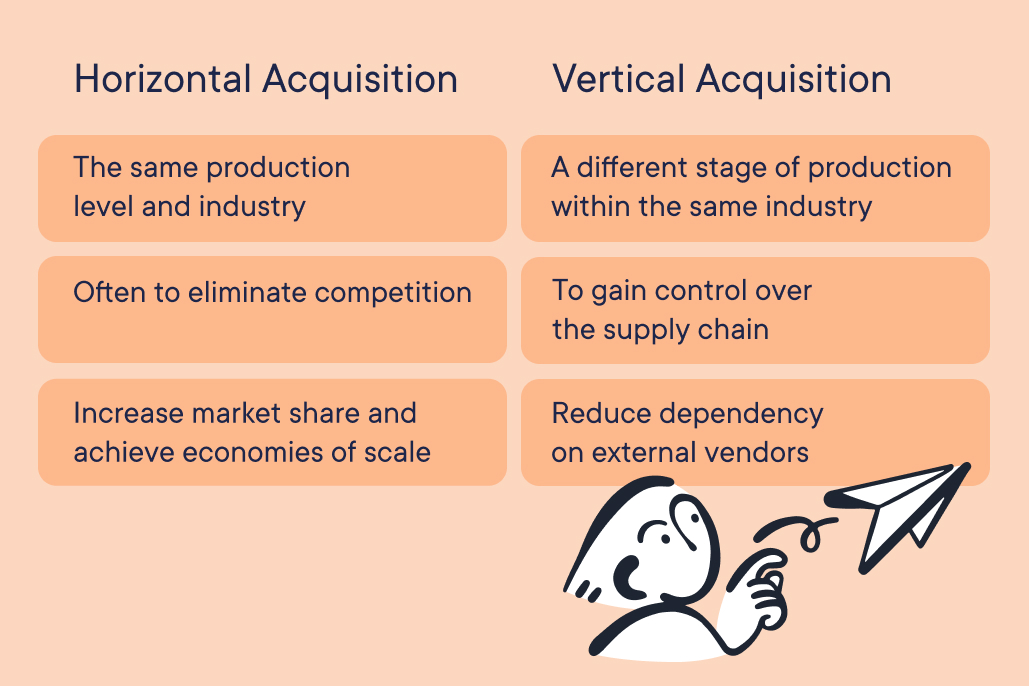
Horizontal vs vertical mergers: How they compare
A horizontal merger joins two competitors at the same stage of production.
A vertical merger joins two companies at different stages of the same supply chain.
The split mirrors integration exactly, but mergers add a legal dimension that private acquisitions often avoid.
Horizontal mergers draw the most regulatory attention.
When two direct competitors combine, the deal can reduce the number of players in a market, so these deals are reviewed most closely for their effect on competition (Federal Trade Commission, 2023 Merger Guidelines, 2023).
Larger deals of either type must clear a premerger notification before they close.
Horizontal and vertical are only two of the four types of mergers, with conglomerate and market extension deals making up the rest.
Advantages and disadvantages of each approach
Each approach trades one kind of control for another.
Horizontal integration buys scale and market share, but it concentrates risk in one market and invites antitrust review.
Vertical integration buys supply chain control and margin, but it demands capital and the skill to run unfamiliar operations.
Advantages of horizontal integration
- Larger market share and reduced direct competition
- Economies of scale across similar operations
- A wider product range in the same market
Disadvantages of horizontal integration
- Antitrust scrutiny when rivals combine
- Heavy role overlap that often forces redundancies
- Risk concentrated in a single market
Advantages of vertical integration
- Tighter control over supply, cost, and quality
- Protection from supplier disruption
- The ability to block rivals from key inputs
Disadvantages of vertical integration
- High capital and operational demands
- The need to learn an unfamiliar business
- Reduced flexibility when the market shifts
The disadvantage most often underestimated is the people cost.
Horizontal deals overlap whole teams in finance, human resources, and operations, so redundancies follow, and morale across the remaining workforce takes the hit.
Between 70 and 90 percent of acquisitions fail to create value, and weak integration of people and culture is a consistent cause (Harvard Business Review, The Big Idea: The New M&A Playbook, 2011).
Careful post-merger integration and honest handling of any workforce reductions protect the value the deal was meant to create.
How do you choose between horizontal and vertical?
The first question is simple: are you trying to grow your market, or secure your supply.
Horizontal integration fits companies chasing market share and a wider product range.
Vertical integration fits companies that need supply stability, cost control, or protection from suppliers.
Two factors decide it.
- Self-sufficiency: Vertical integration gives you more command over production and distribution, along with the cost and complexity of running every stage yourself.
- Diversification: Horizontal integration widens your product range and market reach, while vertical integration concentrates and refines what you already sell.
A third factor decides whether either path works, which is whether your organization can absorb the change.
Vertical integration means running a business you have never run before, which stretches management and adds headcount in new functions.
Horizontal integration means merging two similar teams, which tests culture and often triggers cuts.
Sound workforce planning before the deal closes turns both risks into a plan rather than a surprise.