
Taking over any organization can be difficult, but the size and complexity of many federal agencies, as well as the critical role they play for citizens, magnifies the task at hand.
Article by Sharon Marcil, Meldon Wolfgang, Danny Werfel, Brooke Bollyky, Troy Thomas, and Catherine Manfre
This article is the first in a three-part series from BCG providing insight on how new government leaders can hit the ground running. The second article will explore how leaders can get organized by preparing a plan for the first 100 days, and the third will cover how they can quickly get going, putting their plan into action with a proven change management approach.
Change is coming. In the next several months, thousands of new leaders will take the helm at agencies and departments throughout the US federal government.
In order to create momentum early in their tenure, incoming appointees must quickly get smart about the organizations they are leading. This exercise should kick off with a study of the broad, foundational information about their agency or department, including its mission, personnel, and budget. But while such information is a critical starting point, incoming leaders should push to gain a deeper understanding of the DNA of their organization—one that illuminates its culture and capabilities and illustrates how those elements drive its performance. On the basis of extensive experience in transitions at the presidential, agency, state, and local government levels, as well as at leading companies, BCG has developed a diagnostic approach—think Meyers-Briggs for organizations—that will enable incoming leaders to gain the appropriate level of insight. This diagnostic has four dimensions:
- Talent: the distinguishing factors of an organization’s workforce, including any prevalent specialized skills and the geographic distribution of the staff, that impact how a leader engages and motivates the workforce to support change
- Autonomy: the various external stakeholders (such as Congress, the White House, or the citizen groups the agency serves) and relevant federal laws that may guide or constrain agency operations and the degree of change permissible within an agency
- Execution: the ways of working in various offices, bureaus, and other subunits throughout the agency that will be tasked with executing different aspects of the administration’s and new leaders’ agendas
- Management: the leadership styles of the management teams in the offices, bureaus, and other subunits that will be charged with advancing priorities and potential reforms
This initial work to get smart about the organization is critical for several reasons. First, in the near term, such insight will allow an incoming leader to understand the risks or issues that they will have to address immediately, including those related to national security, economic recovery, and the pandemic response. Second, appointees need a solid comprehension of the agency to get organized and craft an effective 100-day plan. Third, deep insight into the agency will allow appointees to tailor their engagement and change management strategies to the organization’s unique practices, behaviors, people, and culture.
A challenge of scale and complexity
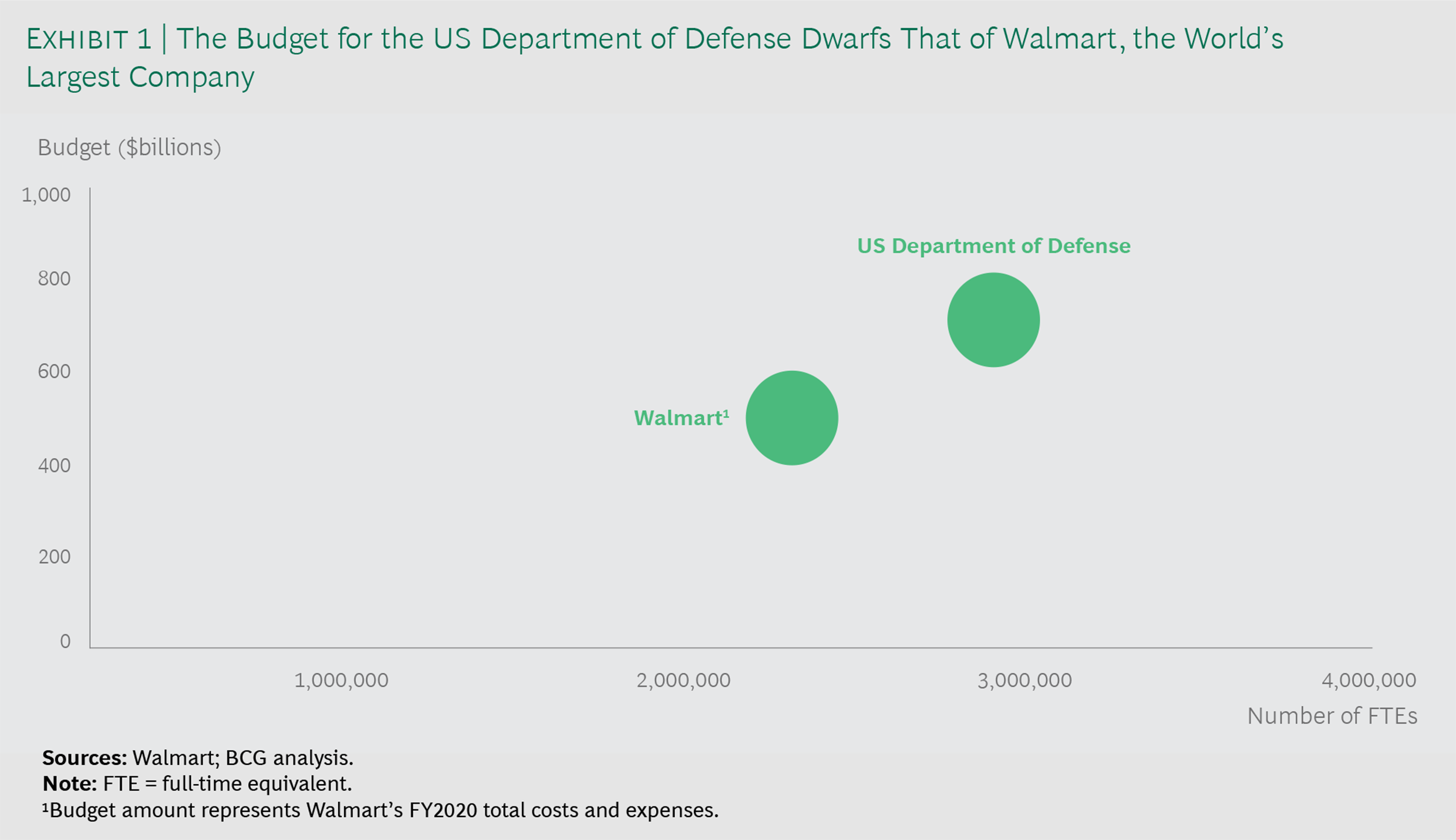
Even appointees that have led other large organizations may not fully appreciate the scale and complexity of the federal agency or department they are tasked with leading. Consider, for example, that the fiscal year 2020 budget of $712.6 billion for the US Department of Defense (DoD) dwarfs the $503.4 billion in total costs and expenses for Walmart—the largest company in the world. (See Exhibit 1.) Similarly, the DoD’s workforce of civil and military personnel in 2020 was more than 33% greater than Walmart’s global workforce. Meanwhile, the US Commerce Department, the US Department of Veterans Affairs, and the US Department of Homeland Security have a combined workforce topping 1 million. And even agencies that are relatively small by federal government standards can be quite large compared with many private-sector or nonfederal public institutions.
Certainly, well-established mechanisms—most notably, the formal agency transition process—can provide incoming government leaders with detailed, foundational information about their organizations. (See “The Ins and Outs of the Agency Transition Process.”) Through briefing materials and meetings with career transition officials, new leaders can get the lay of the land at the agency and gain insights into the actions they can take to advance their budgetary, policy, and other priorities. The formal transition will also help new leaders identify important stakeholders, including decision makers within the organization, individuals who lead critical programs or processes, and those who will be impacted by the change efforts, such as the citizens the organization serves. And it will give incoming leaders insight into the current state of an agency and the policies and issues that should be integrated into plans for the first 100 days and beyond. But while such information is invaluable, new appointees must complement that material with a deeper analysis of the organization if they want to generate early momentum and get lasting results during their tenure.
As leaders for the incoming administration take their new positions throughout the US federal government, they will be hoping to hit the ground running with ambitious policy changes. Those that push change without fully understanding the culture, roots, and unique characteristics of their organizations will face an uphill battle. But leaders who take the time and energy to understand the organization they will be leading are likely to have greater success at positioning and building support for their agenda from day one.
Read the full article and the rest of the series here.